28 February 2012
Update
Consumer
Standard pack size implementation to reduce pricing flexibility
19 product categories to come under new law, might impact growth and margins
FMCG companies will lose flexibility to adjust grammage for increasing realization across 19 product categories including
biscuit, soaps, detergents, edible oils, coffee, tea and milk powder.
Companies need to move to nearest standard unit; will impact volumes and margins in packs priced at INR2, INR3 and INR5.
Incremental price increases would be difficult in small unit pack, margin management would become difficult.
Biscuit, toilet soaps and coffee to see maximum impact; BRIT, HUVR and NEST to see maximum impact
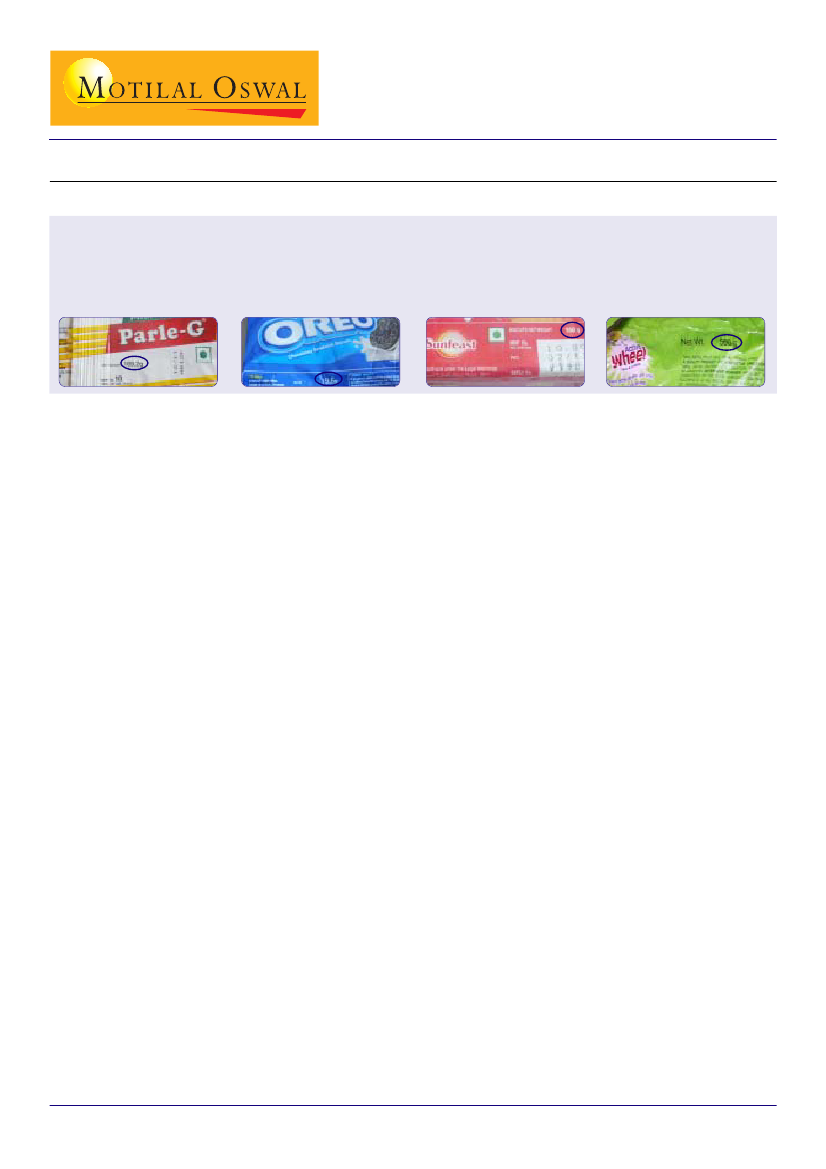
560g
160g
169.2g
19.6g
Standard pack sizes likely from 1 July 2012
The Ministry of Consumer Affairs has issued a
notification to enforce uniform packaging for 19 product
categories. The new regulations will come into effect
from July 1, 2012. The industry is in discussion with the
government for relaxing norms for small packs due to
affordability issue. The current guidelines, which gave
consumer companies the flexibility to pack and price
their products on certain popular denominations, were
started in 2004. Companies typically adjust grammage
instead of hiking prices, especially at lower price points
(INR2, INR5, INR10 and INR20). However, over the years,
companies have used this flexibility to boost realizations
by reducing pack sizes at popular price points (INR2, INR5
and INR10). As a result, the consumer often ended
getting lower quantity than assumed. Unconventional
pack sizes also make price comparison difficult as both
prices and grammage are tinkered. Brands in the same
segment have different grammage, making it difficult
for the consumer to arrive at actual product price.
the new norms to include virtually the entire gamut of
consumer products in due course.
New norms may impact volumes, packaging costs
We believe the new norms would impact volume growth
in the medium term as companies modify pack sizes. In
cases where the pack size has to be increased, there is
also a high probability of prices rising. This could impact
volume growth, especially for products driven by low
price points. Companies would incur a one-time cost
for modifying the pack size. They would also need to
phase out existing inventories which could lead to an
interim period of product availability issues. As
consumers take time to get accustomed to new pack
sizes and adapt their shopping behavior accordingly,
volume growth would also suffer.
Margin management to become difficult
Certain packs are driven by popular price points and are
used by consumer companies for margin management
to pass on input cost increases. While the initial
adjustment might not be much of a problem, barring a
few SKUs, changing prices post that would be a hassle.
Changing prices will become increasingly difficult as
coinage issues arise (coins less than INR0.5 would be
phased out from June 2012). Increasing prices by 10-
20% at one go would be very tricky for SKUs having price
points of INR2 and INR5. This would result in delayed
price increases and companies would try to compensate
by hiking prices in larger SKUs. This could have margin
implications till prices are rationalized.
Britannia,
Hindustan Unilever
and
Nestle India
would feel the
maximum impact of the new packaging regulations in
the medium-term.
Biscuits, soaps and detergents, edible oils and tea
to come under the regulation
The new regulation would initially cover 19 product
categories with major ones being biscuits, toilet soaps
and detergents. It would also cover paints, baby food,
milk powder, tea, coffee and edible oils. There would
be still flexibility for detergent powder and milk powder
as pack sizes below 50gm have been allowed. The
smallest permissible pack sizes in tea and coffee is 25gm,
which will impact sale of small sachets, more so in coffee.
Baby food packs would have to be multiples of 100gm
and biscuits in multiples of 25gm up to 100gm. We expect
Amnish Aggarwal
(AmnishAggarwal@MotilalOswal.com) + 91 22 3982 5404

Consumer | Update
Why the need to enforce standard pack sizes?
Pack sizes across various consumer goods have undergone a sea change since packaging
norms were deregulated in 2004. At that time, the move was aimed at providing
companies the flexibility to launch small and affordable packs at low price points to
increase product penetration.
However, this clause has emerged as a major tool for companies to pass on the input
cost inflation to consumers by tinkering with grammage without changing the headline
price. This often results in consumers purchasing a product only by looking at the
price. In many cases, they are not aware that the quantity has also been reduced. The
industry is in discussion with the government for relaxing norms for small packs due
to affordability issue.
Consumers getting fewer bangs for their buck:
Products like biscuits, soaps and
detergents are most prone to tinkering with pack sizes. We note that over a two-year
period, some popular brands in these categories have reduced pack sizes to the tune
of ~20%.
For example, the quantity in a "Wheel" detergent pack priced at INR20 has been
reduced by 36% over the last four years. Often, the consumer does not notice the
reduction in grammage unless the change in too drastic.
Grammage reduction has resulted in prices increasing by up to 28% over the past two years
Segment
Price Point
(INR)
Biscuits
Parle G
2
Sunfeast Bourbon
10
Britannia Mariegold
5
Detergent
Wheel
20
Tide Naturals
10
Soaps
Lifebuoy
10
Lux
10
Lux
18
No1
50
Instant Noodles Maggi
10
Dishwash
Vim Bar
21
Brand
Current
Wt (gm)
32.9
74
64
580
214
75
70
90
4*115
80
360
Dec 2009
Wt (gm)
42
77
69
650
250
80
75
110
4*125
95
380
Reduction
(gm)
9.1
3
5
70
36
5
5
20
40
15
20
Effective
Hike (%)
28
4
8
12
17
7
7
22
9
19
6
Source: MOSL
Often, a consumer
realizes grammage has
been tinkered only when
a detergent sachet gets
over earlier-than-
anticipated, or the
number of biscuits in a
packet is lower, or a
Maggi noodles pack does
not satiate his hunger
Unconventional pack sizes create confusion:
Unconventional pack sizes create
confusion in the minds of consumer regarding product prices. We note this incidence
is higher for products with low price points like INR2, INR5 and INR10. For some
products, it also extends for price points up to INR20 and INR30.
28 February 2012
2

Consumer | Update
We have outlined some of the major products that are sold in non-standard pack
sizes. In certain cases, both pack sizes and prices have changed, which adds to the
confusion.
Different grammage and price changes have made price comparison difficult for consumers
Segment
Current
wt
gm
Taj Mahal
490
Taaza
245
Lifebuoy
120
Head and Shoulders 190
Tiger
88
Cream cracker
85
Oreo
68.6
Oreo
16.9
Parachute Coconut
45
Brand
Dec 2009
wt
(gm)
490
245
120
200
82
100
68.6
25.4
50
Current
Price
(INR)
190
70
18
129
5
15
12
4
14
Dec 2009
Price
(INR)
180
60
15
120
4
15
10
5
12
Price
Hike
(INR)
10
10
3
9
1
0
2
-20
2
Effective
Price
Hike (%)
5.6
16.7
20.0
13.2
16.5
18.3
20.0
20.0
29.6
Source: MOSL
Te a
Soap
Shampoos
Biscuits
Edible Oil
"Head & Shoulders" shampoo: New pack has MRP of INR129, but 10% lower grammage
200ml
180ml
Source: Company/MOSL
P&G recently withdrew its INR20-off offer on 200-ml "Head & Shoulders"
shampoo packs which had an MRP of INR139. It introduced a new pack with an
MRP of INR129, indicating that it has reduced prices by INR10; however the
company also reduced grammage by 10% from 200ml to 180ml. Thus, the
consumer ends up paying 20% more. Even when calculated on MRP (INR129),
prices are still higher by 3% as the company has priced the product at a lower
price point to make it more attractive for the consumer.
Cadbury launched its "Oreo" brand of biscuits at price points of INR5, INR10 and
INR20. Less than six months later, the company increased prices from INR10 to
INR12 and from INR20 to INR40. It also launched a new pack at INR4 in place of
the earlier INR5 and reduced the number of biscuits from 3 to 2 in the packet,
enabling a 20% price increase, but maintaining a lower price point.
28 February 2012
3

Consumer | Update
What are the proposed standard pack sizes?
Below are the new packaging norms for the most relevant product categories. The
standard pack sizes are very category-specific:
Products like milk powder and detergents, which are packed in small sachets,
have been allowed to have any grammage below 50gm.
The smallest permissible pack size for tea, coffee, biscuits and toilet soaps is
25gm.
The upper limits for baby foods and mineral water are 10kg and 5kg, respectively.
Standard pack sizes for key product categories under the new norms
Segment
Baby Foods
Biscuits
Coffee
Te a
Milk Powder
Mineral Water
Edible Oils
Detergent Powder
Laundry Soaps
Toilet Soaps
Paints
Standard Sizes (gm)
Multiples of 100gm (up to 1KG), 2kg, 5kg, 10kg
25, 50, 75, 100, 150, 200, 250, 300 and multiple of 100gm up to 1kg
25, 50, 100, 200, 250, 500, 1kg and in multiples of 1kg
25, 50, 100, 125, 250, 500, 1kg and multiples of 1kg
<50, 50, 100, 200, 500, 1kg and multiples of 500gm
100,150,200,250,300,500,750,1ltr,1.5ltr,2ltr,3ltr,4ltr,5ltr
50, 100, 200, 500, 1kg, 2kg, 3kg, 5kg and in multiples of 5kg
<50gm, 50, 100, 200, 500, 700, 1kg, 1.5kg,2kg and multiples of 1kg
50, 75, 100 and in multiples of 50gm
25, 50, 75, 100, 125, 150 and in multiples of 50gm
50, 100, 200, 500, 1ltr, 2ltr, 3ltr, 4ltr, 5ltr, and in multiples of 5ltr
Source: Ministry of Consumer Affairs
Impact of new packaging regulations
Margin management to become difficult:
To protect margins amid rising costs,
consumer companies cut down on grammage while maintaining prices. Under the
new regulations, while the initial adjustment might not be much of a problem, barring
for a few SKUs, prices changes after that could be difficult. The new norms will also
give rise to coinage issues as coins with denominations below INR0.5 would be phased
out from June 2012. Companies may increase grammage and charge the larger SKUs
more or opt for subsidizing extremely small SKUs (increasing prices by 10-20% at one
go would be very difficult in small SKUs with price points of INR2 and INR5). This could
have margin implications till prices are rationalized. Currently, it takes consumer
companies up to three months to pass on the impact of input cost inflation, which
would now increase further.
Volume growth to be hit, prices to rise:
The new packaging regulation would impact
volume growth of several segments in the medium-term as companies change pack
sizes and shift towards the closest allowed pack size. In cases where pack size is
increased, there is also a fair possibility of prices increasing, which could result in
lower volumes. On the other hand, increasing price points like INR2, INR5 and INR10
could result in lower growth. The problem will be acute for products with low price
points like INR2 as even a small change in quantity can alter the consumer economics
significantly.
28 February 2012
4

Consumer | Update
Currently, Britannia's popular "Marie Gold" biscuit is priced at INR5 for a 64-gm
pack. Under the new norms, the company will either have to increase the size
to either 75gm or 50gm, which will result in the price rising to INR6 (INR5.85) or
declining to INR4 (INR3.85), respectively. In both cases, the consumer would be
the loser and the company would have to vacate the popular price point of
INR5. A biscuit packet priced at INR6 would have lower volumes than one priced
at INR5.
A 580-gm "Wheel" detergent pack is currently priced at INR20. Under the new
regulation, the standard pack sizes are 500gm and 700gm, which could be priced
at INR17.25 and INR24.25, respectively. For detergents, the family's requirement
is the key deciding factor and pack sizes that don't fit would be impacted. For
example, a four-member family with a monthly requirement of 600gm would
either have to buy a 700-gm pack and spend INR4 more, or buy a 500-gm pack
(80gm less) for INR20. There is an equal probability that the family would reduce
the quantity to 500gm, which will impact volume growth in the near-term.
Packaging and manufacturing cost to rise:
Changes in pack sizes would require
companies to modify their packaging. It will result in modifications of packaging lines
for which companies will have to incur one-time costs. Similarly, for products like
biscuits, toilet and laundry soaps, companies will have to change the size of molds.
For example, a packet of Parle's glucose biscuit ("Parle-G") sells at INR2 (four biscuits
weighing 32.9gm). Now, the company would either reduce the weight to 25gm
(implying lower biscuit size) at a price point of INR1.5 or INR2, or it would have to
come out with a new 50-gm packet priced at INR3. For an out-of-home consumer, a
25-gm packet with smaller biscuits might not serve the purpose, and 50-gm packet
priced at INR3 may be more than his requirements. In case the company has to reduce
the size of the biscuits, it will also have to change the mold and modify its packaging
lines.
Temporary supply disruptions:
We believe changes in pack sizes would also have
implications on the supply of certain SKUs and inventories. Companies would have to
phase out inventories and make modifications in their packing lines. This will lead to
an interim phase of product availability issues. As consumers take time to get
accustomed to new pack sizes and adapt their shopping behavior accordingly, volume
growth would suffer.
28 February 2012
5

Consumer | Update
Biscuits will be worst hit; grammage change key to margin
management
Major players in Indian biscuit market
Biscuits Statistics
Category Size
Sales CAGR
EBIDTA Margins
Challengers
INR120b
12-14%
5-7%
Kraft
Major Players
Britannia
Parle
ITC
Mkt. Share (%)
33
33
11
Source: Company/MOSL
The Indian biscuit market is the largest processed food segment in the country with a
market size of INR120b and growing at 12-14% CAGR. Britannia and Parle have ~33%
market share each, while ITC has 11% share. The industry is characterized by high
volumes and low margins (5-7% EBIDTA margin), with high consumer awareness and
low advertising.
Low-unit packs enable uptrading:
We believe biscuits would be most impacted by the
new packaging norms. The category has seen emergence of popular price points like
INR2, INR4 and INR5. Major companies like Britannia, Parle, ITC and Kraft have used
the INR5 price point as an effective tool for enabling consumer uptrading. Most brands
have their priced entry level packs at these prices and used the flexibility to alter
grammage to hold on to the effective consumer outlay.
Grammage reduction frequent across price points:
Although companies have
maintained price points, they have been aggressive in reducing grammage to boost
realizations. Britannia's "Tiger Glucose" brand which was priced at INR5 has seen a
16.5% increase in prices in past two years through a combination of grammage and
Biscuit prices have increased by up to 28% since December 2009 led by grammage reduction
Brand
Britannia
Tiger
Mariegold
Goodday Butter
Goodday Cashew
Nicetime
Maska Chaska
Bourbon
Parle
Parle G
Kreams
20-20 Butter
Monaco
Sunfeast
Bourbon
Special Cashew
Special Butter
Marie
28 February 2012
Dec-11
Dec-09
Change
Price (INR) Wt (gm) Price (INR) Wt (gm) Price (INR) Wt (gm)
5
5
10
15
10
10
12
2
5
5
7
10
6
5
10
88
64
81
90
80
62
78
33
70
50
68
74
50
50
130
4
5
10
12
10
10
10
2
5
5
7
10
6
5
10
82
69
90
90
86
66
78
42
80
62
75
77
62
62
150
1
0
0
3
0
0
2
0
0
0
0
0
0
0
0
6.0
-5.0
-9.0
0.0
-6.0
-4.5
0.0
-9.1
-10.0
-12.0
-7.0
-3.0
-12.0
-12.0
-20.0
Source:
Effe.Price
Chg(%)
16.5
7.8
11.1
25.0
7.5
7.3
20.0
27.7
14.3
24.0
10.3
4.1
24.0
24.0
15.4
MOSL
6

Consumer | Update
price reduction. Prices of other brands like "Good Day" and "Nice Time" have increased
by 7-11% during the same period. The effective prices of Parle's brands have increased
by 14-28% across various popular price points like INR2 and INR5 through grammage
reduction. While the consumer's outlay has remained intact, the number of biscuits
in the packet has declined or their size has been reduced.
Pack sizes create confusion: INR10 pack of "Parle-G" is 169.2-gm, Sunfeast Glucose is 160-gm
160g
169.2g
Source: MOSL
Initial impact mixed; INR5 price point to see limited impact:
We believe the initial
impact of the new norms would be mixed as companies shift to the closest permissible
pack sizes. Price realizations might rise or fall by a few percentage points. A large
number of SKUs would have to shift to pack sizes of different grammage and this
could impact volume growth in the medium-term.
But changing prices could be an issue:
However, we expect companies to face problems
in maintaining price points (under the new norms, grammage cannot be tinkered).
Further, coinage issue would result in sharp price increases or companies would have
to maintain price points and sacrifice margins. For example, cookie brands like
Britannia's "Good Day Butter", Sunfeast's "Special Butter" and Parle's "20-20 Butter"
are priced at INR5 for 50gm. As companies cannot reduce grammage to below 50gm,
they will have to increase prices. But this move will result in coinage issues as the
price increase has to be at least 10% to take it to INR5.5.
Similarly, the price of the popular "Parle-G" brand has to be lowered from the current
INR2 to INR1.5 and weight also reduced from 32.9gm to 25gm. The company will have
either reduce the size of biscuit or number of biscuits in a packet, which will impact
tonnage growth.
28 February 2012
7

Consumer | Update
Biscuits would face the maximum impact of the new standard pack sizes
Brand
Price
Point
(INR)
5
5
5
10
5
15
10
10
2
5
5
10
5
6
Current
Wt
(gm)
88
88
60
64
81
50
90
80
61.5
33
70
50
74
50
50
Std
wt
(gm)
75
100
50
50
75
50
100
75
50
25
75
50
75
50
50
Varia-
tion
(gm)
-13
12
-10
-14
-6
0
10
-5
-11.5
-7.9
5
0
1
0
0
New
Price
(INR)
4.5
5.5
4
4
10
5
17
9
8
1.5
5
5
10
5
6
Realization
Impact
(%)
4.0
-3.0
-3.5
2.0
8.0
No impact
2.0
-4.0
-1.5
lower tonnage
-6.0
No Impact
-1.3
No Impact
No Impact
Source: MOSL
Tiger
Britannia Milk Bikis
Britannia Mariegold
Goodday Butter
Goodday Cashew
Nicetime
Maska Chaska
Parle G
Parle Kreams
Parle 20-20 Butter
Sunfeast Bourbon
Special butter
Special Cashew
"Oreo Cream" biscuits are 19.6gm in INR4 pack, "Sunfeast Dream Cream" 78gm in INR10 pack
19.6g
78g
Source: MOSL
Parle's Festo has 70 grams at INR5
Britannia nice time has 80 gram at INR10
80g
70g
Source: MOSL
28 February 2012
8

Consumer | Update
Toilet soaps - standard size will reflect true
competitiveness
Toilet Soaps Statistics
Category Size
Sales CAGR
EBIDTA Margins
Challengers
INR90b
8-10%
12-15%
ITC
Major Players
HUL
GCPL
Reckitt
Wipro
Mkt. Share (%)
44
10
9
8
Source: Company/MOSL
Toilet soaps constitute the largest category in the body care segment with a market
size of INR90b. It is one of the highly penetrated categories with low single-digit
volume growth and high single-digit sales growth. HUL is the market leader with
~44% market share. GCPL, Reckitt and Wipro have 8-10% share. ITC is the latest entrant
and has carved out more than 6.5% market share in the past 3 years.
Low-priced small packs used to undercut unorganized sector/increase purchase
frequency:
Toilet soaps have high penetration but the sector is characterized by the
presence of several unorganized players. Every small town has a few of its local brands.
Low-priced small packs (INR5 and INR10) are used by major companies to offer a
branded product at competitive prices. Small packs are also used to increase purchase
frequency.
Toilet soaps - grammage increase has been big contributor to effective price changes
Brand
Lux
Lifebuoy
No1
Vivel
Rexona
Dove
Pears
Liril
Dove
Dec-11
Dec-09
Change
Effe.Price
Price (INR) Wt (gm) Price (INR) Wt (gm) Price (INR) Wt (gm)
Chg(%)
19
90
18
125
1
-35.0
46.6
10
60
10
75
0
-15.0
25.0
10
70
12
90
-2
-20.0
7.1
56
100*4
50
125*4
6
-40.0
40.0
18
90
15
100
3
-10.0
33.3
18
97
18
100
0
-3.0
3.1
40
75
33
75
7
0.0
21.2
30
75
26
75
4
0.0
15.4
25
75
19
75
6
0.0
31.6
18
42
NA
NA
NA
NA
NA
Source: MOSL
Grammage reduction rampant in economy and mid-priced segments:
Toilet soaps
have INR5 and INR10 as major entry price points. These SKUs have seen frequent
changes in grammage as players have tried to hold on to these price points. For
example, the weight of the popular "Lux" brand priced at INR10 has been reduced
from 75gm in December 2009 to 60gm in December 2011, translating into an effective
price increase of 25%. "Lifebuoy" has seen only 7% price increase. The 100-125gm
cake segment has seen significant changes in both grammage and prices in the recent
past. In this segment, prices have increased by 30-46% over the past two years for
brands like "Lux", "No1" and "Vivel", mainly due to sharp rise in input costs.
28 February 2012
9

Consumer | Update
The premium soap segment has seen very few grammage changes with companies
preferring to increase the MRP to improve realizations. Due to the presence of several
brands, multiple price points and weights, toilet soaps have not depicted the
underlying competitive intensity. However, with standard pack sizes, consumers will
be able to clearly demarcate between brands on the basis of price, which could alter
the dynamics of this segment.
Mass and mid-priced segment to see maximum impact:
Prices of premium toilet
soaps have increased but with very little changes in grammage. This is applicable to
brands like "Dove", "Liril", "International Lux", "Fiama Di Wills", "Pears" and "Dettol".
Exceptions have been in cases where companies tried to launch a smaller entry level
pack to promote product trials. Brands like "Lux", "No1", "Lifebuoy" and "Vivel" have
non-standard unit packs. However, the packs have seen both grammage reduction
and price increases in the past. We believe that the switch to standard unit should not
be much of an issue for the toilet soap segment. We also note that though the segment
is highly competitive, it has not seen a price war. As a result, the adjustment to new
pack sizes should happen smoothly.
Implementing new standard weights will not be much of an issue for the toilet soaps segment
Brand
Price
Point
(INR)
10
19
10
15
18
18
20
5
Current
Wt
(gm)
60
90
70
100
97
90
40
50
Std
wt
(gm)
50
100
75
100
100
100
50
50
Varia-
tion
(gm)
-10
10
5
0
3
10
10
0
New
Price
(INR)
8.5
21
10
15
18
20
25
5
Realization
Impact
(%)
2.0
-0.5
-7.0
0.0
-3.0
0.0
0.0
No impact
Source: MOSL
Lux
Lifebuoy
No1
Rexona
Vivel
Dove
Dettol
However, changing prices could be an issue after a while and the industry will not be
able to hold on to price points like INR5, INR10 and INR12 in the long term. This could
have an impact on volume growth.
28 February 2012
10

Consumer | Update
Detergents - sachets untouched, economy segment to
feel the impact
Detergents Statistics
Category Size
Sales CAGR
EBIDTA Margins
Challengers
INR140b
10-12%
8-12%
Henko
Major Players
HUL
Ghari
P&G
Mkt. Share (%)
35
16
18
Source: Company/MOSL
Detergents are the highest tonnage category in the consumer industry. This segment
has emerged as the most competitive over the past few years and witnessed two
price wars in the past eight years. HUL is the biggest player with ~36% market share,
followed by Ghari and P&G, with 15% market share each. HUL is the only player with
products straddling all price points. Ghari is well-placed in the mass segment with its
share being very close to HUL's "Wheel" brand. P&G has been aggressive in the category
with its brands like "Tide Naturals", "Tide" and "Ariel".
Detergents - Changes in pack sizes and prices of popular brands
Brand
Dec-11
Price (INR) Wt
Wheel
20
30
Ghari
35
Tide Natural
20
Tide Plus
40
Rin Advanced
70
Surf Excel Blue
62
Surf Excel Blue
90
Henko Stain Champion 42
Surf Excel
159
Ariel Oxy Blue
159
(gm)
560
850
1000
314
475
1000
500
750
400
1000
1000
Dec-09
Change
Effe.Price
Price (INR) Wt (gm) Price (INR) Wt (gm)
Chg(%)
20
650
0
-90.0
16.1
30
1000
0
-150.0
17.6
30
1000
5
0.0
16.7
20
400
0
-86.0
27.4
35
500
5
-25.0
20.3
50
1000
20
0.0
40.0
55
500
7
0.0
12.7
80
750
10
0.0
12.5
48
500
-6
-100.0
9.4
152
1000
7
0.0
4.6
152
1000
7
0.0
4.6
Source: MOSL
Active Wheel
560g
Source: Company/MOSL
Low-priced packs and sachets have been growth drivers:
Detergent companies used
low-priced packs (INR10-20) and also sachets priced at INR1 and INR2 to drive volumes.
Sachets account for 15-20% of the total volumes for brands like "Surf Excel" and "Rin
Advanced". For detergents, the new norms on pack sizes would not be affect volumes
below 50gm. Most players have been increasing prices to pass on the cost push in
larger packs in mid priced and premium detergents packs. However, packs priced at
INR10, INR20 and INR30 usually go through grammage adjustments rather than actual
change in pack prices. We note price-point packs for "Wheel" and "Ghari" have seen
16-18% price increase through grammage reduction.
Price adjustment likely in mass segment brands:
The detergent segment is likely to
witness pack size adjustments in mass market brands as they have been priced at
INR10, INR20 and INR30. For example, Ghari recently priced its 1-kg pack at INR35 as
against earlier price of INR30 for an 850-gm pack. The allowance of packs below 50gm
has been a big relief for the industry as they can adjust the grammage of small sachets.
28 February 2012
11

Consumer | Update
Non-standard pack sizes of detergent brands creates confusion
Brand
Price
Point
(INR)
20
30
30
10
20
40
90
42
Current
Wt
(gm)
560
850
850
154
314
475
750
400
Std
wt
(gm)
500
700
1000
100
200
500
700
500
Varia-
tion
(gm)
-60
-150
150
-54
-114
25
-50
100
New
Price
(INR)
18.0
25.0
35
7
13
42
84
52
Realization
Impact
(%)
1.0
1.0
-1.0
7.0
2.0
0.5
0.0
-1.0
Source: MOSL
Wheel
Tide Naturals
Tide Plus
Surf Excel Blue
Henko Stain Champion
However, we expect some consumer resistance at price points of INR10 and INR20.
This could even result in some shift towards sachets or even downtrading.
28 February 2012
12

Motilal Oswal Sector Gallery

Disclosures
This report is for personal information of the authorized recipient and does not construe to be any investment, legal or taxation advice to you. This research report does not constitute an offer, invitation or inducement
to invest in securities or other investments and Motilal Oswal Securities Limited (hereinafter referred as MOSt) is not soliciting any action based upon it. This report is not for public distribution and has been
furnished to you solely for your information and should not be reproduced or redistributed to any other person in any form.
Unauthorized disclosure, use, dissemination or copying (either whole or partial) of this information, is prohibited. The person accessing this information specifically agrees to exempt MOSt or any of its affiliates
or employees from, any and all responsibility/liability arising from such misuse and agrees not to hold MOSt or any of its affiliates or employees responsible for any such misuse and further agrees to hold MOSt
or any of its affiliates or employees free and harmless from all losses, costs, damages, expenses that may be suffered by the person accessing this information due to any errors and delays.
The information contained herein is based on publicly available data or other sources believed to be reliable. While we would endeavour to update the information herein on reasonable basis, MOSt and/or its
affiliates are under no obligation to update the information. Also there may be regulatory, compliance, or other reasons that may prevent MOSt and/or its affiliates from doing so. MOSt or any of its affiliates or
employees shall not be in any way responsible and liable for any loss or damage that may arise to any person from any inadvertent error in the information contained in this report . MOSt or any of its affiliates
or employees do not provide, at any time, any express or implied warranty of any kind, regarding any matter pertaining to this report, including without limitation the implied warranties of merchantability, fitness
for a particular purpose, and non-infringement. The recipients of this report should rely on their own investigations.
This report is intended for distribution to institutional investors. Recipients who are not institutional investors should seek advice of their independent financial advisor prior to taking any investment decision
based on this report or for any necessary explanation of its contents.
MOSt and/or its affiliates and/or employees may have interests/positions, financial or otherwise in the securities mentioned in this report. To enhance transparency, MOSt has incorporated a Disclosure of Interest
Statement in this document. This should, however, not be treated as endorsement of the views expressed in the report.
Disclosure of Interest Statement
1. Analyst ownership of the stock
2. Group/Directors ownership of the stock
3. Broking relationship with company covered
4. Investment Banking relationship with company covered
Companies where there is interest
None
Marico, Nestle India
None
None
Analyst Certification
The views expressed in this research report accurately reflect the personal views of the analyst(s) about the subject securities or issues, and no part of the compensation of the research analyst(s) was, is, or
will be directly or indirectly related to the specific recommendations and views expressed by research analyst(s) in this report. The research analysts, strategists, or research associates principally responsible
for preparation of MOSt research receive compensation based upon various factors, including quality of research, investor client feedback, stock picking, competitive factors and firm revenues.
Regional Disclosures (outside India)
This report is not directed or intended for distribution to or use by any person or entity resident in a state, country or any jurisdiction, where such distribution, publication, availability or use would be contrary to
law, regulation or which would subject MOSt & its group companies to registration or licensing requirements within such jurisdictions.
For U.K.
This report is intended for distribution only to persons having professional experience in matters relating to investments as described in Article 19 of the Financial Services and Markets Act 2000 (Financial
Promotion) Order 2005 (referred to as "investment professionals"). This document must not be acted on or relied on by persons who are not investment professionals. Any investment or investment activity to
which this document relates is only available to investment professionals and will be engaged in only with such persons.
For U.S.
MOSt is not a registered broker-dealer in the United States (U.S.) and, therefore, is not subject to U.S. rules. In reliance on the exemption from registration provided by Rule 15a-6 of the U.S. Securities Exchange
Act of 1934, as amended (the "Exchange Act") and interpretations thereof by the U.S. Securities and Exchange Commission ("SEC") in order to conduct business with Institutional Investors based in the U.S.,
Motilal Oswal has entered into a chaperoning agreement with a U.S. registered broker-dealer, Marco Polo Securities Inc. ("Marco Polo").
This report is intended for distribution only to "Major Institutional Investors" as defined by Rule 15a-6(b)(4) of the Exchange Act and interpretations thereof by SEC (henceforth referred to as "major institutional
investors"). This document must not be acted on or relied on by persons who are not major institutional investors. Any investment or investment activity to which this document relates is only available to major
institutional investors and will be engaged in only with major institutional investors.
The Research Analysts contributing to the report may not be registered /qualified as research analyst with FINRA. Such research analyst may not be associated persons of the U.S. registered broker-dealer, Marco
Polo and therefore, may not be subject to NASD rule 2711 and NYSE Rule 472 restrictions on communication with a subject company, public appearances and trading securities held by a research analyst account.
Motilal Oswal Securities Ltd
3rd Floor, Hoechst House, Nariman Point, Mumbai 400 021
Phone: (91-22) 39825500 Fax: (91-22) 22885038. E-mail: reports@motilaloswal.com