Sector Theme: Oil | 3 October 2013
Oil & Gas
Harshad Borawake
(HarshadBorawake@MotilalOswal.com); +91 22 3982 5432
Kunal Gupta
(Kunal.Gupta@MotilalOswal.com); +91 22 3982 5445
Oil & Gas | Thematic
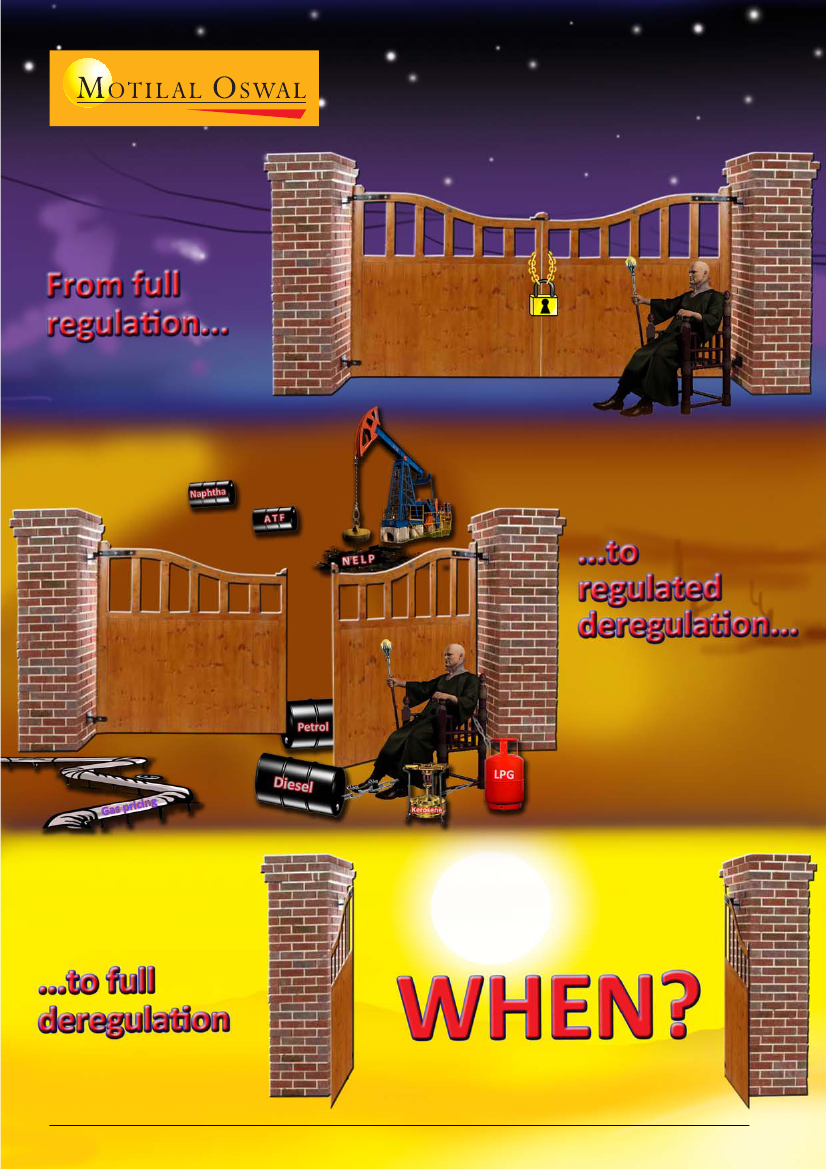
Breaking free … WHEN?
From 'Regulation' to 'Regulated Deregulation' to 'Full Deregulation'
Page No.
Summary
........................................................................................................................
4-8
Reforms, a key driver for stock outperformance
.....................................................
9-20
Stock Performance driven by reforms, rather than fundamentals
Reforms were more by force, than by choice
Benefited all participants… …though partly at the cost of oil PSU finances
Need to move from ‘incremental reforms’ to ‘bold reforms’
Clarity on reforms could drive up capex by 50%
.....................................................
21-26
Expect next 5 year capex at USD100b
20,000 new fuel retail stations required in next 5 years
>75mmt of refining capacity required to satisfy petrol/diesel consumption
…however clarity and sustenance of reforms critical to realize this potential
What lies ahead; who will be the winners?
.............................................................
27-35
Different challenges for upstream and downstream players
Upstream players seem better placed
Upstream subsidy likely to reduce significantly… …but statutory levies could increase
OMCs could be dark horses; repeat of 2007 unlikely
Annexure
....................................................................................................................
36-50
1: What was Oil Pool Account and why it was dismantled?
.................
36
2: Oil and Gas Regulators in India............................................................ 37
3: Petroleum pricing in India – a historical perspective
........................
38
4: Refineries in India................................................................................. 39
5: India Refining Capacity Growth (KBPD)
..............................................
40
6: New Exploration Licensing Policy (NELP) Programme....................... 41
7: Under recoveries and its sharing
.........................................................
42
8: Gas pricing in India
...............................................................................
44
9: Refinery Transfer Pricing Conundrum
.................................................
46
10: Key recommendations of various committees
.................................
48
11: Price break-up details of petroleum products
.................................
50
Companies
..................................................................................................................
51-91
ONGC
.........................................................................................................
52
Oil India..................................................................................................... 58
GAIL
...........................................................................................................
64
OMC’s (BPCL, HPCL and IOCL)
...................................................................
69
Reliance Industries
...................................................................................
76
Cairn India
.................................................................................................
82
Petronet LNG
............................................................................................
86
3 October 2013
2

Oil & Gas | Thematic
Summary of sub-themes
# 1 Timing of Indian reforms surprisingly similar to other developing countries
Like India, many countries had embarked on oil sector reforms in early 2000's
but later fizzled out due to increasing oil prices
Deregulation has a better chance under a majority government v/s a coalition
government
Key lessons: Depoliticize reforms; ensure minimal impact on economically weak;
targeted subsidy in initial period and clear communication with people and civil
societies.
# 2 India pays highest oil subsidy in non-exporting nations; reforms critical
India spends the highest on oil subsidies among oil importing nations
Indian oil subsidies ahead of China; only Iran, Saudi Arabia and Russia (all are oil
exporting countries) are ahead of India.
As the demand growth is strong at 4-5%, in the absence of major ramp-up in
domestic production, India's oil dependency will increase; making the need of
reforms critical.
# 3 Government's Five-year plans portrays evolution of Indian Oil & Gas sector
In 1990's India's focus was to reduce oil consumption and to initiate steps to
substitute petroleum products by coal, lignite, gas and electricity.
In early 2000's focus shifted to de-regulation (lasted for brief period only) and
promoting E&P.
In late 2000's emphasis was given on acquiring overseas assets, removing inter-
state tax anomalies.
# 4 Higher gas price expected to usher significant investments and gas supply
Over 1950-2012, 69tcf of 2P recoverable gas reserves discovered in India; of which
42tcf have been developed and are under production (~ 18tcf yet to be produced)
and 27tcf are yet to be developed.
USD8/mmbtu will give meaningful reserve upside; USD12/mmbtu, an ideal price
to fully exploit the domestic reserve potential.
Higher gas price (USD12/mmbtu) to lead USD412b investment; gas reserves of
91tcf and USD298b revenue to govt.
# 5 Petroleum retail business evolution an opportunity for multiple entities
Indian fuel retail business not yet mature to service the impending large fuel
demand growth.
De-regulation will bring in competition and sector could evolve in (a) Pricing,
(b)emission norms, (c) retail outlet formats
Focus to shift towards (a) efficiency, (b) service, (c) branding, (d) non-fuel
revenue; among others.
3 October 2013
3

Oil & Gas | Thematic
Oil & Gas
Breaking free … WHEN?
From 'Regulation' to 'Regulated Deregulation' to 'Full Deregulation'
The Oil & Gas sector has been a 'regulated sector with cyclical returns'. The cyclicality is
more due to policy changes, than business fundamentals.
Post the diesel reforms in January 2013, we were positive on 'incremental reforms'.
However, INR depreciation scuttled the benefit s.
With the sector once again facing sharp headwinds, we would be disappointed if the
current crisis (read opportunity) is also wasted, with only 'incremental reforms'.
'Bold reforms' are inevitable in the Indian Oil & Gas sector. While we acknowledge that
progress might remain tardy in the near term, given the imminent election cycle, we
believe that now it is more a question of 'when' rather than 'whether'.
In this report, we assess the evolution of the sector amidst reforms in the last two
decades, but more importan tly, we try to identif y the likely changes and winners/
beneficiaries if reforms continue.
Key conclusions
Recent reforms take India away from 'Regulated Deregulation' and give an
opportunity to implement bold reforms to achieve 'Full Deregulation'.
In the next five years, we expect to once again witness a reshaping of the
sector, more prominently in downstream.
Upstream seems well placed in the run-up to full deregulation. OMCs are likely
to face more competition from private players.
Though forced, reforms benefit all; key driver for stock outperformance
State-owned oil companies have outperformed (>100%) market indices in five of
the last 14 years. Unlike private players, their outperformance was driven more by
reforms than business fundamentals. Though reforms were forced, they have
created fortunes for all participants. In the recent decade, OMCs' finances worsened
(RoE's down from >35% to ~10% for OMC's and sub-20% for upstream) due to retail
price control and under-recoveries (USD30b in FY13 v/s Central government
revenues from sector at USD22b). We expect the ongoing reforms to correct this
anomaly to a large extent.
Sector capex could increase 50% in five years, with clarity on reforms
We estimate a likely increase of 50% in sector capex to over USD100b in the next
five years across the value chain. However, this potential can only be realized if the
government gives clarity and assurance on sustenance of the reforms.
What lies ahead; who will be the winners?
Investors are advised to refer
through disclosures made at
the end of the Research
Report.
3 October 2013
While clarity on several issues will emerge over time, among the most likely
outcomes of the reforms are: (a) increased competition in downstream, (b) demand
elasticity led by market-linked pricing, and (c) rationalization of capex. Upstream
players seem better placed, as (a) gas price hike, and (b) allowing exploration in
producing/developed fields will benefit all, while low under-recoveries would
4

Oil & Gas | Thematic
improve earnings of the state-owned companies. For downstream, market-linked
pricing is welcome, but OMCs could lose market share to private players; while we
believe, opportunity lies in the higher earnings through fair marketing margins.
Their focus will shift towards competition, technology, safety standards, alternative
fuels and prudent capex planning.
Valuation and view
Oil PSU's stock performance has little correlation with the financial performance
and as argued above is largely driven by reforms.
We believe that the government should capitalize on the crisis to push for bold
reforms in the sector.
In event of likely deregulation over coming years, we prefer ONGC/OINL in
upstream (significant earnings growth opportunity) and BPCL in OMC's (relatively
strong balance sheet and E&P potential).
Maintain Neutral on Gail India due to headwinds for gas availability, however
believe PLNG is available at attractive valuation given its medium term earnings
potential.
In the private space, Policy reforms on upstream will benefit Cairn India and RIL
equally in expediting the monetization of E&P acreage. Maintain Buy on Cairn
India for its attractive valuation and Neutral on RIL as the next earnings growth
is still some time away when its new core-business/E&P projects commission
from FY16/FY17.
Earnings and Valuations
M Cap CMP TP/Upside
USDb (INR) (INR) (%)
Integrated/Upstream
RIL¹
42.5
ONGC
35.9
CAIRN
9.7
Oil India
4.3
OMC's
IOC
8.0
BPCL
3.8
HPCL
1.0
Gas Companies
GAIL²
6.6
GSPL
0.5
PLNG
1.4
CGD Companies
IGL
0.6
¹ No. of shares a dj. for
822
262
317
447
205
326
190
325
53
119
944
397
389
641
287
447
272
342
60
160
15
52
23
44
40
37
43
5
12
35
Reco
EPS (INR)
P/E (x)
EV/EBITDA (x)
P/B (x)
FY13 FY14E FY15E FY13 FY14E FY15E FY13 FY14E FY15E FY13 FY14E FY15E
71.9
28.3
63.1
59.7
18.3
26.0
26.7
74.0
28.9
65.6
60.1
19.5
28.2
16.3
28.9
9.0
10.6
80.6
36.7
55.2
68.9
28.0
34.8
26.3
28.8
9.2
12.9
11.4
9.3
5.0
7.5
11.2
12.5
7.1
10.2
5.6
7.7
10.9
11.1
9.1
4.8
7.4
10.5
11.6
11.7
11.2
5.9
11.2
10.4
10.2
7.2
5.7
6.5
7.3
9.4
7.2
11.3
5.8
9.2
8.7
8.3
3.6
4.1
3.7
10.2
7.6
10.8
4.1
3.6
6.3
5.5
8.7
3.3
3.2
3.5
10.6
7.2
10.7
4.6
3.1
7.2
4.9
7.9
2.7
3.3
2.8
6.6
6.4
8.7
4.4
3.0
5.6
4.0
1.3
1.5
1.3
1.4
0.8
1.4
0.5
1.7
1.0
2.0
1.2
1.3
1.0
1.3
0.7
1.3
0.5
1.5
0.9
1.8
1.1
1.2
0.9
1.1
0.7
1.2
0.4
1.4
0.8
1.5
Neutral
Buy
Buy
Buy
Buy
Buy
Buy
Neutral 31.7
Neutral 9.6
Buy
15.3
275 305
11 Neutral 25.3 26.4 31.6
treasur y shares; ²P/E a dj. for investment s
2.6
2.2
1.8
Source: MOSL
3 October 2013
5

Oil & Gas | Thematic
Valuation summary
M Cap
CMP
USDb
(INR)
Integrated/Upstream
ONGC
35.9
362
TP Upside Reco
(INR)
(%)
397
52
Buy
Remarks
SOTP based; Domestic (INR253/sh, DCF); OVL (INR103/sh, @~USD5/boe
on 1P); Cairn (INR11/sh); Invest (INR11/sh, @25% disc.); Cash (INR19/sh)
Expect Diesel reforms to cut under recoveries by 40% in FY15, due to lack
of clarity maintain upstr eam share a t INR700/650b in FY14/FY15.
Valuations a ttr active. Model gas price of USD6.3/mmbtu from FY15
RIL¹
42.5
822
944
15 Neutral
SOTP based; Refining & Petchem (INR639/sh, 6x FY15E EBITDA);
E&P (INR193/sh); In vestmen ts (INR6 5/sh); net cash (INR46/sh)
Me aningful earnings increase is sti ll 3 years away, as it s USD12b projects
start coming on stream. Medium term core business (@90% of EBIT)
outlook continues to remain cautious with ROE at ~12%.
Though assume gas price of USD8
/mmb tu from FY15; up side limited as
meaningful KG-D6 production incr ease 3-4 years away.
CAIRN
9.7
317
389
23 Buy
SOTP based; Rajasthan (INR191/sh, 800mmboe net); Cash (INR149/sh);
Exploration up side (INR25/sh). Pur e play on crude prices and Fx rate.
Expect reserve upgrade in medium-term, watch out production ramp-up.
Valuations reasonable, but concerns on c ash utiliz ation ov er long term
(Cash balance at ~USD5b at end-FY15 post planned capex and dividend)
Oil India
4.3
447
641
44 Buy
Valued at average of three methodologies: (1) P/E of 9x FY15E, (2) 4.5x
FY15E EV/EBITDA and (3) DCF (WACC of 12%).
Model gas price increase to USD6.3/mmbtu from FY15
Valuations attractive. Gas price hi ke benefit wi ll be a key trigger.
OMC's
Diesel reforms to lead to (a) cut in under recoveries (b) reduce working
capital requirements and c) result in lower interest and debt burden.
Also, likely marketing margin increase will more than compensate for
market share loss to private petroleum product refiners.
IOC
8.0
205
287
40 Buy
Valued at an av erage of (a) 4.5x EV/EBITDA; (b) 0.9x P/B and c) 9x P/E on
FY15 basis; investment value (INR100/sh, 25% disc.).
IOC’s earnings quality is be tt er than HPCL/BPCL, giv en its diversification
(refining, petchem and pipelines).
Expect earnings growth from Panipat naphtha cracker (stabilized in
2QFY13), and 15mmtpa Paradip refinery (commissioning in 1QFY15).
BPCL
3.8
326
447
37 Buy
Valued at an av erage of (a) 4.5x EV/EBITDA; (b) 1.0x P/B and c) 9x P/E on
FY15 basis; E&P (INR151/ sh); Investment s (INR58/sh, 2 5% disc.)
Mozambique FID by 4QFY14 coupled with third-party reserve certification
will signific an tly reduce the risk. Value Mozambique at USD1.9b
Value Wahoo discov ery in Brazil at USD0.3b. Expect further reserve
addition from its ongoing drilling program in SEAL basin at Brazil.
HPCL
1.0
190
272
43 Buy
Valued at an average an of (a) 4x EV/EBITDA; (b) 0.7x P/B and c) 8x P/E on
FY15 basis; investment value (INR99/sh, 25% disc.).
Weak Balance Sheet among OMCs & low profitability due to high interest.
But, with high marketing to refining volume ratio, its EPS is more sensitive
to any increase in marketing margin.
GAIL²
6.6
325
342
5 Neutral
SOTP ba sed; Core business (INR248/sh, 9x FY15E EPS); E&P (INR20/ sh);
Investments (INR62/sh)
Expect medium-term earnings pressure, led by incremental gas
headwinds and model 3% transmission volume CAGR in FY13-15.
Proposed gas price hike to impact Petchem and LPG profitability .
PLNG
1.4
119
160
35 Buy
Valued on average of (1) P/E (10x FY15E EPS) and (2) DCF (INR191).
Play on medium term gas deficit in India; Long term earnings
predictability; reinvesting in core business
Though near-term EPS growth capped due to slower ramp-up at Kochi,
upside to our EPS est, would come from higher likely higher marketing margins.
¹ No. of shares a dj. for treasur y shares; ²P/E a dj. for investment s
Source: MOSL
3 October 2013
6

Oil & Gas | Thematic
Story in charts
Oil PSU's outperformed broader markets in five of the
last 14 years, mostly led by reforms
..reforms were more by force than by choice led by
worsening financial situation of the government
….however, early 2000 reforms g ave entry to private
players; helping to create significant value (USD b)
….OMC's though suffered later due to controlled pricing
leading to dismal RoE's (%)
Despite unfavourable returns, Oil PSU's continued their
capex, while Private players curtailed the same (INR b)
Oil PSU's outperformed broader markets in five of the last 14 years, mostly led by reforms
..reforms were more by force than by choice led by
worsening financial situation of the government
….however, early 2 000 reforms gave entry to private
players; helping to create significant value (USD b)
….OMC's though suffered later due to controlled
pricing leading to dismal RoE's (%)
Despite unfavourable returns, Oil PSU's continued their
capex, while Private players curtailed the same (INR b)
Source: Compan y, Bloomberg, Industr y, MOSL
3 October 2013
7

Oil & Gas | Thematic
Story in charts
ONGC/OINL's EPS has significant sensitivity to gas price
OMC's EPS increase significantly at higher marketing
margins (sensitivity to FY15E EPS)
Central government tax revenues (net of subsidy) from
oil sector now at the lowest level of the last decade
Estimate 50% jump in capex over next five years to
USD100b led by >75mmt refining capacity, 2 0K retai l
outlets
Attractive valuations
ONGC/OINL's EPS has significant sensitivity to gas price
OMC's EPS increase significantly at higher marketing
margins (sensitivity to FY15E EPS)
Central government tax revenues (net of subsidy) from oil sector now at the lowest level of the last decade
Estimate 50% jump in capex over next five years to
USD100b led by >75mmt refining cap acity, 20K retail outlets
Attractive valuations
3 October 2013
Source: MOSL, GoI
8

Oil & Gas | Thematic
Reforms a key driver for stock outperformance
Though forced, reforms benefit all participants
State-owned oil companies have outperformed market indices in five of the last 14
years. Unlike private players, their outperformance was driven more by reforms than
business fundamentals.
Though reforms were forced, they have created fortunes for all participants.
In the recent decade, OMCs' finances worsened due to retail price control and under-
recoveries. We expect the ongoing reforms to correct this anomaly to a large extent.
Stock performance driven by reforms, rather than fundamentals
Stock prices
have been influenced
more by sector reforms
than business
fundamentals
OMCs' stock performance is more strongly correlated with reforms in the sector than
with their financial performance. In the last 14 years, OMCs have outperformed the
broader markets in five financial years and have performed largely in-line with the
broader markets in four financial years.
The four-year outperformance during FY01-04 was driven by the multiple reforms
roadmap announced by the government in 1997, particularly in fuel price deregulation.
However, in 2004, the sector was again regulated, resulting in stock underperformance,
though profits did not decline to that extent. The FY09 outperformance was driven by
the sharp fall in crude prices, which significantly lowered under-recoveries. Since
FY11, there has been no meaningful diversion in the performance of OMCs v/s
benchmark indices.
Oil PSU's outperformed broader markets in five of the last 14 years, mostly led by reforms
Source: Bloomberg, MOSL
OMCs outperformance after FY01/FY02 fizzled out as the
government again began to regulate petroleum pricing
Shift from APM to market-linked crude pricing led
to upstream outperformance over FY01-04, post which the
ad-hoc subsidy burden took a toll (INR b)
*Only ONGC and Oil India
3 October 2013
Sour ce: Company, MOSL
9

Oil & Gas | Thematic
The FY09 outperformance was driven by the sharp fall in crude prices, which
significantly lowered under-recoveries. During FY09-FY13, Brent crude price increased
>3x to >USD100/bbl while sector gross under recoveries increase 30x from INR50b in
FY04 to INR1,610b in FY13. During this period, government response was largely ad-
hoc and no serious attempt was made to effect reforms in the sector. Post 2004 till
January 2013, the only credible reform was petrol price deregulation from June 2010.
With no credible reforms, under recoveries surged in the last decade with oil prices
Source: Bloomberg, PPAC, MOSL
Price reforms in the last nine years were largely ad-hoc
FY05
FY06
FY07
45
64
2,914
494
4.0
Jun-06
-2.0
Nov-06
2.0
Jun-06
FY08
40
82
3,316
773
2.0
Feb-08
FY09
46
85
3,900
1,033
5.0
Jun-08
-5.0
Dec-08
3.0
Jun-08
FY10
47
70
3,302
461
FY11
46
86
3,933
780
FY12
48
114
5,484
1,385
FY13
55
111
6,028
1,610
Fx Rate (INR/USD)
45
44
Brent (USD/bbl)
42
58
Brent (INR/bbl)
1,897
2,568
Under recoveries (INRb) 201
400
Petroleum Product Price Hikes (INR/ltr)
Petrol
2.0
2.5
Jun-04 Jun-05
1.1
3.0
Aug-04 Sep-05
Diesel
1.0
2.0
Jun-04 Jun-05
1.3
Feb-08
4.0
3.5
Jul-09 Jun-10
3.0 Deregulated
Feb-10
2.0
2.0
3.4
Jul-09 Jun-10 Jun-11
1.4
2.0
-1.0
Aug-04 Sept-05 Nov-06
Kerosene
LPG (INR/cylinder)
20
Jun-04
20
Nov-04
-2.0
Dec-08
2.6
Feb-10
3.0
Jun-10
35
Jun-10
2.0
Jun-11
50
Jun-11
5.6 Sep-12
Allowed OMC's to hike
Diesel prices b y INR0.45/
ltr (Jan-13) every month
De-regulated Bulk
Diesel (Jan-13)
10
Jun-08
-25
Jan-09
Cylinders capped to 9
per household per year
(Jan-13)
Source: Indus try, MoPNG, MOSL
Petroleum product pricing evolution in India has followed an inverted sequence. Rather
than moving from a controlled to a decontrolled regime, it has moved from free market
to a controlled regime (refer Annexure-3). India had free market pricing till 1975, followed
by APM till 1998, and then controlled pricing (barring some products) till now.
We classify Oil Sector
reforms in the last 2
decades
in 3 key phases
3 October 2013
We classify the reforms spread over the last two decades into three broad phases:
1. Phase-1 (1991):
Driven by overall economic reforms
2. Phase-2 (1997-2002):
Driven by burgeoning oil pool deficit
3. Phase-3 (2010 onwards):
Driven by high under-recoveries
10

Oil & Gas | Thematic
Summary of key reforms post independence
Year
1953
Pre-1991
Reforms / Key
Changes
Oil India formed in
JV with govt. and
Burmah Oil &
Became 100% govt.
company in 1981
Post Iran crisis
(Abadan refinery
nationalization)
foreign companies
agreed to set up
refineries in India
Agreed to setup
refinery at Mumbai
by Burmah Shell &
Standard Vacuum and
at Vizag by Caltex.
Setup Oil & Natural
Gas division;
making E&P a govt.
monopoly.
O&G division later
became a statutory
commission; Found
oil in Cambay basin
Year
1991
Phase 1: 1991
Reforms / Key
Changes
Launched Economic
Reforms forced by
Balance of Payment
crisis. Central&state
fiscal def. a t > 11%
Opened up the oil
sector for private
participation
Year
1997
Phase 2: 1997-2002
Reforms / Key
Changes
New Exploration
and Licensing Policy
(NELP) announced
Phase 3: 2010 onwards
Reforms / Key
Year
Jun-10 Changes
Deregulated Petrol
Price
1951
-54
1991
Nov-97
Government
decided on phased
dismantling of APM
2012
1992
1955
1993
1958
Aug/
Sep
1993
IOC formed for
product marketing
Shocked by oil
1973
crisis, govt. again
focused on Coal, till
Mumbai High
Discovery in 1974
APM Era:
Govt.
1974
formed Oil Prices
Committee (OPC)
and later in 1984 Oil
Cost Review Comm.
1980-86
Invited international
to bid for E&P
acreage; witnessed
some interest, but no
significant reserve
accretion
1959
Nov-93
1995
1996
1996
New Investment
Policy announced to
offer E&P acreage
round the year; 28
fields were offered
Government
decanalised the
imports of LPG,
Kerosene and LSHS
Allowed importing
and marketing of
LPG and Kerosene
under Parallel
Marketing Scheme
Deregulated
lubricant marketing
Sundararajan report
'Hydrocarbon
Perspective: 2010 -
Meeting the
Challenges'
R- Group
Recommendations
based on
Sundararajan
Committee report
Expert Technical
Group reco's on
tariffs on capital
goods; dismantling
of APM; pipeline
tariffs and
downstream comp.
Apr-98
MS, HSD, SKO, LPG,
ATF pricing moved t o
Import parity price
to compute refinery
gate price
Apr-98
Naphtha FO, LSHS,
Bitumen wax and
Paraffin Wax
decontrolled
Apr-98
Private refiners
allowed to import
the crude directly
(de-canalized)
Jun-98
Refinery sector de-
licensed
Mar-01
PSU oil companies
restructured
2012
-13
2013
Decision to shift
LPG and Kerosene
subsidy to Direct
Cash T ransfer
platform through
Aadhar Card
Limited domestic
LPG cylinder supply
to 9 per household
per year (v/s 6
announced in 2012)
In Jan-13, govt.
allowed monthly
diesel price hike of
INR50/ltr
Apr-01
ATF decontrolled
Source: Indus try, MoPNG, parliament.nic.in, PPAC, MOSL
Oil Sector Reforms continued across the different Political Party governments
APM Era begun
Brief
Regulated
in 1975
De-regulation
Pricing
Prime
Indira
Morarji
Indira
Rajiv
VP
PV
AB
H. D.
IK
AB
Manmohan Singh
Minister
Gandhi
Desai
Gandhi Gandhi
Singh Narasimha Vajpayee Deve
Gujral Vajpayee
Rao
Gowda
Term
Jan 66
Mar 77
Jan 80 Oct 84 to Dec 89 Jun 91 to May to June 96 to Apr 97 to Mar 98 to May 04 to May 09
to Mar 77 to Jul 79 to Oct 84 Dec 89 to Nov 90 May 96 Jun 96
Apr 97
Nov 97 May 04 May 09 to date
Yr of Election 1971
1977
1980
1984
1989
1991
1996
1998
1999
2004
2009
Source: GoI, ECI, MOSL
3 October 2013
11

Oil & Gas | Thematic
Deciphering FY01-04 outperformance
A four-year reform
roadmap triggered the
outperformance of OMCs
over FY01-04
OMCs' outperformance over FY01-04 was driven by the government's long-term reform
roadmap in November 1997, based on the recommendations of R (restructuring)-
Group, which in turn had relied on the Sundararajan Committee report. The key
decisions based on R-Group recommendations include:
Dismantling of the APM regime in the backdrop of surging oil pool deficit, and
Shift of petroleum pricing to import parity and later to market pricing.
Significant surge in the oil pool deficit to INR150b and the government's inability to
pay this deficit resulted in dismantling of the Administered Pricing Mechanism (APM)
and forced the government to opt for reforms. Other reasons cited for dismantling of
APM include:
Inadequate financial resource generation by oil companies to invest in E&P, new
refining capacity and marketing/distribution network;
Lack of incentives to invest in technology upgradation or cost competitiveness and
Non-conducive regulatory controls for entry of private investment and thereby
greater market competition.
The R-Group recommended sequencing of reforms, starting with refining (de-licensed
in June 1998), followed by upstream (crude price linked to market price by end-FY02),
and then marketing (still not complete).
Roadmap for phased dismantling of APM from FY99 to FY02
Planned Reform
Year 1 (FY99)
Year 2 (FY00)
Year 3 (FY01)
Gradual shift from 'Cost Plus' crude pricing to market linked crude pricing
Crude Price
75% linkage to
77.5% linkage to
80% linkage to
international
international price international
price
price
Year 4 (FY0 2)
82.5% linkage to
international
price
Current Status
Crude pricing now
market linked, however
PSU upstream now
bears sub sidy.
Petroleum Product Pricing to move to import parity pricing and deregulate by 2002
Kerosene
30% price increase 30% price increase 20% price increase Adjust price to
Continues to remain
v/s existing
v/s revised
v/s revised
reach subsidy at
regulated and subsidized
ex-storage price
ex-storage price
ex-storage price
33.3% of import price
LPG
33% subsidy to
33% further subsidy Price adjustment to Full Deregulation Continues to remain
be passed on
to be passed on
reach subsidy level
regulated and subsidized
at 15% of import parity
Petrol
Full Deregulation Decontrolled in June 2010
Diesel
Full Deregulation Ongoing monthly price
hike of INR0.5/ltr from Jan
2013
Other Products
To decontrol
Deregulation of
Full Deregulation Full Deregulation
Naphtha, FO,
imports and pricing
LSHS, Bitumen,
of ATF
Paraffin wax
Actual Reform
Year 1 (FY99)
Year 2 (FY00)
Year 3 (FY01)
Year 4 (FY0 2)
MS, HSD, SKO, LPG
and ATF price shifted
to import parity
Naphtha FO, LSHS,
wax, bitumen
decontrolled
PSU oil companies
restructured
ATF price
deregulated
Source: PPAC, MoPNG, MOSL
3 October 2013
12

Oil & Gas | Thematic
FY97-FY04 witnessed significant investments by private players in Refining and
Marketing (Reliance, Essar, Shell, MRPL). However, due to increasing crude/product
prices, the government, in 2004, once again began controlling the petroleum prices.
However, government
regulated the pricing
again from 2004,
resulting in
underperformance
This resulted in under-recoveries for the marketers and the government only
compensated the state-owned entities. As a result, the private players began incurring
losses and most eventually shut down. While, the compensation to the OMC's in the
initial period was in the form of oil bonds and later through cash compensation. The
announcement and actual disbursal of the compensation has been ad-hoc and
invariably delayed resulting in the significant increase in the debt levels of the OMC's.
Led by these factors, OMCs financials became weak resulting in the stock
underperformance since 2004.
Reforms were more by force than by choice…
Given the profound impact of the Oil & Gas sector on the overall economy, reforms in
the sector were more by force than by choice. Each period of reform was preceded by
a difficult economic scenario, leaving no option with the government but to opt for
the reforms.
High fiscal deficit (5-6%), increasing oil import bill, and need for infrastructure
investments are some of the common factors preceding Oil & Gas reforms in the last
two decades. These factors necessitated reforms to reduce subsidies, improve
efficiency by removing entry barriers, and encourage private investments.
High fiscal deficit forces the government to go for reforms
Oil sector reforms
were more by force
than by proactive stance
by the government
Source: CSO, MOSL
Sudden surge in oil import bill drives the government towards reforms
Source: MoPNG, PPAC, MOSL
3 October 2013
13

Oil & Gas | Thematic
…but have benefited all participants…
Resurgence of the Energy sector with the entry of private entities post 1995, has
helped create enormous wealth for all stakeholders. Private companies' participation
is now across the energy value chain ranging from upstream to product retailing. Total
market capitalization of the sector has increased 21x in the last 18 years, with the
private sector accounting for a major part of the increase.
Market capitalization for the sector has increased 21x in the last 18 years (USD b)
Source: Bloomberg, Industr y, MOSL
…though partly at the cost of oil PSU finances
While the overall industry has benefited in the last two decades; OMC's financial
health suffered. Spiraling crude prices and INR/USD depreciation led to a drastic jump
in under-recoveries in the last 2-3 years. Delay in full deregulation of the sector led to
greater pressure on the OMCs' working capital requirements, leading to increased
debt levels. Also, lower GRMs coupled with higher interest costs have resulted in
lower profitability for the OMCs.
OMCs' RoE impacted due to high under recoveries leading to high interest cost and controlled marketing profitability
Source: OMCs, MOSL
3 October 2013
14

Oil & Gas | Thematic
Oil sector reform in India,
though started
two decades ago…
..were never completed
Need to move from 'incremental reforms' to 'bold reforms'
Oil & Gas reforms, though started two decades ago, were never completed and the
sector still continues to be largely controlled. Till date, despite the apparent economic
benefits, perceived political compulsions have ensured continuity of petroleum price
controls in India.
2002 decision of dismantling APM was completed but petroleum price
deregulation was never fully implemented.
An upstream regulator (DGH) is in place, but is not fully independent.
Midstream regulator (PNGRB) is also in place, but is still battling to prove its
powers.
While petrol prices are deregulated, diesel prices continue to be regulated.
Pricing reforms
in the last nine years
were ad-hoc and late
led by political
compulsions
Similar to Brazil (which has achieved successful deregulation of the sector), India's
approach is to first deregulate products that impact the politically weak stakeholders.
Hence, the petrol price deregulation in June 2010.
Need to move from
"incremental reforms"
to "bold reforms"…..
….would be disappointed
if the current crisis is
wasted, with only
'incremental reforms'
Post the diesel reforms in January 2013, we were positive on the 'incremental reforms'.
However, INR depreciation scuttled the benefits.
With the sector once again facing sharp headwinds, we would be disappointed if this
crisis (read opportunity) is also wasted, with only 'incremental reforms'. 'Bold reforms'
are inevitable in the Indian Oil and Gas sector. While we acknowledge that progress
might remain tardy in the near term, given the imminent election cycle, we believe
that now it is more a question of 'when' rather than 'whether'.
While Central government revenue is subdued;
state government revenue from sector has increased
Need to reduce government stake in oil PSU's;
>68% stake in 3 of the 6 oil PSU's
Source: MOPNG, PPAC, BSE, MOSL
3 October 2013
15

Oil & Gas | Thematic
While, fiscal deficit and high import bill once again will force the government to opt
for reforms in the sector, this time, however, we believe the situation is more
precarious.
The taxes from the Oil & Gas sector to the Central government (net of subsidies)
are now at the decade low level at INR174b v/s a peak of INR1.0t in FY08.
Also, as a percentage of GDP, the ratio has declined from 2.4% in FY04 to 0.2% in
FY13.
We believe this could be should be an inflection point for the government to opt for
the bold reforms and also push state governments to reduce their taxes.
Net of government subsidy share, contribution of Oil & Gas taxes to the Central government
revenues is at lowest level in the last decade (INR b)
Source: Indus tr y, GoI, MOSL
Share of Oil & Gas tax contribution to GDP has declined over the years, largely led by lowering of taxes
Source: Indus try, GoI, MOSL
3 October 2013
16

Oil & Gas | Thematic
What changes do we expect/are required in a roadmap towards de-regulation
Particulars
Up stream
Recent Reforms
Li kely Change in Five Years
Allowing exploration in the
Rationalized subsidy/taxes on oil/gas
producing/developed block
produced from nomination acreage
Make sharing as per PSC on
Shift E&P acreage allocation to OLAP
revenue basis rather than
(Open Acreage Licensing Policy) by
on profit basis
completing National Data Repository
Fast tracking of regulatory
Able regulatory body in place with
decisions to boost oil/gas
independent decision making power
production
Currently fixed at USD4.2/mmbtu
Approved Rangarajan Committee
Gas pricing to be market determined
formula which will take gas
Uniform taxes across the states
price from USD4.2/mmbtu to
~USD8/mmbtu from April 2 014
Trade p arity pricing for Diesel
Finance ministry pushing for
Post de-regulation of diesel, there
Export Parity
will be no question of Export or Trade
parity
Marketing margins to improve v/s
fixed INR1.4/ltr since FY06
Petrol is de-regulated from
Govt has allowed OMC's to
Uniform taxation across the states
June 2010
increase Diesel prices
and reduction in state taxes
Diesel, LPG and kerosene
by INR0.45/ltr every month
Diesel to be de-regulated
are still regulated
Govt is implementing
Subsidy on Kerosene and LPG will
Direct cash transfer
come down drastically post 100%
mechanism to tap the
shift to direct cash transfer platform
leakages in the domestic
LPG and PDS Kerosene subsidy
-
Reduce the government stake in oil
PSU's
Sour ce: Industr y, MOSL
Current Status
Currently NELP regime is
prevalent in India.
Lot of government interference
in day to day activities
Upstream
(Gas Pricing)
Midstream
(Refining and
Marketing)
Downstream
(Retail
Fuel Pricing)
Other
Reforms, a key driver for stock outperformance - Key Conclusions
Indian Oil PSU's stock outperformance has a strong correlation with the reforms
in the sector than with the financial performance of the companies
Given the profound impact of the Oil sector on overall economy, reforms in the
Indian oil & gas sector were "more by force rather than by choice".
Emergence of energy sector post entry of private player's post 1995 has helped
in creating enormous wealth for all the stakeholders.
Delay in the full deregulation of the sector led to greater pressure on working
capital requirements for OMC's, leading to increased debt levels
Ti ll date, despite the apparent economic benefits; perceived political
compulsions have ensured continuity of the petroleum price controls in India
Need to move from "incremental reforms" to "bold reforms".
3 October 2013
17

Oil & Gas | Thematic
Sub-theme 1: Timing of Indian reforms surprisingly similar to other developing countries
Like India, several other developing countries have also
realized the need to de-regulate the Energy sector and
phase out subsidies to reduce fiscal deficit. Our
comparative analysis surprisingly indicates that, just like
India, many other countries had announced Oil sector
reforms during the period 2000-2005, which fizzled out
later, led by volatile/high crude prices. In the last 1-2
years, even other countries have been forced to get back
to reforms.
While deregulation has a better chance under a majority
government v/s a coalition government, we summarize
some of the key lessons countries that have successfully
de-regulated petroleum product pricing.
Key lessons to be drawn from countries that have successfully deregulated the sector
Adopt a gradual approach
and depoliticize reforms to
the extent possible
Conduct a detailed socio-
economic survey to ensure
minimal impact on
economically weaker
populace
Continue targeted subsidy by
cash transfer in early period to
reduce opposition and enhance
durability of reforms
Communicate clearly with
people/civil societies
Avoid multiple prices of a
single product (cases in point:
kerosene and LPG)
Analyzing reform process across the world
Country
China
Reforms Period Recent Developments
Early Reforms 2000-2005
Mar-13
In new oil pricing system, China
Prices set by NDRC with a lag based on
shortened price adjustment period
av erage spot prices (NY, Rott erdam and
from 22 to 10 working days and
Singapore) reluctant to adjust prices.
eliminated 4% oil price fluctuation
This squeezes margins for refiners
limi t
May-12
Started tracking fuel usage,
Retail fuel prices were increased by over 100%
substituting gas for MS/HSD;
during 2005. However, no change in domestic
From June 2013, restricted subsidised
retail prices for subsidized petroleum
fuel consumption based on usage
products in 2006
Apr-13
To hike LPG price b y ~USD0.02/kg
NA
for 12 months
Jun-13
Post elections, political leadership
NA
is keen to reduce oil sector subsidies
to reduce fiscal deficit
Jun-12 and
Post 13% petrol price hike in Jun-12,
Increases in July 2005; September 2005 and
in Nov-12 hiked prices of gas(+50%),
April 2006.
diesel/kero(33%), petrol(+14%)
Nov-12
Household consisting of <6 members,
and income <USD14K p.a, to get
~USD100 annually
Feb-13
Hiked premium gasoline/diesel prices
2005: Introduced price adj mechanism,
by 20%, kero and heavy fuel oil by 15%,
resulting in price increase s in February,
and LPG by 50%
August and October.
Jun-12
Hiked price of gasoline by 20% and
NA
diesel by 10%
2012/13
Announced in Mar-13 that there were
August 2005: increased retail prices by
no plans to reduce the subsidy on
25 percent.
premium gasoline
Jan-12
In Jan-12, the govt raised the
Automatic formula tried and abandoned in
possibility of phasing-out subsidies
2004. Main domestic fuel prices frozen since
for gas/diesel, after efforts in 2011
end-2004 (crude @USD27/bbl) after 10%
failed in the face of strong opposition
increase for gasoline/ diesel.
2013
Plans to raise fuel prices every month
NA
in 2013 to bring them closer to
international levels
Jul-13
Plans to increase gas tariffs by 15%
for all users
Source: Media Articles, IMF, Industr y, MOSL
18
Indonesia
Thailand
Malaysia
Jordan
Ghana
Morocco
Nigeria
Bolivia
Mexico
Russia
3 October 2013

Oil & Gas | Thematic
Sub-theme 2: India pays highest oil subsidy in non-exporting nations; reforms critical
While Iran, Saudi Arabia and Russia are ahead of India in
terms of oil subsidies, among the oil importing nations,
India pays the highest oil subsidies - even higher than
China. India paid USD33.9b as Oil & Gas subsidy in 2011
v/s China's USD18.5b. India's subsidy outgo is at 2.4% of
GDP.
While UAE leads in terms of subsidy per person at
USD4,172 (India at USD33.4/person), Uzbekistan has the
highest subsidy-to-GDP at ~22% (India at ~2%). Though
demand growth is still strong at 4-5%, in the absence of
major ramp-up in domestic production, India's oil
dependency will increase.
India ranks fourth in the world among fossil fuel subsidizing countries (USD b)
Source: Bloomberg, IEA, MOSL
India spends the highest on oil subsidies among oil importing nations, even higher than China
(USD b)
India
Source: IEA, IMF, MOSL
3 October 2013
19

Oil & Gas | Thematic
Sub-theme 3: Government's Five-year plans portrays evolution of Indian Oil & Gas sector
India's successive five-year plans have acted as key
guidance notes on re-framing sector policies to safeguard
the nation's energy security. Focus on increasing
domestic Oil & Gas production, rationalizing petroleum
product pricing, increased foreign company
participation, etc, are some of the common points
discussed across five-year plans. Below, we present a
gist of takeaways pertaining to the Oil & Gas sector from
the last five five-year plans.
9th (1997-2002)
20.5
5.7
5.2
116.1
120.7
35.2
65.4
5.7
27.6
10th (2002-2007)
42.4
7.6
7.1
149.0
147.0
36.1
69.7
2.4
30.1
11th (2007-2012)
84.4
8.0
10.4
213.2
182.6
40.4
74.5
6.1
46.1
India's energy policy has evolved over the years, primarily through five-year plans
Five year plan
Avg. Oil Price
(USD/bbl)
GDP gr. avg. (%)
Avg. gas
consump. gr. (%)
Ref cap (mmt)
Oil consumption
exit rate (mmt)
Oil production
exit rate (mmt)
Import dep. (%)
Avg. oil consump
growth (%)
Gas production
exit rate (bcm)
Focus Areas
Focus shifted from
managing/reducing
demand to
securing supply to
satisfy the demand
7th (1987-1992)
19.1
5.3
16.4
51.9
64.9
29.2
42.9
5.3
15.0
8th (1992-1997)
18.0
6.5
8.9
61.6
91.6
35.6
54.7
6.6
22.3
Need for
managing oil
demand
including
formulation of
a national
transport fuel
policy
Reduce oil
demand by 6-
7mmt by FY97
Substitute
petroleum
products by
coal, lignite,
gas and
electricity
Building
strategic
tankages to
ensure
petroleum
product supply
Alternative fuel
development
such as CBM,
MS-Ethanol
blend, and gas
hydrates
Focus on reducing
subsidy burden
Focus on building
up the indegenious
technological
capabilities
Govt. had early
plans to increase
gas usage in
country, but
somehow has
fallen short of
targets
Technology:
To
improve
utilisation of
rigs, in ventor y,
quality of wells
drilled,
optimise
refinery
operations,
and reduce
fuel loss
Emphasised
the need for
evolving gas
policy in
advance in
wake of
expected gas
discoveries
Refining cap
addition:
Cost-
effective
debottlenecking
schemes and
low-cost
expansions
Accelerate
pace of E&P
activity
Eliminate the
flaring of
natural gas
Increased
focused on
acquiring oil
and gas equity
abroad
Deregulation
of APM,
generate
internal
resources and
attract private
capital.
To improve E&P
reservoir
management
and increasing
recovery rates
by at least 5%.
Set up
regulatory
mechanism in
upstream/
downstream.
Studying the
possibility of
importing LNG
at competitive
rates.
Phasing out of
subsidies.
Subsidies, if
any, to be
routed through
the Central
Budget
Creating an
apex
committee on
energy with a
panel of
professionals/
experts to
approve policy
guidelines and
overlook
implementation
Promote a
green/clean
environment by
setting
emission
norms and
product quality
specifications
Incr easing E&P,
acquiring
equity in oil/
gas abroad,
building
strategic crude
oil storage and
developing
alternate fuels
Concept of
transfer of
direct
subsidies on
Kerosene and
LPG was
introduced
Identified
need to remove
State tax
anomaly /
introduce a
uniform VAT .
Set up PNGRB,
downstream
regulator
Availability of
clean, modern
fuel to all
households
should be our
guiding
concern
20
3 October 2013

Oil & Gas | Thematic
Clarity on reforms could drive up capex by 50%
Expect next five year sector capex to touch USD100b
We estimate a likely increase of 50% in sector capex to over USD100b in the next five
years across the value chain.
However, this potential can only be realized if the government gives clarity and assurance
on sustenance of the reforms.
Clarity and assurance on sustenance of reforms essential
We believe that the full benefit of deregulation can be reaped by all participants if
the government gives a fair understanding on the pace and direction of reforms to
strategize their responses. Full deregulation* could re-rate OMCs. However, to bring
in effective structural change, industry players will require:
Assurance on sustenance of free pricing - positive for petroleum retailers.
Clarity on gas pricing - positive for gas value chain, benefiting producers,
transporters as well as LNG importers.
Fast tracking of upstream work programs - positive for upstream companies.
50% jump in sector capex likely in five years
If deregulation and other aligned reforms were to happen at adequate pace in the
next 1-2 years, investments by both the state-owned and private players would
increase across the value chain.
We estimate overall capex in the sector at USD100b+ over the next five years as
against actual capex of USD68b in the last five years. However, if deregulation* and
other reforms get delayed, capex over the next five years would be just ~USD80b.
Estimate 50% jump in capex over next five years to USD100b (Private + PSU)
Source: Indus try, MoPNG, MOSL
*Deregula tion: Reduction or elimination of gov ernment power in a particular industry, usually
to create mor e competition within the indus try.
3 October 2013
21

Oil & Gas | Thematic
Over the next 5 years Auto Fuel consumption in India could grow by 30-50% at 5-8% CAGR
Petrol (In mmt) - 10% of total
Last 5/10 Yr CAGR: 9% / 8%
Petrol (In mmt) - 10% of total
Last 5 Yr CAGR: 9%
Last 10 Yr CAGR: 8%
At 8% CAGR, 7mmt of
additional Petrol required till
FY18 v/s 5mmt in the
last 5 years
Diesel (In mmt) - 45% of total
Last 5 Yr CAGR: 8%
Last 10 Yr CAGR: 7%
At 8% CAGR, 32mmt of
additional Diesel required till
FY18 v/s 21mmt in the
last 5 years
LPG(In mmt) - 10% of total
La st 5 Yr CAGR: 5%
Last 10 Yr CAGR: 6%
At 8% CAGR, 7mmt of
additional LPG required till
FY18 v/s 4mmt in the
last 5 years
Diesel (In mmt) - 45% of total
Last 5/10 Yr CAGR: 8% / 7%
LPG(In mmt) - 10% of total
Last 5 /10Yr CAGR: 5% / 6%
Source: PPAC, MOPNG, MOSL
20,000 new fuel retail stations required in next five years
At 175KLPM, expect
20,000 new fuel retail
outlets in next 5 years
Large investments will be required in the retail marketing network in fuel retail stations
as well as in product pipelines and storage tanks. The current average volume per
outlet stands at ~185KLPM (kilolitres per month). Assuming a volume of 175KLPM per
station, we estimate additional requirement of at least 20,000 new stations over the
next 5 years.
With a likely 50% volume growth by FY18, huge retail network investments are imperative
Sour ce: Industr y, MOSL
3 October 2013
22

Oil & Gas | Thematic
OMCs have expanded their retail network at ~9% CAGR in the last 10 years ('000 outlets)
*Essar and Reliance have ~1,400 retail stations each; Shell has ~60 outlets
Source: OMC's, MOSL
Petrol pump economics: Average volumes of 175KL per month imply a return of 16.8% on cash invested
INR in ‘000
Case 1
Case 2
125
1,500
1.1
1.8
1.3
1,950
750
429
771
0.51
225
112
434
130
304
0.20
11.8
4,500
Case 3
150
1,800
1.1
1.8
1.3
2,340
900
489
951
0.53
225
134
592
177
414
0.23
14.2
4,500
Case 4
175
2,100
1.1
1.8
1.3
2,730
1,050
542
1,138
0.54
225
156
757
227
530
0.25
16.8
4,500
Case 5
200
2,400
1.1
1.8
1.3
3,120
1,200
619
1,301
0.54
225
179
897
269
628
0.26
19.0
4,500
Comments
Volumes (KLPM)
100
Volumes (‘000 Litres)
1,200
Diesel Dealer Margin (INR/ltr)
1.1
Petrol Diesel Margin (INR/ltr)
1.8
Average Dealer Margin (INR/ltr) 1.3
Annual Margin
1,560
Employee Cost
600
S,G&A
EBITDA
EBITDA (INR/ltr)
Depreciation (@ 5%)
Interest on WC (@ 11%)
PBT
Income tax (@ 30%)
PAT
PAT (INR/ltr)
CRoCI (%)
Investment
*Cash return on cash invested
389
571
0.48
225
89
257
77
180
0.15
9.0
4,500
Last revised by ~20% in Oct-12
Petrol @1.79: Diesel @1.09 in ratio of 30: 70
Annual revenues to the retail outlet
Would var y between H ighway
and City locations
Electricity, fuel shrinkage
Assumed inventory days at 4
Investment could vary between INR30-60 lakh;
excludes land cost
Sour ce: Industr y, MOSL
Changing trends of dealer commission in India (INR/ltr)
3 October 2013
23

Oil & Gas | Thematic
>75mmt of refining capacity required to satisfy petrol/diesel consumption
Auto fuel consumption in India recorded 8% CAGR in the last 5 years. If we were to
model, lower auto fuel demand at 6-7% CAGR, assuming (a) demand elasticity with
increasing diesel prices and (b) likely subdued GDP growth in the near, we estimate
additional diesel requirement of ~30mmt in the next five years.
Taking into consideration typical 35-40% diesel production in any refinery, we estimate
that 75-80mmt of new refining capacity will have to be set up, if India aspires to
remain self sufficient in the refining capacity. While the announced (new + expansion)
refinery capacities are ~80mmt, only 50mmt of these are definitive ones. We estimate
that additional at least 30mmt of new refining capacity will be required to satisfy the
auto fuel demand by FY18.
We estimate additional refinery capacity (expansion/new) requirement of 30mmt over and above the definitive expansion plans
of 50mmt in the next 5 years (mmt)
Sour ce: Industr y, MOPNG, MOSL
Clarity and sustenance of reforms critical to realize potential
In 2004, private players had committed large investments in petroleum retailing, but
burnt their fingers, as the government regulated retail prices again and unlike the
OMCs, it did not give any compensation to the private marketers. Reliance, Essar and
Shell had put up ~2,900 stations, and MRPL and CPCL were about to make an
investment. This time around, we believe private players will require greater clarity/
assurance before committing more capital.
Clarity on timelines and the reforms process is the most basic expectation from the
government, in our view. This will help companies to (a) prioritize their work program,
(b) design investment strategy, and (c) will also give enough time to garner required
funds for investment.
Over the last few years, the contrast in investment cycle is clearly visible with the
cash balance increasing (helped by curtailed capex) in the private oil companies,
while oil PSU's continuing with their capex program. Private investment (mainly RIL
and Cairn) in recent period has dried primarily due to the uncertain regulatory
environment.
3 October 2013
24

Oil & Gas | Thematic
Capex of private players has declined in recent years …
…leading to high cash balances (INR b)
Source: Compan y, MOSL
Being the promoter of the OMCs, the government is an implied guarantor for their
loans. Hence, despite weak/ad-hoc financials, the OMCs' capex intensity has continued
led by increase in debt.
While OMCs' capex has remained high…
…this has primarily been driven by debt funding (INR b)
Source: Compan y, MOSL
Now, in 2013, while the monthly diesel price hike is a welcome decision, there is no
guarantee/commitment by the government that diesel prices will be eventually
deregulated and that the deregulation will continue thereafter. We list out the
minimum required clarity on the reform front by the government so as to enable
large private investments.
What is the desired clarity on reforms in petroleum product pricing?
What has been done till now
Petrol
Diesel
Deregulated in June 2010
Allowed INR0.45/ltr monthly price
hikes from January 2013; 7 price
hikes till date
Level of clarity available
After initial hiccups, Petrol now
seem to be fully deregulated
No clarity on continuance of
monthly price hikes.
(@INR0.4 5/ltr run rate , it
would take >20 months for
deregulation)
Subsidy payment mode to be
shifted to direct cash transfer
Subsidy payment mode to be
shifted to direct cash transfer
Level of clarity required
No change required
Continuance of hikes till de-
regulation and no reversal in the
same.
Domestic LPG
Subsidized cylinders limited
to 9 per year per household
No substantial reforms, given the
perceived political sensitivity
PDS Kerosene
Definitive timelines and also
introduction of Income criteria
to avail subsidy
Removal of dual pricing to check black
marketing and timeline for complete
shift to cash transfer
Source: Indus try, MoPNG, MOSL
25
3 October 2013

Oil & Gas | Thematic
Sub-theme 4: Higher gas price expected to usher significant investments and gas supply in India
have been discovered in India. Of these, 42tcf have
A recent study by a global energy consultant, IHS CERA
been developed and are currently under production
on "Yet to be Found" gas in India in the 12 basins with
(~ 18tcf yet to be produced) and 27tcf are yet to be
known reserves has brought out the significant potential
developed.
of domestic gas exploration. While, USD12/mmbtu is an
ideal price to fully exploit the domestic reserve
Besides the yet to be developed 27tcf, a creaming
curve analysis of the 12 major basins shows that a
potential, USD8/mmbtu indicates meaningful upside in
further 64tcf of risked recoverable resources are "Yet
the gas production.
to be Found" through further exploration, taking the
total potential to 91tcf.
Key conclusions on conventional gas resources
Higher gas price in India could bring investments of
Finding and development (F&D) investments and
government revenues increase 4x when domestic
USD412b, gas reserves of 91tcf, and incremental
gas prices increase from USD8/mmbtu to USD12/
revenues of USD298b for the government.
mmbtu.
Over 1950-2012, 69tcf of 2P recoverable gas reserves
USD412b investment likely at gas price of USD12/mmbtu
Government revenues could increase to USD298b
Source: Indianpetro.com, MOSL
Undeveloped + Yet to be Found potential at 91 tcf
Resource / Reserve details
Discovered Gas (1950 to 2012) - A
Produced till 2012 - B
Develope d & Yet to be Produced - C
Developed D = (B + C)
Undeveloped E = (A - D)
“Yet t o be Found” - F
Total Poten tial G = (E + F)
Reserve (tcf)
69
24
18
42
27
64
91
India gas potential of 91tcf contingent on gas pricing
Source: Indianpetro.com, MOSL
3 October 2013
26

Oil & Gas | Thematic
What lies ahead; who will be the winners?
Upstream seems better placed, downstream players could be dark horses
While clarity on several issues will emerge over time, among the most likely outcomes of
the reforms are: (a) increased competition in downstream, (b) demand elasticity led by
market-linked pricing, and (c) rationalization of capex.
Upstream players seem better placed, as (a) gas price hike, and (b) allowing exploration in
producing/developed fields will benefit all, while low under-recoveries would improve
ONGC/OINL's earnings if taxes remain unchanged.
For downstream, market-linked pricing is welcome, but OMCs could lose market share to
private players; while we believe, opportunity lies in the higher earnings through fair
marketing margins. Their focus will shift towards competition, technology, safety standards,
alternative fuels and prudent capex planning.
Different challenges for upstream and downstream players
In event of de-regulation,
upstream and
downstream will face
different challenges
Deregulation leading to market-linked pricing/price normalcy will usher competition
and efficiency in the sector, eventually benefiting all stakeholders. However,
upstream and downstream players would face widely different challenges and their
strategic response to the new business environment would determine their
competitive position and future profitability.
While clarity on several issues will emerge over time, among the most likely outcomes
of the reforms are: (a) increased competition in downstream, (b) demand elasticity
led by market-linked petroleum product pricing, and (c) rationalization of capex.
a) Increased competition in downstream
One outcome of market-linked retail pricing will be the emergence of competition in
the petroleum retailing business. While this could limit volume growth for the
incumbents, profitability of current volumes is likely to increase.
Early 2000's de-regulation
witnessed significant
private participation
Deregulated period of early 2000's witnessed significant private investments: In 2004-
05, when auto fuel retailing was deregulated (though for a brief period), India
witnessed significant investments from private companies. In a short span, private
players like Reliance, Essar and Shell invested more than INR60b in this space, while
ONGC and MRPL also acquired licenses to set up retail outlets. In fact, to comply with
the eligibility criteria of minimum investment of INR20b to obtain an auto fuel
marketing license, Shell India invested in the LNG import terminal at Hazira.
Despite large interest, due to price regulation, eventually very few outlets finally came up
Company
RIL
Essar
Shell
ONGC
Numaligarh*
MRPL
Total
*transferred to BPCL in 2012
License
5,849
1,700
2,000
1,100
510
500
11,659
Actual
1,432
1,400
50
74
3
2,959
Current Status
Almost all closed down
Some locations operating
Could tie-up with third party
Acquired by BPCL
Will add after clarity on reforms
Source: Indus try, MoPNG, MOSL
3 October 2013
27

Oil & Gas | Thematic
While the scenario should be no different this time, we expect a delayed and
calculated entry by private players, having burnt their fingers before.
b) Demand elasticity led by market-linked pricing
Indian auto fuel demand growth has shown remarkable inelasticity in the last six
years, despite weakening GDP growth. Post diesel deregulation, this scenario is likely
to change. Diesel now accounts for 45% of overall fuel consumption v/s 35% in FY03.
Elasticity witnessed in petrol since deregulation:
In the recent years, demand elasticity
is evident in petrol. Growth has declined from double digits to 5% in the last two
years. In our view, this is largely due to the 39% price increase since the government
decision to deregulate petrol in June 2010.
Early signs of demand elasticity in diesel:
While India's GDP growth has moderated
from 9.6% in FY07 to 5% in FY13, diesel demand has remained strong, with average
growth of 8.3%. This can be largely attributed to the predominantly fixed domestic
diesel prices (till January 2013), at times making diesel even cheaper than fuel oil.
However, post the start of monthly price hikes in January 2013, diesel demand has
witnessed a slowdown. In 1HCY13, diesel volumes grew just 2% YoY.
Diesel and petrol demand robust in most of the last decade, despite fall in GDP gowth
Early period of price
adjustment results in
demand growth
slowdown
*Petrol demand growth slowdown witnessed post deregulation
Source: MoPNG,
Bloomberg, MOSL
Gasoline Consumption and growth trend
Diesel Consumption and growth trend
3 October 2013
28

Oil & Gas | Thematic
Share of diesel in overall petroleum consumption up from 35% in FY03 to 45% in FY13
Source: MoPNG, MOSL
In regulated era OMC's
maintained capex
intensity…however not
so in improving refinery
profitability
c) Rationalization of capex
Over the last six years, the OMCs have continued their capex, despite faltering return
ratios and increasing debt, due to energy security needs of the country. Banks
continued to lend to OMCs, as the government is viewed as a guarantor for them.
Private players, on the other hand, have been very prudent in their capex planning.
While the OMCs have piled up debt, the private players have accumulated cash. We
believe the situation will change post reforms. While private companies might
continue to exercise caution, the OMCs too will have to turn more prudent and focus
more on profitability.
OMCs have continued with their capex…
…primarily driven by debt funding (INR b)
Upstream players seem better placed
Unlike OMC's many
definite positive triggers
ahead for upstream
We believe upstream players are better placed, as their business challenges will
largely be the same in the post reforms era - capital deployment to add reserves and
increase production. While, upstream PSU's are likely to benefit from increased
profitability in view of lower under-recoveries, upstream companies (both PSU and
private) would benefit from the recent key decisions: (a) gas price hike, and (b) allowing
exploration in producing/developed fields.
a) Upstream earnings to benefit from domestic gas price hike:
The Indian government
recently approved the Rangarajan Committee gas price formula, which implies
3 October 2013
29

Oil & Gas | Thematic
increase in domestic gas price from the current USD4.2/mmbtu to USD8.2/mmbtu
from April 2014. We believe this is a significant positive for the upstream
companies, and will incentivize them adequately to explore and develop new gas
fields.
A recent study by global energy consultant, IHS CERA indicates that higher gas
price in India could bring in investments as high as USD412b and gas reserves
of USD91tcf (including current undeveloped 27tcf), resulting in incremental
revenues of USD298b for the government.
We model gas price hike from USD4.2/mmbtu to ~USD8/mmbtu in FY15 and
has resulted in EPS increase of ~15-20% for ONGC/OINL and by ~5% for RIL.
Given the high volumes ONGC's revenue will rise the most
ONGC/OINL's EPS has significant sensitivity to gas price
Source: MOSL
b) Allowing exploration in producing fields to boost production/investment:
This
will enable holistic field development, helping to fully exploit the hydrocarbon
potential (increase field life and overall recovery) of the respective block.
Half the product sharing contracts (PSCs) for currently producing fields are
expiring in the next 10 years, and given the requirement to commit large
capital, clarity on the likely extension of the license is essential.
Some large fields where this policy clarity will boost investments are the Cairn-
operated RJ-ON/6, Reliance-operated KG-D6, ONGC-BG-ONGC JV-operated
PMT, etc.
Upstream subsidy likely to reduce significantly…
…however expect
net realization to be
capped as low subsidy
could be partly replaced
by higher forex
Continued diesel reforms will help to reduce under-recoveries significantly (diesel
accounted 60% of FY13 subsidy) and also reduce the upstream subsidy burden. Over
the next 2-3 years, we expect diesel to be deregulated and shift to direct cash transfer
will reduce kerosene and domestic LPG subsidy significantly. Direct cash transfer will
enable better targeting of beneficiaries and also reduce leakages.
…but statutory levies for upstream could increase
We stop short of saying that upstream subsidies will be nil post significant reduction
in under-recoveries, as we expect some increase in the statutory levies for Oil & Gas
production from nomination blocks. The increase is likely to bring the government's
share of revenues/taxes in line with the NELP production sharing contracts (PSCs).
3 October 2013
30

Oil & Gas | Thematic
Globally, the government's tax/revenue share from Oil & Gas production ranges from
33% to 87%.
Average government tax/revenue share across the world (%)
Sour ce: Industr y, MOSL
Currently, the Indian government's share from the nomination blocks (including
subsidy sharing) stands at ~75% v/s ~55% for NELP blocks. If subsidy sharing were to
be lowered to nil, the government's share will decline to ~39%, which in our view will
be likely negated by the government by increasing taxes to bring its share to at least
in-line with NELP, i.e. at ~55%.
E&P Taxation: Without subsidy, govt. taxes for nomination blocks will be lower than NELP; the differential in our view could be
recouped through higher taxes
Source: Indus try, MoPNG, MOSL
3 October 2013
31

Oil & Gas | Thematic
OMCs could be dark horses; repeat of 2007 unlikely
Post deregulation, the business environment is likely to be more challenging for the
OMCs than for the upstream players. Earlier experience of de-regulation was no so
pleasant for OMC's in terms of market share as they had lost the >10% market share in
diesel. However, the OMCs now seem better prepared to face competition than in
2005-07. Against the consensus view, we believe the OMCs could be dark horses.
With increasing private participation, OMC's focus will have to shift more towards
becoming more competitive (dynamic pricing, branding, reach, non-fuel revenues),
technology (payment options, efficiency improvement), high safety standards,
alternative fuels (CNG, bio-diesel, battery charge) and prudent capex planning.
Our interaction with the industry experts on the likely evolution of petroleum retail
business in the event of de-regulation indicate that
(a) Though promising non-fuel revenues unlikely to increase meaningfully in the
medium term.
(b) Despite entry of private players, OMC's market share loss would not be as severe
as 2007; absolute volume loss unlikely.
(c) Focus to improve profitability through investment in refinery upgradation
(complexity) and
(d) Marketing margin in retails business is likely to improve
Non-fuel revenues unlikely to increase meaningfully in the medium term
While, Indian petroleum marketers had embarked on the non-fuel retail business /
allied retail business (ARB) several years ago, it is still to make any meaningful
contribution. Share of ARB in India is dismal at <5% as against 40-60% in developed
markets. Given the Indian travel patterns v/s developed countries, we do not expect
this segment to make any dent in the medium term in terms of profit contribution.
India lags far behind in the non-fuel revenue opportunity
Source: Indus tr y, MOSL
OMC's market share loss would not be as severe as 2007:
Over the last few years,
OMC's have improved across the key market share drivers which include (a) Improving
Purity Perception - GPS tracker, surprise checks at dealer outlets, tamper proofing;
(b) Extending Reach - Doubled retailed outlets to >46,000 in last decade; (c) Customer
engagement - Loyalty cards; prepaid cards for transporters; and (d) Automation - real-
time tracking, superior inventory management among others.
3 October 2013
32

Oil & Gas | Thematic
As OMC's were strong in the urban area's not much
market share loss was witnessed in Gasoline (Petrol)
As Private players opened their outlets mainly on Highways,
OMC's witnessed meaningful market share loss in Diesel
Source: MoPNG, MOSL
Despite significant Private outlet expansion; we do not expect absolute volume loss for OMC's
if Auto Fuel Demand grows at >5% CAGR (last 10 year CAGR stood at 7%)
Sour ce: Industr y, MOSL
Focus to improve profitability through investment in refinery upgradation
(complexity):
OMC's have under-performed private co's and benchmark Singapore
GRM's due to lack of investments in upgradation of old refineries. While, the OMC's
upgraded their refineries to produce EURO III/IV fuels (compulsorily required),
investment in refinery complexity improvement took a backseat. In the near-term,
we expect OMC's to focus on capacity expansion (to reduce gap between their
marketing volumes and refining capacity) and expect them to focus on complexity
improvement over the medium term.
OMC's have under-performed private co's and benchmark Singapore GRM's in the recent years
3 October 2013
33

Oil & Gas | Thematic
Marketing margin in retails business is likely to improve:
While the OMCs' market
share (in volumes) would be impacted, with the entry of private players (largely on
highways), we believe the opportunity will be higher earnings through fair marketing
margins. The OMCs' current marketing margin of INR1.2/liter (~USD3/bbl) was fixed
way back in 2006 and has not been revised since then. Costs have increased in the last
6-7 years and with non-revision of marketing margins, the profitability of OMCs'
marketing divisions has been squeezed.
Auto fuel marketing margins in India amongst the lowest in the World
Sour ce: Industr y, MOSL
OMC's EPS increase significantly at higher marketing margins (sensitivity to FY15E EPS)
Sour ce: Industr y, MOSL
3 October 2013
34

Oil & Gas | Thematic
Sub-theme 5: Likely petroleum retail business evolution an opportunity for multiple entities
Domestic fuel retail business has come a long way from
a traditional pure fuel dispensing station to a multi-
service model giving creating a cross selling opportunity.
We present below our analysis of the likely evolution
of the petroleum retail business over the next decade.
Likely evolution of downstream fuel retailing business
Focus on
service/non-f uel
- Modernization of
outlets to giv e more
value and serv ice to
the consumer
- Innov ative schemes
to promote
customer loy alty
- Focus on non-fuel
retailing leading to
multiple retail
outlet f ormats.
Focus oneff iciency /
reach
- Increased
competition with
entry of new
players.
- Profitability focus
through elimination
of low profit outlets
and improve
internal efficiencies.
R ise of Hyper
markets
- Focus on branding
as fuel sales could
shift to
hypermarket
model which will
have multi brand
fuels
- Focus on multi fuel
outlets
- Dy namic real-time
pricing to improve
profitability
Source: MOSL
India’s fuel emission standards: Behind other countries, with limited consumer awareness
2005
2006
2007
2008
2009
2010
2011
2012
2013
2014
India
Euro II
Euro III
India - 13 cities*
Euro II
Euro III
Euro IV
India - 7 others**
Euro III
Euro IV
Brazil
Euro II
Euro III
Euro IV
PROCONVE 6
China
Euro II
Euro III
Euro IV
South Korea
US NLEV
Euro IV#
Euro V#
Euro Countries
Euro IV
Euro V
Euro VI
*Puducherr y, Mathura, Vapi, Jamnagar, Ankleshwar, Hissar and Bhar atpur
**Delhi, Mumbai, K olk at ta, Chennai, Bang alore, Surat, Agra, Hyderaba d, Pune, Ahmedaba d, Kanpur, Luckno w and Solapur;
# (Diesel vehicle)
Source: Industry, MOSL
Expect multiple retail formats to emerge in coming years
Source: HPCL,MOSL
3 October 2013
35

Oil & Gas | Thematic
Annexure-1: Oil pool account mechanism and why it was
dismantled
The oil pool account mechanism and pricing of petroleum products since the mid-70's
till its dismantling in 1997, were based on the recommendations of the Oil Prices
Committee, 1976 (OPC) as amended by the Oil Cost Review Committee, 1984 (OCRC).
The oil pool account was expected to be self-balancing in the long term and was
maintained to provide (a) uniform and stable prices to consumers, and (b) reasonable
retention margins to oil marketing companies.
Inflows to the account were from collection of surcharges on sale of petroleum
products, while outflows were for meeting cost variations. The difference between
inflows and outflows represented the surplus/deficit of the oil pool account.
Though it was expected to be self-balancing, the account ran into deficit to the tune of
INR150b by the end of August 1997, faced with severe liquidity crunch. The government
had to announce a comprehensive package to end the deficit. Further, to end the oil
pool deficit, the government had to issue '10.5% Special Oil Bonds 2005' of INR182b.
The R-Group had recommended the gradual phasing out of APM and introduction of
free marketing mechanism due to following reasons:
APM cannot generate sufficient financial resources for investments in upstream
and downstream sectors.
Private as well as foreign capital would not come in view of inherent regulatory controls.
APM doesn't provide strong incentives to investment in technological up-gradation
or for cost minimization.
APM has not been completely successful in ensuring a consumer friendly and
internationally competitive vibrant petroleum sector capable of global presence
to provide energy security to the country.
Since all costs are reimbursed, there is no incentive to make profitable
investments. Therefore, cost plus formula breeds inefficiencies.
With the entry of the private sector, the cost plus formula will encourage 'gold
plating' of the plant and inflate costs which the consumer would have to bear.
The subsidies and cross subsidies have resulted in wide distortions in the consumer
prices. This in turn has led to inefficient use of precious fuels and large-scale
misuse of highly subsidized products.
Oil pool mechanism was dismantled in view of increasing deficit (INR b)
The account adjustments
were made under the
following main heads:
(a)Crude Oil Price
Equalization Account
(COPE); (b) Cost & Freight
Adjustment Account
(C&F); (c) Freight
Surcharge Pool Account
(FSP) and (d) Product
Price Adjustment
Account (PPA)
Further, based on the
recommendations of R-
Group and second report
of ETG on Rationalisation
of Duty Structure and
Phased Dismantling of
APM, the Government in
Nov-97, decided to
dismantle the APM in
phases starting from April
1, 1998.
Sour ce: Industr y, MOSL
3 October 2013
36

Oil & Gas | Thematic
Annexure-2: Oil & Gas regulators in India
Directorate General of Hydrocarbons (DGH)
The DGH was established in 1993 under the administrative control of the Ministry of
Petroleum & Natural Gas through a Government of India resolution. The objectives of
DGH are to promote sound management of the nation's oil and natural gas resources,
having a balanced regard for the environment, safety, technological and economic
aspects of petroleum activity. Its key functions and responsibilities are:
Review exploration programs of companies for adequacy,
Technical & financial evaluation and review of development plans of commercial
discoveries, and
Concurrent review of reservoir performance of all the major fields under private/
JV operators and major fields of NOCs.
Petroleum and Natural Gas Regulatory Board (PNGRB)
PNGRB was constituted under the Petroleum and Natural Gas Regulatory Board Act,
2006, notified on 31 March 2006. Functions of the PNGRB include:
Protecting the interests of consumers by fostering fair trade and competition
amongst the entities,
Getting the entities registered and authorizing the entities involved in building
related infrastructure, and
Performing such other functions as may be entrusted to it by the Central
Government to carry out the provisions of this Act.
Oil Industry Safety Directorate (OISD)
The Oil Industry Safety Directorate (OISD) is a regulatory and technical directorate
established in 1986 by the Ministry of Petroleum and Natural Gas. It formulates and
implements safety standards for the oil industry. Its main responsibilities are:
Standardization,
Formulation of the disaster management plan,
Accident analysis, and
Evaluation of safety performance.
Oil Industry Development Board
The Oil Industry (Development) Act, 1974 was enacted following successive and steep
increases in international prices of crude oil and petroleum products since early 1973,
when the need for progressive self-reliance in petroleum and petroleum-based
industrial raw material assumed great importance. The objectives of the Oil Industry
Development Board are:
Rapid step-up of programs for securing self-reliance in petroleum and petroleum-
based raw material,
Assuring necessary resources for execution of such programs, and
Levying a cess on crude oil and natural gas to create an Oil Industry (Development)
Fund. The fund would be used exclusively to provide financial assistance to
organizations engaged in development of the oil industry.
3 October 2013
37

Oil & Gas | Thematic
Annexure-3: Petroleum pricing in India - a historical perspective
Era
Period
Till 1939
Pricing mechanism
Market determined
Details
Burmah-Shell, London office computed/advised on prices.
Retail selling price in India was worked out after adding railway freight,
local taxes etc.
Burmah-Shell, Stanvac, Caltex and BOC operated a price pool for Kerosene
and Petrol.
For HSD, daily prices were fixed by individual oil companies.
Under VSA agreement, a cost plus formula with import parity price linked
to 'Abadan' Iran plus freight to India, insurance, ocean loss, import duty
and other levies/charges)
Burmah-Shell, maintained VSA for each product. Collections at provisional
basic selling price were set off against actual costs. Surplus/deficit were
either ploughed back/recouped from by adjusting selling price.
1939-1948
Market determined
1948-1958
Till 1974
Market
Determined
Pricing
(MNC's were
actively doing
business in
India
1958-1961
1961-1965
Value St ock
Accounting (VSA):
First regulation
attempt - Fore-
runner to oil pool
mechanism
Ad-hoc arrangement
Oil Price Enquiry
Committee (OPEC)
W orking Group on
Oil Prices (WGOP)
Formula
Oil Prices Committee
(OPC)
1966-1970
1970-1975
1975-1998
APM Era: 1975-
1998
(A cost-plus
pricing system
for producers,
together with
cross-
subsidization
scheme for
end-users )
After 1973 Oil Crisis,
govt. formed Oil
Prices Committee
(OPC) and later in
1984 Oil Cost Review
Committee (OCRC)
1998-2006
Import Parity Pricing
Post APM Era
2006 till date
Trade Parity Pricing
K.R. Damle committee found out that sales to other countries were at a
significant discount, hence proposed the linkage of Prices to lowest prices
at Abadan, Iran less discounts.
Talukdar c ommitt ee recommended no major change, but asked f or higher
discount on FOB basis.
Effective September 1967, prices were linked to posted prices at 'Bandar
Mahshahr' in Iran.
Shantilal Shah committee concluded that Import parity pricing was not
correct, but due to lack of cost data and govt. commitment to oil companies
it is adopting import parity pricing.
Also, inland refineries were also made pricing points to compensate
from additional freight cost
OPC under K. S. Krishnaswamy recommended shift from import parity to
"cost plus basis" (APM).
In 1984, OCRC, under J. S. Iyer changed compensation basis from a flat rate
on CE to 12% post tax RONW and weighted cost of borrowings; Applicable
till March 31, 1998.
a .Upstream: Crude FOB = Normative opex + 15% post-tax RoCE + levies like
royalty and cess;
b .Refining: Ex-refinery price = Cost of crude + normative opex + 12% post-
tax RONW;
c. Price to Consumers = Marketing Margin (MM) + Ex. refinery price +
Surcharges + other duties/taxes; MM = Normative opex, and a 12% post-
tax RONW.
Oil Pool Accounts maintained by Oil Co-ordination Committee (OCC): Crude
Oil Price Equalisation (COPE) Account, Cost and Freight (C&F) Account,
Product Price Adjustment (PPA) Account
Lubricants decontrolled in 1993
In November 1997, government notified phased dismantling of APM with
full dismantling by April 2002.
From April 1, 1998, moved to adjusted import parity pricing for MS, HSD,
SKO, ATF and LPG
De-r egulated Naphtha, F O/LSHS, and Bitumen from Apri l 1998 and ATF
from April 2001.
In Oct 2003, MOP&NG approved a sharing of OMCs losses on PDS kero/
dom. LPG by upstream companies.
Rangarajan committee recommendation implemented from June 2006 to
move to trade parity pricing (with weight of 80 % Import Parity Pricing and
20 % Export Parity Pricing).
38
3 October 2013

Oil & Gas | Thematic
Annexure-4: Refineries in India
Company /
Location
Indian Oil (IOC)
Digboi, Assam
Year
Capacity
Comments
(mmt) (kbpd)
0.7
1.0
13.7
13
20
274
1901
Guwahati, Assam Jan-1962
Koyali, Gujarat
Oct-1965
Barauni, Bihar
Haldia, West
Bengal
July-1975
Jan-1975
6.0
7.5
120
150
Mathura, UP
Jan-1982
8.0
Panipat, Haryana 1998
15.0
Bongaigaon, Assam Feb-1974
2.4
Hindustan Petroleum
Corporation Ltd (HPCL)
Hindustan Petroleum
Mumbai,
1952
6.5
Maharashtra
160
300
47
130
Established by Assam Oil Co. and was later taken over by IOCL in 1981.
Capacity Change (mmtpa): 0.5 (1901), 0.65 (1996) and currently at 0.7.
First public sector refinery set up (~INR 173m) in Romanian
collaboration.
Built with Soviet collaboration (INR260m); to process crude from
Ankle shwar, K alol and Nawagam in Gujarat.
Capacity (mmtpa): 2 (1965), 4.3 (1967), 7.3 (1978), 9.5 (1989), 12.5 (1999)
and now at 13.7mmtpa.
Built in collaboration with the Soviet Union at a cost of INR494m.
Capacity (mmtpa): 3.3 (1969), 4.2 (2000), 6.0 (2002) and now at 6.0.
In collaboration with France (fuel products) and Romania (Lube oil base).
Capacity (mmtpa): 2.5 (1975), 3.2 (1988), 3.4 (1996), 4.4 (1997), 5.8 (1999)
and 7.5 (2010)
Cost of INR2.5b; Capacity (mmtpa): 6 (1982), 7.5 (1989) and now at 8.
Cost ~INR39b; Cap. (mmtpa): 6 (1998), 12 (2006), 15 (2010) & now at 15.
Capacity Chg (mmtpa): 1 (1979), 1.35 (1987), 2.35 (1995) and now at 2.4.
First o wne d by Standar d Vacuum (StanVac); rename d ESSO India in 196 2
In 1969 Lube India formed to manufacture LOBS; in 1974 ESSO and Lube
India nationalized and merged to form HPCL
Capacity (mmtpa): 1.25 (1952), 2.5 (1969), 3.5 (1983), 5.5 (1985), 6.5 (2009)
and now at 6.5.
First oil Refinery on the East Coast, commissioned by Caltex Oil
Taken over b y the Gov ernment of India in 1976 and was consequen tly
amalgamated with HPCL in 1978.
Cap (mmtpa): 0.68 (1957), 4.5 (1985), 7.5 (1999), 8.3 (2010); now at 8.3.
A JV between HPCL and Mittal Energy Ltd. located in Bathinda, Punjab
Visakh, Andhra
Pradesh
1957
8.3
166
HPCL - Mittal JV,
Apr-2012
9.0
Bhatinda
Bharat
Petroleum Corporation Ltd (BPCL)
Bharat
Petroleum
Mumbai
Jan-1955
12.0
Maharashtra
Kochi, Kerala
Apr-1963
9.5
180
240
190
BPCL- OOCL JV;
May-2011
6.0
Bina, MP
Numaligarh,
Oct-2000
3.0
Assam
Chennai Petroleum Corporation Ltd (CPCL)
Manali,
1967
10.5
Tami l n adu
Narimanam,Tamilnadu 1993
1.0
ONGC; Tatipaka, AP Sep-2001
0.1
MRPL; Mangalore, Mar-1996
15.0
Karnataka
Reliance industries Ltd (RIL)
Jamnag ar, Gujar at Jul-1999
Jamnagar (SEZ),
Dec-2008
Gujarat
Essar Oi l (Vadinar),
Nov-2006
Gujarat
Total
3 October 2013
120
60
First owned by Burmah Shell Refineries Ltd.; later acquired by Govt and
transferred to BPCL in 1976.
Capacity (mmtpa): 2.2 (1955), 6 (1985), 12 (2005) and now at 12.
Set up under agreement between Govt. of India, Philips Petroleum Co.
of USA and Duncan Brothers of Calcutta.
BPCL acquired Govt's stake in 2001 and amalgamated with BPCL in 2006
Cap (mmtpa): 2.5 (1963), 3.3 (1973), 7.5 (1994), 9.5 (2010) & now at 9.5.
Set up by Bharat Oman Refineries Limited (BORL), a JV of BPCL and
Oman Oil Corp Ltd (OOCL) at a cost of INR122b.
Setup to fulfill the commitment by govt. under " Assam Accord" of 1985
Shareholders: BPCL (61.65%), OINL (26%) and Govt of Assam (12.35%).
JV of Govt. (74%), AMOCO (13%) & National Iranian Oil Co. (NIOC - 13%)
IOCL acquired govt stake in FY01; Cap.(mmtpa): 2.5 (1965) & now at 10.5.
Capacity (mmtpa): 0.5 (1993) and currently at 1mmtpa.
Built at an approved cost of INR270m.
Set up as a JV of HPCL and A V Birla Group; In 2003 ONGC acquired Birla
stake and infused equity making MRPL a majority held ONGC sub sidiary.
Capacity change (mmtpa): 3.7 (1996), 11.8 and currently at 15mmtpa.
Is the World's largest grassroot s Refiner y.
Amalgamation Reliance Petroleum Ltd with RIL in 2009.
Capacity (mmtpa): 10.5 (2006), 14 (2009) and now at 20mmtpa.
210
20
1
300
33.0
29.0
20.0
217.1
660
580
400
4,341
39

Oil & Gas | Thematic
3 October 2013
40

Oil & Gas | Thematic
Annexure-6: New Exploration Licensing Policy (NELP) Program
Indian government, intermittently had tried to attract private investment in the E&P
sector since early 1980's and upto 1991, had invited for 3 offshore bidding rounds.
During 1991-1995, it invited participants for 6 onland and offshore bidding rounds.
However, no significant reserve addition was made. On 1997, serious need was felt to
attract investment in the E&P sector for the following reasons:
33% of Indian sedimentary basin was unexplored/poorly explored and of the
estimated prognosticated reserves of 28btoe, <25% had been established.
To attract risk capital, along with latest technology and management practices,
infuse fresh geological ideas and complement efforts of NOC's.
Government of India formulated the New Exploration Licensing Policy (NELP) in
February, 1997. There have been nine rounds of bidding, starting in 1998, and a total
investment of ~USD20b has been made by various operators. The main features of
NELP are:
1) Blocks to be awarded through open international competitive bidding.
2) ONGC and OIL to compete on a competitive basis and will get the same fiscal and
contract terms as private companies.
3) Cess to be exempted for production from blocks offered under NELP
4) No signature, discovery or production bonuses.
5) Seven-year tax holiday from the commencement of commercial production.
6) Royalty at the rate of 12.5% for the onland areas and 10% for offshore areas.
Royalty to be charged at half the prevailing rate for deep water areas beyond 400
m bathymetry for the first 7 years after commencement of commercial production.
7) Fiscal stability during the entire period of contracts.
Only 22% of India's E&P acreage well explored
Summary of NELP bidding rounds till date
NELP
Round
Pre-NELP*
NELP - I
NELP - II
NELP - III
NELP - IV
NELP - V
NELP - VI
NELP - VII
NELP - VIII
NELP - IX
Total
Source: DGH, MOSL
Year
1993
1999
2000
2002
2003
2005
2006
2007
2009
2010
Offered
48
25
27
24
20
55
57
70
34
360
Blocks
Awarded Operational Discoveries
14
14
39
24
7
40
23
5
8
23
14
20
20
17
15
20
14
19
52
52
8
41
41
NA
32
32
NA
14
14
NA
263
210
149
Source: DGH, MoPNG, MOSL
Typical timelines for E&P under NELP regime
1-2 years
Initial
Surveys
Seismic
Surveys
1-2 years
3-4 years
Exploratory
well
Appraisal
wells
Commercial
Discovery
Development
Production
3 October 2013
41

Oil & Gas | Thematic
Annexure-7: Under-recoveries and their sharing
Under-recoveries: Our FY14 subsidy estimate assumes Brent at USD108.5/bbl
Brent crude
USD108.5/bbl & INR60.6
Marketing
Losses
LPG
INR422/cyl
INR391b
Kerosene
INR33.4/ltr
INR300b
HPCL (~23%):
INR316b
BPCL (~24%):
INR333b
IOC (~53):
INR728b
Gross under-recovery:
INR1,378b
MG
Nil
Nil
Diesel
INR8.7/ltr
INR687b
Upstream
Subsidy
Sharing
INR700b
ONGC (82.5%): INR577b
GAIL (4.2%): INR29b
OIL (13.4%): INR94b
Oil bonds
INR678b
HPCL: INR156b
BPCL: INR164b
IOC: INR358b
OMCs
Nil
HPCL: Nil
BPCL: Nil
IOC: Nil
Source: MOSL
Under-recoveries: We model upstream sharing at INR700/650b for FY14/FY15
(INR b)
FY05
FY06
Fx Rate (INR/USD)
44.9
44.3
Brent (USD/bbl)
42
58
Product Sales (mmt)
62
64
Product-wise Gross Under recoveries (INR b)
Petrol
2
27
Diesel
22
126
Kerosene
95
144
LPG
84
102
Total
201
400
Sharing of Gross Under recoveries (INR b)
Government
0
115
Upstream
59
140
SA Refiners
0
7
OMC ’s
142
138
Total
201
400
Sharing of Gross Under recoveries (%)
Government
0
29
Upstream
30
35
OMC ’s
70
35
Total
100
100
Sharing within Upstream Sharing (INR b)
ONGC
41
120
OIL
7
10
GAIL
11
11
Total
59
140
Sharing within Upstream Sharing (%)
ONGC
69
85
OIL
12
7
GAIL
19
8
Total
100
100
3 October 2013
FY07
45.2
64
69
20
188
179
107
494
241
205
0
48
494
49
42
10
100
170
20
15
205
83
10
7
100
FY08
40.3
82
76
73
353
191
156
773
353
257
0
163
773
46
33
21
100
220
23
14
257
86
9
5
100
FY09
46.0
85
83
52
523
282
176
1,033
713
329
0
(9)
1,033
69
32
(1)
100
282
30
18
329
86
9
5
100
FY10
47.5
70
91
52
93
174
143
461
260
145
0
56
461
56
31
12
100
116
15
13
144
80
11
9
100
FY11
45.6
86
96
27
348
200
205
780
410
303
0
67
780
53
39
9
100
249
33
21
303
82
11
7
100
FY12
47.9
114
100
0
819
278
284
1,385
829
552
0
0
1,385
60
40
0
100
445
74
32
550
81
13
6
100
FY13
54.5
111
104
0
915
296
399
1,610
1,000
600
10
1,610
62
37
1
100
494
79
27
600
82
13
4
100
FY14E
60.6
109
101
0
687
300
391
1,378
678
700
0
1,378
49
51
0
100
577
94
29
700
82.5
13.4
4.2
100
FY15E
60.0
105
107
0
288
279
394
960
310
650
0
960
32
68
0
100
543
88
20
650
84
14
3
100
42

Oil & Gas | Thematic
Under recoveries Sensitivity analysis
For every USD1/bbl variation in oil price
Gross under recovery (U/R) changes by ~INR50b.
Diesel U/R changes by INR35b (~69% of gross change).
Kerosene U/R changes by INR4b (~8% of gross change); LPG U/R changes by
INR11.4b (~23% of gross change).
For every INR1/USD variation in exchange rate changes gross U/R by INR98b (oil at
USD110/bbl and near Fx rate of INR62/USD).
Impact of INR1/ltr price hike on U/R: Diesel - INR80b, Kero - INR10b and LPG hike of
INR25/cyl - INR26b.
Under-recoveries: Sensitivity analysis
Gross Under recoveries (INR b)
Brent (USD/bbl)
56
58
60
62
64
66
Diesel (INR b)
Brent (USD/bbl)
56
58
60
62
64
66
Kerosene (INR b)
Brent (USD/bbl)
56
58
60
62
64
66
LPG (INR b)
Brent (USD/bbl)
56
58
60
62
64
66
90
918
924
930
936
942
948
100
1,017
1,042
1,066
1,090
1,164
1,294
105
1,067
1,100
1,150
1,313
1,475
1,638
110
1,117
1,200
1,396
1,591
1,786
1,982
120
1,364
1,625
1,886
2,147
2,408
2,669
Gross U/R without Diesel (INR b)
90
100
105
415
515
564
421
539
598
427
563
631
433
587
664
439
612
698
445
636
731
Diesel (INR/ltr)
90
503
503
503
503
503
503
100
503
503
503
503
553
658
105
503
503
519
649
778
907
110
503
544
697
850
1,003
1,155
120
651
851
1,052
1,252
1,453
1,653
90
0.0
0.0
0.2
1.6
3.1
4.6
Kerosene (INR/ltr)
90
23.1
24.4
25.8
27.1
28.4
29.7
LPG (INR/cylinder)
90
189
208
227
246
265
283
100
1.3
2.9
4.5
6.1
7.7
9.3
105
3.3
5.0
6.7
8.4
10.0
11.7
110
5.3
7.1
8.8
10.6
12.3
14.1
120
9.4
11.3
13.2
15.1
17.0
18.9
110
614
656
699
741
784
826
120
713
774
835
895
956
1,016
90
219
224
230
236
242
248
100
244
255
265
276
286
297
105
257
270
283
296
309
322
110
270
285
301
316
331
346
120
296
316
336
356
376
396
100
26.7
28.2
29.6
31.1
32.6
34.0
105
28.6
30.1
31.6
33.1
34.6
36.1
110
30.4
32.0
33.5
35.1
36.7
38.3
120
34.0
35.7
37.4
39.1
40.8
42.6
90
197
197
197
197
198
198
100
270
284
298
311
325
339
105
307
328
348
368
389
409
110
344
371
398
425
453
480
120
418
458
499
540
580
621
100
284
306
328
351
373
395
105
332
355
379
403
427
451
110
379
405
430
456
481
507
120
474
503
532
561
590
619
Source: MOSL
3 October 2013
43

Oil & Gas | Thematic
Annexure-8: Gas pricing in India
The government, through the Cabinet Committee on Economic Affairs (CCEA), has
approved (long awaited) the Rangarajan Committee's gas price formula. Media reports
indicate that the implied new gas price is ~USD8/mmbtu v/s the current USD4.2/mmbtu.
The formula will be applicable from 1 April 2014 (FY15) and will be valid for five years.
Further, gas price revision will be on a quarterly basis.
Formula proposed by the committee: PAV = {PIAV + PWAV} / 2
PAV = Sales price for domestic natural gas sales in India
PIAV = Netback FOB price of Indian LNG term imports (excluding spot imports)
PWAV = Weighted average of prevailing gas prices in global markets, based on:
Henry Hub gas price in the US and total volume consumed in North America,
National balancing point gas price in the UK and total volume consumed in
Europe and Eurasia, and
Netback price of Japanese LNG imports and total volume imported by Japan.
Applicability of the formula of Rangarajan committee
The pricing formula will be effective from 1 April 2014 for a period of five years
and will be revised quarterly.
The price for each quarter will be the trailing 12-month average price, with a lag of
one quarter (the price for April to June 2014 will be calculated based on the averages
for the 12 months ended December 2013).
Netback price = A-B-C, where
A = Imported LNG price on netback FOB available from World Energy
Intelligence
B = Liquefaction costs at the respective loading port (source)
C = Transport cost.
Domestic gas price to rise to USD8.4/mmbtu from 1 April 2014 (USD/mmbtu)
Volume
(mmscmd)
(A) Net-back pricing for producers who export to India
FoB Price
Less:
Apr-Jun
Apr-Jun Liquifaction
2013
2014
cost
3.0
3.0
Less:
Treatment
Cost
0.5
0.5
Net-back Price
Apr-Jun
Apr-Jun
2013
2014
6.50
6.50
6.50
8.6
8.6
8.6
Qatar (Long Term)
33.2
10.0
12.1
Medium-term
3.9
10.0
12.1
Weighted avg by India imports (A)
37.1
(B) Net-back for Japan imports / Market pricing at gas hubs in US and Europe
Henry Hub (US)
1,978
NBP (Europe)
2,968
JCC linked (Japan)
325
15.5
16.0
Weighted average by consumption (B)
5,272
Simple average of above two methodologies (A & B) in USD/mmbtu
3.0
0.5
3.00
4.0
9.41
10.5
12.00
12.5
7.17
8.2
6.83
8.4
Sour ce: Company, MOSL
3 October 2013
44

Oil & Gas | Thematic
ONGC is the largest beneficiary of gas price hike
On the customer front, Fertilizer is impacted the most
Of the incremental revenues, Government earns the most
(INR b)
Central government earns 41% of the incremental revenues
*Calc. f or gas price hike from USD4.2 t o USD8.4/mmbtu
Sour ce: Company, MOSL
Key Timelines for Gas Pricing in India
Details
Tarif f Commission set up to look in to Gas Pricing
Issues. ONGC ’s producer price increased on ad-hoc
b asis Tariff Commission recommenda tion fr om
INR2,850 to Rs 3,200 wef 1st July 2005 (from 1st April 06
in NE). ONGC was seeking prices in line with market
related pricing
2006
Initial Report of Tariff Commission - Recommended
price of INR3,450/mscm, Escalation of INR50/MCM for
each 10 point increase in WPI Index, Both MoPNG /
ONGC had reservations on this formula
May-07 Tariff c ommission revised its pricing recommenda tion
Revised normative producer price of INR3,600/mscm
Escalation of INR50/mscm for each 10 point increase
in WPI Index
Jun-07 To avoid further delay ONGC conv ey ed acceptance of
revised price recommendation despite not being in
agreement.ONGC requested 20% annual increase on
price of Rs3600/MCM fixed by TC for FY06, to bring APM
prices in line with market prices. ONGC also asked
for market pricing for additional and new gas above
current APM
Jun-07 CCEA decision for revision of producer pricing based
on TC recommendation
Sep-07 RIL’s KG-D6 gas price fixed at USD4.2/mmbtu
Sep-09 Revised pricing not yet implemented pending
notification
May-10 Govt. revised APM gas price to USD4.2/mmbtu
Dec-12 Rangarajan committee submits its report on Gas
pricing
Mar-14 KG-D6 gas price is slated for change in March 2014
3 October 2013
Date
Jun-05
Prevailing gas prices in India (USD/mmbtu)
Source: MoPNG
45

Oil & Gas | Thematic
Annexure 9: Refinery Transfer Pricing Issue
To reduce under recoveries, Finance Ministry has proposed to change Refinery
Transfer Pricing (RTP) for auto fuels from current 'Trade Parity' basis to 'Export
Parity' basis.
What does proposed change mean?
Trade Parity is weighted average of Import
and Export Parity in the ratio of 80:20 (based on India's import dependence). Shift
to Export Parity will reduce the product pricing, as notional benefit of freight and
import duties (part of Import Parity) will not be available.
Who will be impacted and how much?
Under recoveries savings of ~INR180b will
be loss of refiners (~150b to oil PSU's and ~INR30b to private refiners).
~USD2/bbl impact on GRM:
Realization on auto fuels (Diesel/Petrol) will reduce
by ~USD5/bbl. Assuming Diesel share at ~40% in refinery product slate, the GRM
would be impacted by ~USD2/bbl.
Our view:
The proposed change will be difficult to implement given that the
combined PAT of all oil PSU's (HPCL, BPCL, IOCL, MRPL and CPCL) was only INR
145b/INR47b in FY12/FY13 v/s proposed likely impact of ~INR130b. The impact on
private refiners (RIL and Essar) could be to the tune of INR30b (RIL EPS impact of
~7%).
However, in the worst case, if finance ministry is successful in pushing through
this change, then government will have to think of some alternate way to
compensate the refineries for these losses.
Recent Media Reports indicate that the Kirit Parikh Committee has recommended
continuance of trade parity pricing. Clarity on recommendations will emerge after
the report is submitted.
Shift to e xport parity to cut Die sel price by ~USD5/bbl; with diesel @40% in refinery slate GRM
would be lower by USD2/bbl
Unit
Product Pricing: Refinery Transfer Price
Import
Export
Trade Parity
Parity
Parity
- TPP
(IPP)
(EPP)
(80% IPP + 20% EPP)
120.0
2.2
122.2
41.7
0.4
42.1
1.1
43.2
126.9
120.0
120.0
41.0
41.0
41.0
42.7
120.5
125.6
Source: PPAC, MoPNG, MOSL
FOB Price at Arab Gulf
USD/bbl
Freight cost
USD/bbl
C&F Price in India
USD/bbl
C&F Price in India
INR/ltr
Other Import Charges
INR/ltr
Delivered/Export Price {A}
Cust. Duty @2.5%+3%Edu.Cess {B}
INR/ltr
Refinery Transfer Price
INR/ltr
{C = A + B}
USD/bbl
3 October 2013
46

Oil & Gas | Thematic
Annual Savings/Impact Calculation
Savings = TPP less EPP
Diesel V olumes *
Total Sa vings/Impact
* Excluding bulk sales volume
Unit
USD/bbl
INR/ltr
b litres
INRb
5.2
1.8
75
132
GRM Impact for typical refinery
Impact on diesel realization
Diesel share in a typical refinery
Impact on overall GRM
Unit
USD/bbl
%
USD/bbl
5.2
40%
2.1
Oil PSU's total PAT < propose d pricing change impact
Sour ce: Company, MOSL
3 October 2013
47

Oil & Gas | Thematic
Annexure 10: Key recommendations of various
committees to address under recoveries
1995: Strategic Planning Group on Re-structuring of Oil Industry (R-Group)
Recommended gradual phasing out of Administered Pricing Mechanism (APM)
and introduction of free marketing mechanism
Recommended the sequencing of deregulation of Oil Sector in the following order
- (1) Refining sector, (2) Upstream sector, and (3) lastly the marketing.
2006: Rangarajan Committee
The prices of petrol and diesel to refineries should be the weighted average of
import parity and export parity prices in the ratio of 80:20. This was based on the
data that about 20% of refinery products are exported.
The customs duty on petrol and diesel should be reduced to 7.5%, thereby reducing
the protection to refineries.
The government should allow OMCs to fix retail prices of petrol and diesel, subject,
if necessary to ceilings. This would encourage competition.
The principle of freight equalization should be discontinued. The government
may consider some other manner of mitigating the impact of this measure on
remote areas.
The ad valorem levies should be replaced with specific levies at the rate of INR5/
liter on diesel and INR4.75/liter on petrol.
Subsidized kerosene should be available only to BPL families.
The price of domestic LPG should be raised by INR75/cylinder (14.2 kg) and
thereafter the price should be adjusted gradually to eliminate subsidy altogether.
The subsidy sharing by upstream companies (ONGC, GAIL and OIL) should be
discontinued and instead the OIDB cess collected from them should be increased
to INR4,800/MT (from the present INR1,800/MT).
The share of the subsidy to be borne by the government should be met through
budget provision.
2010: Kirit Parikh Committee - Key recommendations
Petrol and diesel prices to be deregulated.
To increase kerosene price by INR6/liter and to revise in step with per capita
agricultural GDP at nominal prices.
LPG price increase by at least INR100/cylinder and to revise based on increase in
per capita income.
Financing of under recoveries:
Nil under-recovery on petrol and diesel
Cut PDS kerosene allocation and increase prices of kerosene and LPG
Post savings through these measures, the remaining subsidy will be shared by
upstream as per ONGC proposed formula.
The remaining gap will be provided by government through budget in form of
cash subsidy.
The Kirit Parikh Committee also proposed subsidy sharing at different oil prices,
based on ONGC's formula. However, the government has not approved it yet.
48
3 October 2013

Oil & Gas | Thematic
ONGC's proposed subsidy sharing formula
Sr Crude oil
No
1
2
3
4
5
Up to USD60/bbl
USD60-70/bbl
USD70-80/bbl
USD80-90/bbl
Over USD90/bbl
Special Oil Tax/Price Equaliz Disc/
Windfall tax rates
Nil
20%
40%
60%
80%
of
of
of
of
price
price
price
price
>
>
>
>
USD60/bbl
USD70/bbl
USD80/bbl
USD90/bbl
Realization (USD/bbl)
Gross Incremen.
Net
realization
prices
60
70
80
90
100
0
8
6
4
2
60
68
74
78
80
2011: Chaturvedi Committee - Key recommendations
Pricing for petroleum products should be based on prices quoted at major refining
centers in the world/FOB export price. New pricing mechanism will replace current
'Trade Parity'/ 'Import Parity' pricing mechanism. The committee observed that
prices computed by trade parity are higher than the average international FOB
prices and shift to export parity pricing will help in reducing under-recoveries.
Reduce import duties on petrol and diesel from current 2.5% to nil (import duty
on PDS kerosene and LPG is already nil).
Shift from current mechanism of fixing retail price inclusive of state taxes to
before state taxes (likely to resolve large inter-state difference in tax rates).
Conversion of mass transportation from diesel to CNG.
Special oil tax:
Imposing this tax will be a temporary measure for financing under
recoveries till the retail fuel prices are brought in line with market rates and is not
visualized as a general revenue measure.
1. Special oil tax to be imposed on ONGC and OIL for 12 months - 100% tax on the
realization above USD75/bbl.
2. Cut-off price of USD75/bbl to be reviewed periodically in view of investment
needs of E&P companies. For private E&P players and JVs, special oil tax rate
will be 40% for blocks prior to NELP.
3. Special oil tax will be fully deductible for assessment of income tax, any other
tax, and royalty.
Product price adjustment recommendations: (1) HSD prices to be adjusted in 24
months through regular and small price adjustments; (2) petrol prices to be adjusted
by March 2009 (temporarily reduce excise duty from INR13.35 to INR10/liter); (3)
restrict subsidized kerosene supply to BPL (below poverty line) families by issuing
smart cards, and (4) subsidy element in LPG to be phased out in three years.
No special tax on refining companies.
Custom duty has been significantly reduced over the years on petroleum products
3 October 2013
49

Oil & Gas | Thematic
Annexure 11
Price break-up details of petroleum products
Particulars
Unit
Petrol
113.2
2.6
1.7
117.6
48.3
0.4
1.2
50.0
47.6
49.5
50.0
0.0
0.9
1.2
52.2
0.0
0.0
52.2
9.5
1.8
12.7
76.1
Diesel
121.1
2.6
1.7
125.5
47.5
0.4
1.2
49.2
46.8
48.7
48.7
0.0
0.9
1.4
51.0
0.0
10.2
40.8
3.6
1.1
6.0
51.4
Kerosene
120.6
NA
2.2
122.8
45.5
0.3
0.0
45.8
NA
NA
45.8
0.0
0.8
0.8
47.3
0.8
33.5
13.0
0.0
1.3
0.7
15.0
Unit
USD/MT
USD/MT
USD/MT
USD/MT
INR/cyl
INR/cyl
INR/cyl
INR/cyl
INR/cyl
INR/cyl
INR/cyl
INR/cyl
INR/cyl
INR/cyl
INR/cyl
INR/cyl
INR/cyl
INR/cyl
INR/cyl
INR/cyl
INR/cyl
Sour ce:
LPG
789.4
NA
44.4
833.8
707.4
5.9
0.0
713.3
NA
NA
713.3
0.0
39.3
55.4
808.0
22.6
412.0
373.4
0.0
37.3
0.0
410.7
Company, MOSL
International FOB Price
USD/bbl
Trade & quality premium
USD/bbl
Ocean Freight
USD/bbl
C&F (Cost & Freight) Price
USD/bbl
OR
INR/ltr
Import Charges*
INR/ltr
Customs Duty
INR/ltr
Import Parity Price (IPP)
INR/ltr
Export Parity Price (EPP)
INR/ltr
Trade Parity Price (80% of IPP +20% EPP)
INR/ltr
Refiner y Trans fer Price (RTP)
INR/ltr
Add: BC-III/BS-IV Premium
INR/ltr
Add : Freight and Delivery Charges
INR/ltr
Add: Marketing Cost + Margin
Total Desired Price
INR/ltr
Less : Central Govt Budgetary support
INR/ltr
Less: Under-recover y to OMC ’s
INR/ltr
Price Charged to Dealers (Depot Price)
INR/ltr
Add : Specific Excise Duty
INR/ltr
Add : Dealer Commission
INR/ltr
Add : VAT
INR/ltr
Retail Selling Price at Delhi
INR/ltr
*Insurance/Ocean Loss/ LC Charge/Port Dues
Historical price trend of petroleum products in India
Retail selling price and taxes are lower in India as compared...
…to major European nations…although higher than US
3 October 2013
50

Oil & Gas | Thematic
Companies
BSE Sensex: 19,517
Company Name
ONGC
Oil India
GAIL (India)
OMC
Reliance Industries
Cairn India
Petronet LNG
S&P CNX: 5,780
Pg.
52
58
64
69
76
82
86
3 October 2013
3 October 2013
51

3 October 2013
Thematic | Sector: Oil & Gas
ONGC
BSE SENSEX
S&P CNX
19,517
Bloomberg
Equity Shares (m)
52-Week Range (INR)
1,6,12 Rel. Perf. (%)
5,780
ONGC IN
8,556
354/234
0/-17/-10
CMP: INR262
TP: INR397
Buy
Reforms on track; risk-reward favorable
Medium term earnings growth led by production and gas price hike
M.Cap.(INRb)/(USDb) 2,242/35.9
Valuation summary (INR b)
Y/E March
Sales
EBITDA
Adj. PAT
EPS Gr. (%)
BV/Sh.(INR)
RoE (%)
RoCE (%)
Payout (%)
Valuations
P/E (x)
P/BV (x)
9.3
1.5
9.1
1.3
3.3
3.7
7.1
1.2
2.7
4.6
2013 2014E 2015E
1,614 1,812 1,976
540
240
(8.8)
177
16.8
15.6
39.2
584
249
28.9
3.7
194
15.6
14.8
39.3
703
317
36.7
27.5
217
17.8
16.9
38.3
Ongoing diesel reforms, proposed gas price hike (from April 1, 2014) and >4% CAGR in
group production over the next two years are key positives.
Key concerns include irrational subsidy sharing, taking away of benefits from gas price
hike and lower than expected production growth.
On FY15 basis, the stock is trading at 7.1x EPS (lowest in 10 years), EV/BOE (1P) of 4.5x
and with an implied dividend yield of ~5%. Maintain Buy; our SOTP-based target price
is INR397 (implied valuation of 10.8x FY15E EPS).
Addressing growth issues; OVL's acquisitions best possible cash use
After flat/declining production trend for several years, we now expect the ONGC
group to post production CAGR of 4% over FY13-15, led by completion of IOR/
EOR and marginal/new field development. We believe aggressive acquisition
of developed/producing assets by ONGC Videsh (OVL) is the best possible cash
utilization for ONGC, given that (a) there is a need to increase production in the
medium term on account of Syria/Sudan issues, (b) planned IOR/EOR projects
are nearing completion, and (c) bulk of its NELP acreage is still at exploration
stage.
Adj. EPS (INR) 28.3
EV/EBITDA (x) 3.6
Div. Yield (%) 3.6
Policy initiatives signal rationalization; continuation of reforms critical
With (a) petrol deregulation, (b) monthly price hikes of INR0.50/liter in diesel,
(c) capping of subsidized LPG at 9 cylinders/household/year, and (c) targeted
subsidy through direct cash transfer, we believe the government is nearing its
vision of market-linked petro product prices. Diesel reforms are set to reduce
under-recoveries by ~40% to INR960b in FY15 from INR1.6t in FY13. Subsidy
rationalization would not only free capital for reinvestment (past 7-year subsidy
of INR1.7t equals ONGC's capex in the same period) but could also lead to a
stock re-rating.
Shareholding pattern (%)
As on
Jun-13 Mar-13 Jun-12
Promoter
69.2
69.2
69.2
Dom. Inst 10.7
10.8
11.7
Foreign
6.4
6.3
5.3
Others
13.7
13.6
13.8
Gas price hike could significantly increase EPS; if full benefit passed
The Cabinet Committee for Economic Affairs (CCEA) recently approved the
Rangarajan Committee formula, implying a hike in price of domestically produced
gas to ~USD8/mmbtu from 1 April 2104. This could add significantly to ONGC's
earnings, if the benefits are fully passed on to the company. Conservatively, we
model gas price of only USD6.3/mmbtu (v/s earlier USD 8.2/mmbtu) from FY15E,
assuming 50% of incremental price would be given as subsidy to power and
fertilizer sectors.
Stock performance (1 year)
Valuation and view
ONGC offers attractive FY14E dividend yield of ~5%. The stock trades at 7.1x
FY15E EPS and at ~40% discount to global peers on EV/BOE (1P) basis. Our SOTP-
based target price for ONGC is INR397/share.
Buy.
52

ONGC
Story in charts
Despite ad-hoc subsidy, last 10 yr EPS CAGR at ~10% (INR)
Impressive RRR of >1 in last eight years
Source: Company, MOSL
Expect Under-recoveries to reduce (INRb)
Net realizations set to increase (USD/bbl)
Source: Company, MOSL
Production increase in 2HFY14 led by development projects
Prodn
Incr. Prodn Cost USD/
Field / Basin
Years Oil Gasmmtoe(INRb) bbl
C-Series (6 fields)
15 6.1 15.1 21.3 32.0 4.3
G-1 & GS-15 fields
14 1.0 5.9 6.9 22.2 9.3
B-22 Cluster (4 fields)
8 3.6 6.6 10.2 29.2 8.3
B-46 Cluster
11 1.7 5.3 7.0 14.4 5.9
(B-46,48, 105, 188)
B-193 Cluster (8 fields) 15 6.3 5.1 11.4 56.3 14.2
North Tapti
10
4.1 4.1 7.6 5.3
D1 fields
13 8.3
8.3 21.6 7.5
(D1-4, D1-12, D1-14.)
D1 fields (Addl. development)
Cluster 7
16 9.7 4.5 14.3 32.4 6.5
WO-16 Cluster fields
12 2.8 8.6 11.4 25.2 6.4
SB-14 field
13 0.2 1.6 1.8 4.1 6.6
B-127 cluster
10 2.0 4.7 6.7 20.6 8.9
(B-127, 57, 59)
C-26 Cluster
13
8.4 8.4 25.9 8.9
(C-23,C-26,B-12)
BHE and BH-35 Area
3.7
New MHN Complex (Infra)
63.3
Total
41.8 69.9 111.7 358.4 9.2
3 October 2013
Assum.
Compl.
Apr-13
Dec-11
Apr-13
May-13
Dec-13
Jun-12
Jan-13
Jun-12
Apr-14
Apr-14
Oct-13
Mar-15
May-14
Mar-13
Production increase in 2HFY14 led by development projects
Prodn
Incr. Prodn Cost USD/ Assum.
Field / Basin
Years Oil Gasmmtoe(INRb) bbl Compl.
Heera & South Heera 19 10.9 2.3 13.1 23.1 5.1 Jan-12
MH South Re-devp.
19 18.31 2.7 21.01 88.1 12.1 Apr-13
(Phase 2)
MH North Re-devp
17 17.4 3.0 20.3 71.3 10.1 Mar-13
(Phase 2)
Lakwa Lakhmani
13 4.6 0.9 5.5 6.6 3.4 Apr-14
Rudrasagar
13 1.8 0.3 2.2 4.4 5.8 Apr-13
Geleki
12 6.4 1.7 8.1 16.7 5.9 Mar-17
Offshore Grid Connectivity 5.2 0.8 6.0 7.4 3.6 Mar-12
Total
64.6 11.7 76.3 217.6 8.2
53

ONGC
Story in charts
Expect domestic production uptick in coming years
Recent acquisitions to lead OVL to next growth phase
Attractive dividend yield, average payout of 40% (%)
Domestic gas price sensitivity to FY15E EPS and SOTP
ONGC: 1 year forward P/E (x) Chart
ONGC: 1 year forward P/B (x) chart
3 October 2013
54

ONGC
Valuation and view
We have factored in a gas price of USD6.3/mmbtu from FY15 onwards for ONGC.
We currently model Brent oil price of USD108.5/105/100/bbl in FY14/FY15/long-
term.
In-line with the announced reforms, we assume INR0.5/ltr/month diesel price
hike, and thus estimate a ~40% reduction in under recoveries in FY15 v/s FY13
base. Model upstream sharing at INR700b/650b in FY14/FY15.
Key things to watch: (1) Implementation of diesel reforms, (2) Clarity on benefit
of gas price hike, (3) Clarity on Sudan and Syria production for OVL, (4) Subsidy
sharing, (5) Visibility on production growth, and (6) Discoveries in its NELP blocks
and acquisition of overseas assets.
ONGC currently trades at ~40% discount to its global peers on EV/BOE (1P basis)
and timely execution of diesel reforms and passing on of benefits of gas price
hike could lead to stock's re-rating. Implied dividend yield of FY14 dividend stands
at ~4%. The stock trades at 7.1x FY15 EPS of INR36.7. Our SOTP-based target price
for ONGC stands at INR397/sh.
Buy
Key Assumptions
Year End: March 31 (INRm)
Exchange Rate (INR/USD)
APM Gas Price (USD/mmbtu)
Brent crude price (USD/bbl)
Production Details (mmtoe)
Domestic Oil Production (mmt)
Domestic Gas Production (bcm)
Domestic Production (mmtoe)
OVL Production (mmtoe)
Group Production (mmtoe)
Subsidy Sharing (INRb)
Oil Price Realization (USD/bbl)
Gross
Upstream Discount
Net
Cons EPS Break-up (INR/sh)
EPS (Standalone)
EPS (OVL)
EPS (MRPL & Others)
EPS (Consolidated)
FY09
45.8
2.0
84.8
27.1
25.4
52.6
8.8
61.3
282
88.0
39.1
49.0
18.9
3.3
0.9
23.1
FY10
47.5
1.9
69.7
26.5
25.6
52.1
8.9
60.9
116
71.7
15.7
56.0
19.6
2.4
0.6
22.7
FY11
45.7
3.9
86.5
27.3
25.3
52.6
9.4
62.1
249
89.4
35.6
53.8
20.4
3.0
1.1
24.5
FY12
47.9
4.2
114.5
26.9
25.5
52.4
8.8
61.2
445
117.4
62.7
54.7
26.8
3.2
0.4
30.4
FY13
54.5
4.2
110.6
26.2
25.3
51.5
7.3
58.8
494
110.7
62.9
47.8
24.5
4.1
-0.2
28.3
FY14E
60.6
4.2
108.5
26.9
25.7
52.5
7.5
60.0
577
108.5
65.7
42.8
22.9
5.3
0.7
28.9
FY15E
60.0
6.3
105.0
28.0
26.5
54.5
9.1
63.6
543
105.7
59.2
46.5
28.7
6.6
1.3
36.7
SOTP valuation summary
ONGC Domestic
OVL
Cairn India
Net (Debt) / Cash
Listed Investments
Target Price
USD b
37
15
2
3
2
58
INR b
2,167
883
94
160
96
3,400
INR/sh
253
103
11
19
11
397
Valuation method
DCF Based, WACC of 12%
2P reserves @ USD5.1/boe (same as ONGC)
DCF based; 25% discount
MRPL, IOC, GAIL & Petronet LNG; 25%
discount to our target/market price
3 October 2013
55

ONGC
Financials and Valuation
Consoliated Income Statement
Y/E March
Net Sales
Growth (%)
Government Levies
Other Operating Costs
Total Operating Costs
EBITDA
% of Net Sales
Interest
D,D&A
Other Income
Prov, wrtie-offs prior period
PBT
Tax
Rate (%)
PAT
Adj PAT
Growth (%)
Minority int., assoc profits
Net Profit post MI
2011
1,176
15.6
192
483
676
500
42.5
4
206
69
16
343
115
33
228
213
8.1
4
210
2012
1,464
24.4
231
655
886
578
39.5
4
234
58
-31
428
144
34
284
263
23.3
3
260
2013
1,614
10.3
257
818
1,075
540
33.4
5
232
65
0
367
128
35
240
240
-8.8
-2
242
2014E
1,812
12.2
293
935
1,228
584
32.2
8
250
62
0
387
138
36
249
249
3.7
2
247
(INR Billion)
2015E
1,976
9.1
317
956
1,274
703
35.6
7
274
68
0
490
173
35
317
317
27.5
4
314
Balance Sheet
Y/E March
Share Capital
Reserves
Net Worth
Debt
Deferred Tax
Liability for Abandonment
Minority Interest
Capital Employed
Net Fixed Assets
Producing Properties
Pre-producing Properties
Investments (incl. mkt. sec.)
Goodwill
Cash & Bank Balances
Inventories
Sundry debtors
Loans & Advances
Other Current Assets
Total Curr. Assets
Current Liabilities
Provisions
Total current liabilities
Net Curr. Assets
Total assets
E: MOSL Estimates
2011
43
1,103
1,145
63
112
199
20
1,539
542
572
102
34
90
287
86
98
110
9
590
340
51
391
198
1,539
2012
43
1,322
1,364
152
122
204
22
1,865
688
608
117
29
78
374
132
117
130
44
797
390
61
452
345
1,865
2013
43
1,469
1,512
135
137
207
20
2,011
755
660
105
32
73
388
92
95
123
43
740
299
54
354
387
2,011
2014E
43
1,619
1,662
135
147
210
22
2,175
809
730
123
32
68
416
102
95
125
43
780
311
54
366
414
2,175
(INR Billion)
2015E
43
1,812
1,855
136
159
213
26
2,389
863
804
142
32
63
481
105
108
128
43
864
320
58
378
486
2,389
3 October 2013
56

ONGC
Financials and Valuation
Ratios
Y/E March
Basic (INR)
EPS
Cash EPS
Book Value
DPS
Payout (incl. div tax)
Valuation (x)
P/E
Cash P/E
EV / EBITDA
EV / Sales
Price / Book Value
Dividend Yield (%)
EV/BOE (USD, 1P basis)
Profitability Ratios (%)
RoE
RoCE
Turnover Ratios
Debtors (No. of Days)
Fixed Asset Turnover (x)
Leverage Ratio
Net Debt / Equity (x)
2011
24.5
49.6
133.9
9.0
56.2
2012
30.4
58.2
159.5
9.8
32.8
2013
28.3
57.2
176.7
9.5
39.2
2014E
28.9
59.2
194.2
9.7
39.3
2015E
36.7
70.1
216.8
12.0
38.3
8.6
4.5
3.4
1.4
1.6
3.7
6.0
9.3
4.6
3.6
1.2
1.5
3.6
5.2
9.1
4.4
3.3
1.1
1.3
3.7
4.6
7.1
3.7
2.7
0.9
1.2
4.6
4.5
19.5
18.8
20.7
19.4
16.8
15.6
15.6
14.8
17.8
16.9
26.2
2.4
26.8
2.4
23.9
2.2
19.1
2.3
18.8
2.4
-0.2
-0.2
-0.2
-0.2
-0.2
Cash Flow Statement
Y/E March
OP/(Loss) before Tax
DD & A
Other op. expenses
Direct Taxes Paid
(Inc)/Dec in Wkg. Capital
CF from Op. Activity
(Inc)/Dec in FA & CWIP
(Pur)/Sale of Investments
Loans and Advances
Inc from Invst
CF from Inv. Activity
Issue of Shares
Inc / (Dec) in Debt
Dividends Paid (incl.tax)
Interest paid
CF from Fin. Activity
Inc / ( Dec) in Cash
Add: Opening Balance
Closing Balance
E: MOSL Estimates
3 October 2013
2011
343
114
4
-105
70
425
-277
33
0
-244
4
0
-118
-4
-118
63
224
287
2012
428
129
107
-119
-71
475
-393
3
0
-390
0
92
-85
-4
2
86
287
373
2013
367
182
0
-112
-27
410
-281
-3
0
-283
0
-17
-95
0
-112
15
373
388
2014E
387
206
0
-129
0
464
-340
0
0
-340
0
0
-97
0
-97
27
388
415
(INR Billion)
2015E
490
232
0
-160
-6
556
-371
0
0
-371
0
0
-120
0
-120
65
415
481
57

3 October 2013
Thematic | Sector: Oil & Gas
Oil India
BSE SENSEX
S&P CNX
19,517
Bloomberg
Equity Shares (m)
M.Cap.(INRb)/(USDb)
52-Week Range (INR)
1,6,12 Rel. Perf. (%)
5,780
OINLIN
601.1
268.7/4.3
630/415
-1/-17/-10
CMP: INR447
TP: INR641
Buy
Steady production growth; cash deployment a trigger
Attractive valuations; reforms to be key catalyst
Valuation summary (INR b)
Y/E March
Sales
EBITDA
Adj. PAT
EPS Gr. (%)
BV/Sh.(INR)
RoE (%)
RoCE (%)
Payout (%)
Valuations
P/E (x)
P/BV (x)
EV/EBITDA (x)
Div. Yield (%)
7.5
1.4
3.7
6.7
7.4
1.3
3.5
4.3
6.5
1.1
2.8
4.9
2013 2014E 2015E
95.3
42.5
35.9
4.1
320
19.4
26.0
58.2
99.6 112.9
44.7
36.1
60.1
0.6
357
17.8
23.6
37.3
52.8
41.4
68.9
14.7
401
18.2
24.4
37.3
We expect the recently-announced diesel reforms and likely gas price hike from April
2014 to drive Oil India's (OINL) growth in the next two years.
OINL's operational performance is on track and we expect the company to report oil/
gas production CAGR of 2%/6% over FY13-15.
The stock is trading at historically low valuations - 6.5x FY15E EPS, and offers a dividend
yield of ~5%. Our SOTP for OINL is INR641 - 44% upside. Buy.
Diesel reforms set to reduce subsidy, expect rationalization soon
Post (a) petrol deregulation in June 2010, (b) capping of subsidized LPG cylinders
in FY13, (c) gradual shift to direct cash transfer in kreo/LPG, and (d) initiation of
diesel reforms; we believe the government is nearing its vision of market-linked
pricing. Expect diesel reforms to reduce under-recoveries by ~40% in FY15 v/s
FY13. We model upstream subsidy at INR700b/650b in FY14/15 and expect clarity
on long-term sharing, which would not only free capital for reinvestment (past
8-year subsidy is 3.5x of OINL's capex in the same period), but could also re-rate
the stock.
Adj. EPS (INR) 59.7
High cash reserves present opportunities; expect steady production
OINL's cash reserves at ~USD2b are ~53% of its balance sheet. Though the large
cash hampers RoE in the short term, it provides wide investment options. We
estimate oil/gas production CAGR at 2%/6% over FY13-FY15 and beyond, given
that: (a) despite mature fields, production is yet to peak, (b) reserve mix is
favorable, with (i) 65% oil in 2P, (ii) 1P reserves at ~48% of 2P (thus, more possible
upside in 1P), and (c) reserves/production (R/P) of >24 years. Further, its reserve
replacement ratio (RRR) has consistently been >1.
Shareholding pattern (%)
As on
Jun-13 Mar-13 Jun-12
Promoter
68.4
68.4
78.4
Dom. Inst
6.9
7.9
5.2
Foreign
9.6
7.7
1.7
Others
15.0
15.9
14.7
Gas price hike could add significantly to earnings
Recently, the Cabinet Committee for Economic Affairs (CCEA) approved the
Rangarajan Committee formula, implying an increase in price of domestically
produced gas to ~USD8/mmbtu from 1 April 2104. This could add significantly to
OINL's earnings if the benefits are passed on to the company. Conservatively,
we model gas price of only USD6.3/mmbtu (v/s earlier USD8.2/mmbtu) from
FY15E, assuming 50% of incremental price would be given as subsidy to power
and fertilizer sectors.
Valuation and view:
We note that OINL's historical EPS CAGR since FY05 is 16%,
despite ad-hoc subsidy and believe valuations are attractive (lowest since
listing), given that (a) OINL's EPS CAGR over FY13-15 is likely to be 7.4%, and (b)
its RoE/RoCE is likely to be ~20%. We value OINL at INR641/share, based on the
average of: (1) P/E (9x FY15E), (2) EV/EBITDA (4.5x FY15E), and (3) DCF (WACC of
12%). The stock trades at >40% discount to global peers on EV/BOE (1P basis),
and at 6.5x FY15E EPS of INR68.9, and offers a dividend yield of ~5%.
Buy.
Stock performance (1 year)
58

Oil India
Story in charts
16% PAT CAGR in last 8 years, despite ad-hoc subsidy (INR)
Impressive RRR of >1 in last nine years
Expect Under recoveries to reduce (INRb)
Net realizations set to increase (USD/bbl)
>95% of current reserves in North East and 100% on-land
OIL has low finding and development costs (USD/bbl)
3 October 2013
59

Oil India
Story in charts
Expect steady increase in oil production (mmboe)
Gas output to rise with higher customer base (bcm)
Despite high cash, return ratios impressive
Domestic gas price sensitivity to FY15E EPS and SOTP
OINL: 1 year forward P/E (x)
OINL: 1 year forward P/B (x)
3 October 2013
60

Oil India
Valuation and view
OINL trades at its lowest valuations (P/E and P/B) since listing and at ~40% discount
to global E&P peers on EV/BOE (1P basis).
We note that OINL's historical EPS CAGR since FY05 is 16%, despite ad-hoc subsidy.
We believe valuations are attractive, given that (a) OINL's EPS CAGR over FY13-15
is likely to be 7.4%, (b) its RoE/RoCE is likely to be ~20%, and (c) likely increase in
price of domestically produced gas from April 2014.
The MoPNG proposal to adopt the Rangarajan Committee formula for APM gas in
the current year itself would double realization to ~USD8/mmbtu. Conservatively,
we model gas price of only USD6.3/mmbtu from FY15E, assuming 50% of
incremental price would be given as subsidy to power and fertilizer sectors.
The stock trades at >40% discount to global peers on EV/BOE (1P basis), and at 6.5x
FY15E EPS of INR68.9, and offers a dividend yield of ~5%. Maintain
Buy.
OINL: Key assumptions
Year End: March 31 (INRm)
Exchange Rate (USD/bbl)
APM Gas Price (USD/mmbtu)
Brent Crude Price (USD/bbl)
Taxes & Duties
Royalty rate - Oil (%)
Royalty rate - Gas (%)
Cess (INR/MT)
Production Details
Oil (mmt)
Gas (bcm)
Total (mmtoe)
Subsidy Sharing (INRb)
Oil Price Realization (USD/bbl)
Gross
Upstream Discount
Net
EPS (INR/sh.)
FY09
46.0
1.8
84.7
20
10
2,500
3.47
2.27
5.74
3.0
81.7
26.1
55.6
37.1
FY10
47.6
1.8
69.7
20
10
2,500
3.57
2.42
5.99
1.6
68.5
12.3
56.2
43.4
FY11
45.6
3.9
86.7
20
10
2,500
3.59
2.35
5.94
32.9
86.1
27.6
58.5
48.0
FY12
47.9
4.2
114.5
20
10
2,500
3.85
2.63
6.48
73.5
114.7
54.8
59.8
57.3
FY13
54.5
4.2
110.6
20
10
4,500
3.70
2.64
6.34
78.9
109.6
56.0
53.6
59.7
FY14E
60.6
4.2
108.5
20
10
4,500
3.74
2.68
6.41
91.0
107.5
56.2
51.3
60.1
FY15E
60.0
6.3
105.0
20
10
4,500
3.83
2.94
6.77
85.2
104.0
50.8
53.2
68.9
Our SOTP for Oil India stands at INR641/share
Methodology
DCF
EV/EBITDA
P/E
Average
Fair Value
678
626
620
641
Remarks
12% WACC
4.5x FY15 EBITDA
9x FY15E EPS
3 October 2013
61

Oil India
Financials and Valuation
Consoliated Income Statement
Y/E March
Net Sales
Change (%)
Change in Stocks
Production Costs
Statutory Levies
EBITDA
% of Net Sales
D,D&A
Interest
Other Income
Prior period & other adj.
PBT
Tax
Rate (%)
PAT
Adj. PAT
Change (%)
2011
83,034
5.0
-76
13,789
24,423
44,898
54.1
12,669
139
12,458
1,421
43,127
14,255
33.1
28,872
28,872
10.6
2012
97,741
17.7
-88
23,074
27,904
46,851
47.9
15,263
105
19,536
0
51,019
16,550
32.4
34,469
34,469
19.4
2013
95,252
-2.5
-274
22,598
30,439
42,489
44.6
9,201
26
19,570
0
52,832
16,939
32.1
35,893
35,893
4.1
2014E
99,640
4.6
-161
23,617
31,452
44,732
44.9
11,210
53
20,429
0
53,898
17,786
33.0
36,111
36,111
0.6
(INR Billion)
2015E
112,909
13.3
0
26,475
33,676
52,758
46.7
14,358
53
23,687
0
62,034
20,606
33.2
41,428
41,428
14.7
Balance Sheet
Y/E March
2011
Share Cap. (incl sh. suspense) 2,405
Reserves
153,614
Net Worth
156,019
Total Loans
10,143
Deferred Tax
11,491
Well Abandonment
1,645
Capital Employed
179,297
Gross Fixed Assets
Less: Depreciation
Net Fixed Assets
Capital WIP
Producing/pre-producing
Investments
Curr. Assets, L & Adv.
Inventory
Debtors
Cash & Bank Balance
Loans & Adv. and Other CA
Current Liab. & Prov.
Liabilities
Provisions
Net Current Assets
Application of Funds
E: MOSL Estimates
33,203
23,305
9,897
4,137
40,632
8,904
2012
6,011
171,202
177,213
101
10,767
2,031
190,113
35,340
24,757
10,584
5,106
40,560
26,142
2013
6,011
186,103
192,115
10,578
12,186
2,127
217,006
40,437
26,331
14,105
7,210
46,323
18,571
2014E
6,011
208,763
214,775
10,578
13,264
2,127
240,744
45,533
28,583
16,950
7,210
67,204
18,571
(INR Billion)
2015E
6,011
234,759
240,770
10,578
15,260
2,127
268,736
50,629
31,219
19,410
7,210
84,961
18,571
5,004
9,322
117,675
16,742
5,333
10,518
109,355
19,214
6,443
9,027
121,329
28,800
6,035
10,421
122,445
28,800
6,592
11,809
131,142
28,800
21,505
11,509
115,728
179,297
23,188
13,511
107,721
190,113
17,096
17,706
130,797
217,006
27,157
18,060
122,483
232,418
29,663
18,421
130,258
260,410
3 October 2013
62

Oil India
Financials and Valuation
Ratios
Y/E March
Basic (INR)
EPS (Adj)
Cash EPS
Book Value
DPS
Payout (incl. Div. Tax.)
Valuation (x)
P/E
Cash P/E
EV / EBITDA
EV/Sales
EV / BOE (1P Reserves)
Price / Book Value
Dividend Yield (%)
Profitability Ratios (%)
RoE
RoCE
Turnover Ratios
Debtors (No. of Days)
Fixed Asset Turnover (x)
Leverage Ratio
Net Debt / Equity (x)
2011
48.0
56.0
259.5
15.0
36.4
2012
57.3
65.9
294.8
19.0
38.5
2013
59.7
69.1
319.6
30.0
58.2
2014E
60.1
70.5
357.3
19.0
37.3
2015E
68.9
80.3
400.5
22.0
37.3
7.5
6.5
3.7
1.7
5.7
1.4
6.7
7.4
6.3
3.5
1.6
5.1
1.3
4.3
6.5
5.6
2.8
1.3
4.9
1.1
4.9
19.7
27.3
20.7
27.7
19.4
26.0
17.8
23.6
18.2
24.4
35
3
38
3
38
2
38
2
38
2
-0.7
-0.6
-0.6
-0.5
-0.5
Cash Flow Statement
Y/E March
OP/(Loss) before Tax
Depreciation
Interest /Other Income
Direct Taxes Paid
(Inc)/Dec in Wkg. Capital
Other op activities
CF from Op. Activity
(Inc)/Dec in FA & CWIP
(Pur)/Sale of Investments
Other In activities
CF from Inv. Activity
Inc / (Dec) in Debt
Interest paid
Dividends Paid
CF from Fin. Activity
Inc / ( Dec) in Cash
Add: Opening Balance
Closing Balance
E: MOSL Estimates
2011
43,132
4,790
-7,886
-13,819
4,016
288
30,522
-9,518
4,692
6,343
1,517
9,893
-153
-9,533
206
32,245
85,429
117,675
2012
51,019
5,142
-13,509
-18,968
3,125
4,163
30,972
-8,599
-16,688
11,335
-13,951
-10,042
-68
-15,231
-25,340
-8,320
117,675
109,355
2013
52,832
5,671
-12,888
-15,850
-8,313
4,730
26,183
-33,015
7,571
12,914
-12,530
10,477
-26
-20,891
-10,441
3,213
109,355
112,567
2014E
53,898
6,245
-12,136
-16,708
9,430
3,465
44,193
-33,000
0
12,189
-20,811
0
-53
-13,452
-13,505
9,877
112,567
122,445
(INR Billion)
2015E
62,034
6,843
-11,359
-18,610
922
5,940
45,771
-33,000
0
11,411
-21,589
0
-53
-15,432
-15,485
8,697
122,445
131,142
3 October 2013
63

3 October 2013
Thematic | Sector: Oil & Gas
GAIL
BSE SENSEX
S&P CNX
19,517
Bloomberg
Equity Shares (m)
M.Cap.(INRb)/(USDb)
52-Week Range (INR)
1,6,12 Rel. Perf. (%)
5,780
GAIL IN
1,268.5
412.3/6.6
396/273
6/0/-19
CMP: INR325
TP: INR342
Neutral
Transmission volume woes continue
Gas price hike to impact LPG/petchem profits; subsidy sharing critical
Valuation summary (INR b)
Y/E March
Sales
EBITDA
Adj. PAT
EPS Gr. (%)
BV/Sh.(INR)
RoE (%)
RoCE (%)
Payout (%)
Valuations
P/E (x)
P/BV (x)
EV/EBITDA (x)
Div. Yield (%)
7.9
1.3
6.9
3.0
8.7
1.2
7.8
2.8
8.7
1.1
7.1
2.8
2013 2014E 2015E
473.3 531.5 609.8
62.8
40.2
10.1
191
17.5
19.4
35.2
62.5
36.6
28.9
-8.9
210
14.4
15.0
34.9
70.4
36.5
28.8
-0.3
229
13.1
14.0
34.9
Given the limited scope of incremental gas volumes in India in the medium-term,
GAIL's pipeline network is likely to remain under utilized impacting profitability.
Recently-announced APM gas price hike (from April 2014) will impact Petchem and
LPG business profitability. However, there could be some respite if government were
to reduce GAIL's subsidy burden
Adjusted for investments, the stock trades at 8.7x FY15E EPS of INR28.8. Our SOTP-
based fair value estimate is INR342/share. Maintain Neutral.
Pipeline under-utilization to hurt in medium term
GAIL's transmission capacity is set to increase from 200 to 300mmscmd in the
next 2-3 years. However, with low volume growth, we expect pipelines to remain
underutilized. Gail India’s (GAIL) last four years’ gross block CAGR of 15% exceeds
PAT CAGR of 9%, due to pipeline network under-utilization. Hence, expect
earnings will be depressed due to non-commensurate increase in revenues and
due to higher interest and depreciation charge.
Adj. EPS (INR) 31.7
Petchem capacity to double, but domestic gas price hike a concern
GAIL is doubling its Petchem capacity to 900KT and expects mechanical
completion by December 2013 and commercial production by 1QFY15. However,
led by depreciation and likely increase in domestic gas cost, overall petchem
EBIT in INR/kg terms is likely to fall meaningfully in FY15. Also, the recently
announced APM gas price hike will impact its profitability in LPG business.
However, with an increase in gas price, we do not rule out the possibility of
reduced subsidy burden for GAIL.
Shareholding pattern (%)
As on
Jun-13 Mar-13 Jun-12
Promoter
64.6
64.6
64.6
Dom. Inst 15.0
15.7
17.7
Foreign
17.6
16.9
14.6
Others
2.8
2.8
3.2
CGD and E&P investments to add value, however in long term
GAIL is expanding its city gas distribution (CGD) network through 12 JVs and
plans to add ~50 cities in the medium term. Its 22.5% stake in IGL (~4mmscmd
volume) is valued at INR5/share. At 25mmscmd gas volumes, CGD business could
add INR30/share (not included in our SOTP). Also, value accretion would come
from its E&P investments, with its key block in Myanmar commenced production
in 1HCY13.
Stock performance (1 year)
Valuation and view
Key events to watch out are (a) subsidy sharing, (b) clarity on transmission
volume ramp-up and (c) commissioning of petchem expansion. Though we like
the management's strategy to build capacity, we expect GAIL's medium term
earnings to remain subdued, led by headwinds on incremental gas availability.
Adjusted for investments, the stock trades at 8.7x FY15E EPS of INR28.8. Our
SOTP-based fair value estimate is INR342/share.
Neutral.
64

GAIL
Story in charts
KG basin leads decline in volumes (mmscmd)
LPG EBIT likely to be impacted by higher gas cost in FY15
Petchem capacity set to double by FY15
Petchem EBIT likely to be lower due to higher gas cost LPG
Underutilization / gas price hike to lower profitability
GAIL: 1 year forward P/B (x) Chart
3 October 2013
65

GAIL
Valuation and view
Key events to watch out are (a) subsidy sharing (if FY15E subsidy is reduced to nil,
then EPS upgrade of INR6), (b) clarity on transmission volume ramp-up and (c)
commissioning of petchem expansion.
We expect GAIL's earnings to remain subdued in the medium term as headwinds
on incremental gas availability continue. Though we like the management's
strategy to build a network to enable gas sourcing (domestic + LNG), we remain
Neutral due to earnings concern in the near term.
GAIL's 1QFY14 subsidy burden at INR7b (v/s INR7b in 1QFY13 and INR5.9b in 4QFY13)
was in line. In the wake of scheduled increase in domestic gas price from Aril
2014, if the Government were to remove GAIL from subsidy sharing, then based
on our assumptions we estimate a net advantage of ~INR6/share.
Adjusted for investments, the stock trades at 8.7x FY15E EPS of INR28.8. Our SOTP-
based fair value estimate is INR342/share. Maintain
Neutral.
Key Assumptions
Brent crude (USD/bbl)
Subsidy (INRb)
Exchange Rate (INR/USD)
Avg. Gas Price (USD/mmbtu)
Natural Gas Transmission
Total (mmscmd)
Average Tariff (INR/mscm)
LPG Transmission
Volume ('000 MT)
Average Tariff (INR/MT)
Petrochemicals
Capacity ('000MT)
Utilization (%)
Sales ('000 MT)
Realization (USD/MT)
LPG & liq. HC
Sales ('000MT)
LPG realization (USD/MT)
EPS (INR/sh)
FY09
84.7
17.8
46.1
3.7
84
840
2,744
1,392
410
103%
423
1,488
1,401
739
22.1
FY10
69.8
13.3
47.5
3.6
107
829
3,160
1,415
410
100%
409
1,472
1,442
607
24.8
FY11
86.7
21.1
46.0
5.0
119
888
3,337
1,422
420
100%
420
1,546
1,368
778
28.7
FY12
114.5
31.8
47.9
5.0
119
895
3,362
1,351
450
100%
448
1,589
1,439
910
28.8
FY13
110.0
26.9
54.5
5.0
105
983
3,200
900
450
95%
427
1,605
1,390
957
31.7
FY14E
108.5
29.1
60.6
5.2
100
1,060
3,050
1,250
450
104%
468
1,615
1,410
890
28.9
FY15E
105.0
19.5
60.0
7.1
105
1,050
3,300
1,250
900
80%
720
1,563
1,424
905
28.8
SOTP valuation summary
Business
PE Multiple (x)
FY15 EPS
Core Business
E&P
Listed Investments
Unlisted investments
Target price
INR/sh
8.0
8x
27.6
220
20
62
12
315
Base Case
INR/sh
9.0
9x
27.6
248
20
62
12
342
INR/sh INR/sh
10.0
11.0
10x
11x
27.6
27.6
276
20
62
12
370
303
20
62
12
397
Remarks
9x FY15E EPS (EPS adj. for dividend
income)
4 key blocks valued on in-place/
contingent resources
25% discount to CMP/target price
25% discount to book value
3 October 2013
66

GAIL
Financials and Valuation
Consoliated Income Statement
Y/E March
Net Sales
Change (%)
Change in Stocks
Purchases
Raw Materials
Employee Costs
Other expenses
EBITDA
% of Net Sales
Depreciation
Interest
Other Income
PBT
Tax
Rate (%)
Reported PAT
Adjusted PAT
Change (%)
2011
324,586
30.2
1,325
220,059
21,788
7,527
19,344
54,544
16.8
6,503
829
5,186
52,398
16,788
32.0
35,610
36,399
13.4
2012
402,807
24.1
4,978
284,405
24,941
6,075
25,429
56,981
14.1
7,907
1,165
5,491
53,400
16,862
31.6
36,538
36,538
2.6
2013
473,327
17.5
570
333,969
29,687
7,855
38,455
62,792
13.3
9,809
1,950
9,545
60,578
20,356
33.6
40,222
40,222
10.1
2014E
531,492
12.3
-3,779
375,691
35,559
9,033
52,471
62,518
11.8
11,665
2,960
7,631
55,524
18,879
34.0
36,644
36,646
-8.9
(INR Billion)
2015E
609,813
14.7
0
417,076
57,361
10,388
54,575
70,413
11.5
16,826
6,293
7,500
54,794
18,263
33.3
36,531
36,531
-0.3
Balance Sheet
Y/E March
Share Capital
Reserves
Net Worth
Loans
Deferred Tax
Capital Employed
Gross Fixed Assets
Less: Depreciation
Net Fixed Assets
Capital WIP
Investments
Current Assets
Inventory
Debtors
Cash & Bank Balance
Loans/Adv. & Other Assets
Current Liab. & Prov.
Liabilities
Provisions
Net Current Assets
Application of Funds
E: MOSL Estimates
2011
12,685
179,849
192,533
23,100
16,332
231,966
221,444
97,408
124,036
58,792
25,825
2012
12,685
203,560
216,245
53,469
17,686
287,400
263,066
104,490
158,576
79,425
35,489
2013
12,685
229,593
242,278
90,635
23,001
355,914
311,490
114,415
197,075
89,778
37,190
2014E
12,685
253,463
266,148
128,635
27,998
422,780
373,843
126,080
247,762
110,351
37,190
(INR Billion)
2015E
12,685
277,259
289,944
125,635
32,562
448,141
475,700
142,906
332,793
51,471
37,190
8,551
19,059
21,314
62,538
14,197
21,766
9,313
72,080
15,353
25,513
23,579
58,353
13,290
26,545
22,521
59,506
14,214
30,456
20,965
60,750
47,544
40,605
23,313
231,966
59,852
43,595
13,910
287,400
72,980
17,949
31,871
355,914
75,004
19,380
27,479
422,782
81,264
18,433
26,688
448,142
3 October 2013
67

GAIL
Financials and Valuation
Ratios
Y/E March
Basic (INR)
EPS
Cash EPS
Book Value
DPS
Payout (incl. dvd tax)
Valuation (x)
P/E
Cash P/E
EV / EBITDA
EV / Sales
Price / Book Value
Dividend Yield (%)
Profitability Ratios (%)
RoE
RoCE
Turnover Ratios
Debtors (No. of Days)
Fixed Asset Turnover (x)
Leverage Ratio
Net Debt / Equity (x)
2011
28.7
33.2
151.8
8.0
31.1
2012
28.8
35.0
170.5
8.7
35.1
2013
31.7
39.4
191.0
9.6
35.2
2014E
28.9
38.1
209.8
9.0
34.9
2015E
28.8
42.1
228.6
9.0
34.9
7.9
6.4
6.9
1.1
1.3
3.0
8.7
6.6
7.8
1.0
1.2
2.8
8.7
6.0
7.1
0.9
1.1
2.8
19.8
24.8
17.9
21.0
17.5
19.4
14.4
15.0
13.1
14.0
21
1.4
20
1.4
20
1.3
18
1.3
18
1.4
0.0
0.2
0.3
0.4
0.4
Cash Flow Statement
Y/E March
OP/(Loss) before Tax
Depreciation
Other op items
Direct Taxes Paid
(Inc)/Dec in Wkg. Capital
CF from Op. Activity
(Inc)/Dec in FA & CWIP
(Pur)/Sale of Investments
Inc from Invst
CF from Inv. Activity
Issue of Shares
Inc / (Dec) in Debt
Dividends Paid
CF from Fin. Activity
Inc / ( Dec) in Cash
Add: Opening Balance
Closing Balance
E: MOSL Estimates
2011
52,400
6,504
-873
-14,839
-12,420
30,773
-46,290
-5,095
4,090
-47,295
0
7,215
-11,094
-3,879
-20,402
41,715
21,314
2012
53,400
7,919
2,892
-14,253
-5,081
44,877
-66,182
-9,653
4,420
-71,416
0
27,069
-12,531
14,538
-12,000
21,314
9,314
2013
60,578
10,202
1,067
-15,129
-6,384
50,334
-54,968
-4,062
4,309
-54,722
0
32,953
-14,299
18,654
14,266
9,314
23,580
2014E
55,524
11,665
0
-13,881
3,334
56,642
-82,926
0
0
-82,925
0
38,000
-12,775
25,225
-1,058
23,580
22,521
(INR Billion)
2015E
54,794
16,826
-1
-13,699
-766
57,155
-42,977
0
0
-42,977
0
-3,000
-12,735
-15,735
-1,557
22,521
20,965
3 October 2013
68

3 October 2013
Thematic | Sector: Oil & Gas
OMC's
BSE SENSEX
S&P CNX
19,517
5,780
Reforms on track, benefits to accrue in 2-3 years
Marketing margins could improve, BPCL is our Top pick in OMC's
BPCL: Financial Snapshot (INR B)
Y/E March
2013 2014E 2015E
Sales
2,422 2,669 2,694
EBITDA
67
67
67
Adj. PAT
19
20
25
Adj. EPS (INR) 26.0 28.2 34.8
EPS Gr. (%) 140.9
8.2 23.5
BV/Sh.(INR)
233
252
276
RoE (%)
11.5 11.6 13.2
RoCE (%)
8.9
8.9
8.8
Payout* (%) 35.2 35.2 35.3
Valuations
P/E (x)
12.6 11.7
9.5
P/BV (x)
1.4
1.3
1.2
EV/EBITDA (x) 7.6
7.2
6.5
Div. Yield (%) 3.3
2.3
2.9
*Based on standalone
We expect on-track diesel reforms to lead to a ~40% cut in under-recoveries to INR972b
in FY15 from INR1.6t in FY13.
As OMCs do not share under-recoveries, the earnings benefit would accrue in 2-3
years through reduction in interest burden, led by (a) likely receipt of subsidy dues
from the government, and (b) freeing of WC.
Of the three OMCs, BPCL is our top pick for its E&P upside potential.
Diesel reforms to cut under-recoveries by ~40% in FY15
With (a) diesel reforms, (b) petrol deregulation, (c) capping of subsidized LPG
cylinders, and (d) targeted subsidy through direct cash transfer, we believe the
government is nearing its vision of market-linked petro product prices. Assuming
monthly price hike INR0.5/liter in diesel, along with other reforms, we estimate
40% reduction in overall under-recoveries to INR960b in FY15 from INR1.6t in
FY13. While clarity of final subsidy sharing is yet to emerge, a roadmap to
meaningful reduction in under-recoveries is, nevertheless, a positive for OMCs,
in our view.
HPCL: Financial Snapshot (INR B)
Y/E March
2013 2014E 2015E
Sales
2,065 2,383 2,275
EBITDA
39
36
40
Adj. PAT
9
6
9
Adj. EPS (INR) 26.7 16.3 26.3
EPS Gr. (%)
-0.7 -38.9 61.4
BV/Sh.(INR)
404
414
432
RoE (%)
6.7
4.0
6.2
RoCE (%)
6.8
5.5
6.4
Payout (%)
37.3 35.1 35.1
Valuations
P/E (x)
7.1 11.6
7.2
P/BV (x)
0.5
0.5
0.4
EV/EBITDA (x) 8.1
7.6
6.1
Div. Yield (%) 4.5
2.6
4.2
Meaningful earnings benefit for OMCs to accrue over longer term
While we are still in the early days of reforms, we believe the benefits for OMCs
will accrue in steps and will be contingent on smooth continuation/
implementation of the announced reforms.
In the early stage of reforms, OMC stocks would benefit through re-rating.
Over the next two years, diesel reforms are unlikely to have any impact on
operating profit, as we expect OMCs to not share under-recoveries. The
earnings benefit will accrue through reduction in interest burden, led by (a)
likely receipt of outstanding subsidies, and (b) freeing of working capital.
Higher marketing margin could boost earnings in a deregulated scenario:
OMCs' retail petroleum product marketing margin was fixed in 2006 at
~INR1.2/liter and has not been revised since then. We believe that in a
deregulated scenario, marketing margins will converge with global peers or
at least revert to FY04 levels (brief period of deregulation) of INR2-2.5/liter.
While private players will take some market share, increase in marketing
margins will more than offset market share loss for OMC's.
IOCL: Financial Snapshot (INR B)
Y/E March
2013 2014E 2015E
Sales
4,607 4,752 4,668
EBITDA
127
119
182
Adj. PAT
44
47
68
Adj. EPS (INR) 18.3 19.5 28.0
EPS Gr. (%) -62.7
6.3 43.9
BV/Sh.(INR)
261
274
292
RoE (%)
7.2
7.3
9.9
RoCE (%)
7.6
6.9 10.2
Payout (%)
33.8 30.8 28.5
Valuations
P/E (x)
11.2 10.5
7.3
P/BV (x)
0.8
0.7
0.7
EV/EBITDA (x) 9.1
9.4
5.8
Div. Yield (%) 3.0
2.9
3.9
Valuation and view
Of the three OMCs, BPCL is our top pick for its E&P upside potential. However,
given the high ratio of marketing volumes to refining capacity, HPCL will have
the highest increase in profitability, if marketing margin improves in the future.
IOC's earnings are relatively more protected, given its higher diversification
and lower sensitivity to the marketing business.
69

OMC's
Story in charts
OMC's debt has increased significantly (INRb)
..also return ratios have been impacted (RoE in %)
Post adjusting for Oil bonds and rec. from govt, OMC's net
debt stands at ~50% of reported debt (INRb)
FY13 (INRb)
Gross Debt
Less:
Oil Bonds
Receivables from GoI
Cash
Net Debt
HPCL
387
59
127
1
200
BPCL
236
52
87
23
74
IOCL
783
136
238
5
403
With the benefit of diesel reforms, we expect interest burden
to reduce in next 2 years (INR b)
HPCL's marketing/refining ratio is highest among OMCs
OMCs EPS increases meaningfully at higher marketing margins
(sensitivity to FY15E EPS)
3 October 2013
70

OMC's
Story in charts
BPCL: Valued at INR447/sh
Valuation Method
EV/EBITDA (FY15E 4.5x)
P/B (FY15E 1x adj. BV)
P/E (FY15E 9x adj. EPS)
Average
* includes investment value
INR/sh
406
419
515
447
BPCL: Investment value
Investments
Oil India
Petronet LNG
Indraprastha Gas
Treasury Shares
E&P Value
Mozambique
Brazil (Wahoo)
Brazil (SEAL)
Total
INRb
7
11
7
17
100
9
-
151
INR/sh
10
16
9
23
139
12
-
209
25%
25%
25%
25%
discount
discount
discount
discount
to
to
to
to
CMP/TP
CMP/TP
CMP/TP
CMP/TP
BPCL has 10% stake
5 successful wells, await
reserve estimates
HPCL: Valued at INR272/sh
Valuation Method
EV/EBITDA (FY15E 4.5x)
P/B (FY15E 0.7x adj. BV)
P/E (FY15E 8x adj. EPS)
Average
* includes investment value
INR/sh
183
332
301
272
HPCL: Investment value
Investments
Bhatinda Refinery
Oil India
MRPL
Total
INRb
17
6
10
34
INR/sh
51
18
31
99
30% discount to investment
25% discount to our TP/CMP
IOCL: Valued at INR287/sh
Valuation Method
EV/EBITDA (FY15E 4.5x)
P/B (FY15E 0.8x adj. BV)
P/E (FY15E 9x adj. EPS)
Average
* includes investment value
INR/sh
207
319
336
287
IOCL: Investment value
Investments
CPCL
Gail (India)
ONGC
Petronet LNG
Oil India
Treasury Shares
Treasury Sh (BRPL)
Treasury Sh (IBP)
Total
INRb
3
8
197
11
14
5
4
244
INR/sh
1
3
81
5
6
2
2
100
25%
25%
25%
25%
25%
discount
discount
discount
discount
discount
to
to
to
to
to
TP/CMP
TP/CMP
TP/CMP
TP/CMP
TP/CMP
25% discount to TP/CMP
3 October 2013
71

OMC's
Story in charts
BPCL: 1 year forward P/E (x) Chart
BPCL: 1 year forward P/B (x) Chart
HPCL: 1 year forward P/E (x) Chart
HPCL: 1 year forward P/B (x) Chart
IOCL: 1 year forward P/E (x) Chart
IOCL: 1 year forward P/B (x) Chart
3 October 2013
72

OMC's
BPCL: Financials and Valuation
3 October 2013
73

OMC's
HPCL: Financials and Valuation
3 October 2013
74

OMC's
IOCL: Financials and Valuation
3 October 2013
75

3 October 2013
Thematic | Sector: Oil & Gas
Reliance Industries
BSE SENSEX
S&P CNX
19,517
Bloomberg
Equity Shares (m)
52-Week Range (INR)
1,6,12 Rel. Perf. (%)
5,780
RIL IN
3,229.4
955/761
-8/2/-5
CMP: INR822
TP: INR944
Neutral
Focus shifts to new big capex in core businesses
25% of CE in long gestation non-core businesses impacting profitability
M.Cap.(INRb)/(USDb) 2,654/42.5
Valuation summary (INR b)
Y/E March
Sales
EBITDA
Adj. PAT
EPS Gr. (%)
BV/Sh.(INR)
RoE (%)
RoCE (%)
Payout (%)
Valuations
P/E (x)
P/BV (x)
EV/EBITDA (x)
Div. Yield (%)
12.6
1.3
8.3
1.1
12.3
1.2
8.7
1.1
11.3
1.1
7.9
1.2
2013 2014E 2015E
3,603 4,007 3,879
308
210
4.8
616
12.3
11.6
14.6
306
216
74.0
3.0
679
11.5
11.0
16.5
339
236
80.6
9.1
746
11.4
11.0
16.4
Meaningful earnings addition is likely only in FY16/17, when RIL's large projects (petcoke
gasification/off-gas cracker) commission, and later in FY18, when its domestic gas
volumes are expected to increase.
We expect RoE to hover at ~12% in the medium term and do not expect any significant
upsides in its core business in the near term.
The stock trades at 11.3x FY15E adjusted EPS of INR80.6 and at an EV of 7.9x FY15E
EBITDA. Our SOTP stands at INR944. Neutral.
EPS has been stagnant for two years led by petchem and E&P segments
RIL's earnings (EPS) have been stagnant in the last two years (3% CAGR), despite
refining segment strength (EBIT CAGR of ~18%), led by sub-par performance in
its petrochemicals (-11% CAGR) and E&P (-34% CAGR) segments. Lower petchem
margins and continuously declining production at KG-D6 led to the poor
performance of these segments. The medium-term GRM outlook remains
subdued and we expect GRM to be volatile due to occasional bunching up of
shutdowns. On the petchem front, we believe polymer margins have bottomed
out, but anticipate slow recovery.
Adj. EPS (INR)* 71.9
New projects to lead next phase of growth; but only FY17-18 onwards
RIL's next growth phase from the announced USD12b capex is expected only in
FY16/17. Updates on new projects: (a) Polyester expansion: Capacity to start
commissioning from 2HFY14, (b) Petcoke gasification: Procurement of long lead
items is ongoing; could be completed in 36 months (expects GRM addition of
USD2.5/bbl), (c) Off-gas cracker: Technology suppliers, project management and
EPC contractors finalized; likely to commission by 2016/17. RIL is also looking to
invest ~USD5b in the next 3-4 years in its shale gas business; total investments
till date are ~USD6b. Expect increase in shale gas volumes to drive earnings
growth (FY13 EBITDA at ~USD500m) in medium term.
*Ex of treasury shares
Shareholding pattern (%)
As on
Jun-13 Mar-13 Jun-12
Promoter
48.6
48.6
48.6
Dom. Inst 20.1
20.2
21.3
Foreign
16.5
16.2
16.5
Others
14.9
15.1
13.6
Non-core business investments at >USD12b impacting ROE
Stock performance (1 year)
RIL has already invested >USD12b in other businesses like Retail, Telecom, Shale
Gas, Hotels, etc. Retail, Shale Gas and BWA are the prime focus areas. Though
these businesses present growth opportunity, there is an element of risk involved
due to lack of expertise and experience. We await further clarity on the same.
Valuation and view
Steep INR depreciation benefits RIL - every 1% INR depreciation increases RIL's
EPS by ~1.2%. Every USD1/bbl change in GRM impacts RIL's EPS by ~10%. The
stock trades at 11.3x FY15E adjusted EPS of INR80.6 and at an EV of 7.9x FY15E
EBITDA. Our SOTP-based target price stands at INR944.
Neutral.
76

Reliance Industries
Story in charts
RIL GRM have been at a premium to benchmarks (USD/bbl)
Light/Middle distillates constitute 81% of RIL product slate
Petchem margins (EBIT) seem to be bottoming out (%)
Net realizations set to increase (USD/bbl)
Project
Off-gases
cracker
Capex
(USDb)
4.0
Feedstocks
Refinery off-gases
(From CDU, FCC etc.)
Petcoke
(From delayed
coker unit)
Key Products
Petrochemicals
(mainly ethylene
chain)
Petrochemicals,
Power, Steam,
Chemicals
PX, PFY, PSF, PET
Integrated
4.0
gasification
combined cycle
(IGCC)
Polyester
3.5
expansion
Total
11.5
Shale Gas volumes encouraging (mmscmd)
KG-D6 production continues to decline (mmscmd)
3 October 2013
77

Reliance Industries
Story in charts
Status of RIL's key blocks: Meaningful production uptick still 3 years away
Key Blocks
KG-D6
Current Status
FY14
FY15
Development plan approved for R-Series FDP likely to be Development
(media reports)
approved
D1/D3 RFDP submitted for workover Booster pump
wells; side track campaigns and MEG installation
upgrade
Prodn likely
to stabilize
Update / Planned Work Program
FY16
FY17
FY18
Development Development Production
start likely
Prodn could
rise to 17-20
mmscmd
Development Development Development Production
start likely
FY19
Satellite fields - DoC review for D29, D30, FDP likely to be FDP likely to
D31 (Satellite) being pursued with MC
submitted
be approved
MJ-1 discovery
To start
appraisal
NEC-25 (NEC-
Integrated development plan for D-32, D- FDP likely to be Development
OSN-97/2)
40, D-9 and D-10 disc. submitted to MC. approved
CY-D6 (CY-PR-
Appraisal program for D53 reviewed by
DWN-2001/3)
MC.
3D complete, studying appraisal well
results
CY-D5
(CY-
DoC for D35 (A1) discovery submitted in Reported 2nd
DWN-2001/2 )
March 2010; await DGH approval.
discovery
KG-V-D3 (KG-
Await DGH approval for DoC of D39 / D41.
DWN-2003/1)
CB-10 (CB-ONN-
Ph 1 upto Dec’14; identifuing new
2003/1)
CBM blocks
locations
- Await DoC approval for 8 discoveries
Production
start likely
Development Development Development Production
start likely
*MC: Management Committee; FDP: Field Development Plan
Source: Company, MOSL
Break-up of Consolidated Capital Employed: Investments in
new business at >USD12b (USDb)
High cash balances and investment in long gestation projects
impacting current return ratios (%)
RIL: 1 year forward P/E (x)
RIL: 1 year forward P/B (x)
3 October 2013
78

Reliance Industries
Valuation and view
Steep INR depreciation in the recent month will benefit RIL's earnings. Every 1%
INR depreciation results in ~1.2% increase in EPS for RIL. We model INR/USD of
60.6/60 for FY14/15.
For FY14/FY15, we model a) GRM at USD8.5/8.8/bbl, b) KG-D6 gas price at USD4.2/8/
mmbtu and c) KG-D6 volumes at 13.2/13mmscmd, respectively. Every USD1/bbl
change in GRM impacts RIL's EPS by ~10%.
Meaningful earnings addition is expected only in FY16/17, when its large projects
(petcoke gasification/off-gas cracker) commissions and later in FY18 when its gas
volumes increase. ROE's to hover at ~12% in medium term and core business
outlook is unlikely to improve meaningfully in near term.
On FY15E basis, the stock trades at 11.3x adj EPS of INR80.6 and EV/EBITDA of 7.9x.
Our SOTP basis target price stands at INR944/sh.
Neutral
Key assumptions
Key Metrics
Exchange Rate (INR/USD)
Refining
Capacity (mmt)
Production (mmt)
Capacity Utilization (%)
GRM (USD/bbl)
Blended GRM
Singapore GRM
Premuim to Singapore
E&P
Gas Production (mmscmd)
Oil Production (kbd)
Pricing
Brent Oil (USD/bbl)
Wellhead Gas Price (USD/mmbtu)
EPS
EPS (ex Treasury)
FY09
45.8
33.0
32.0
97
12.3
5.8
6.5
FY10
47.6
62.0
60.6
98
6.9
3.6
3.3
39.8
10.7
84.8
49.6
55.0
INR b
1,867
1,110
757
564
243
18
45
30
51
66
111
191
24
0
48
21
98
-135
2,757
69.7
4.2
49.6
54.8
Adj. INR/sh
639
380
259
193
83
6
16
10
17
23
38
65
8
0
16
7
34
-46
944
FY11
45.6
62.0
66.5
107
8.4
5.2
3.2
56.2
18.9
86.5
4.2
62.0
68.4
FY12
47.9
62.0
67.6
109
8.6
8.3
0.3
42.6
13.8
114.5
4.2
61.3
67.7
FY13
54.5
62.0
69.1
111
9.2
7.9
1.4
26.5
9.1
110.6
4.2
65.0
71.9
FY14E
60.6
62.0
68.6
111
8.5
6.5
2.0
13.2
6.4
108.5
4.2
66.9
74.0
FY15E
60.0
62.0
68.6
111
8.8
7.5
1.3
13.0
6.0
105.0
8.0
72.9
80.6
RIL: Valuation at INR944 per share
Business
Core business
Refining
Petchem
E&P Initiatives
KG - D6 Gas (KG Basin)
USD b
32
19
13
10
4
0
1
1
1
1
2
3
0
0
1
0
2
-2
47
Remarks/Methodology
EV @6x FY15E EBITDA, implied USD1135/Nelson complexity bpd
Core business EV @6x FY15E EBITDA
Includes KG-D6, NEC-25, CBM, KG-III-6 and Yemen block
DCF; 60% stake; Plateau of 40mmscmd in FY18; 6tcf cumulative; model
4tcf yet to recover
DCF; 60% stake; 43mmbbls recovery; (LT Brent - USD100/bbl)
DCF; 60% stake; OGIP of 3tcf, prodn likely in 2019
Prospective resources of 695mmboe as per Hardy; RIL (60%)
DCF; 100% stake; OGIP of 3.65 TCF, assumed 50% recovery
Currently producing; EV @3x FY15E EBITDA
JV with Atlas, Pioneer & Carrizo; valued at 2x equity investment
Includes Reliance Retail, RGTIL, RIIL and SEZ
At book value
At 0.5x investment value
BWA Foray
Valued at 0.5x equity investment
100% subsidiary of RIL; 1x equity investment
Based on fully diluted equity shares of 2,921m (excl 309m treasury shares)
79
KG - D6 MA1 Oil (KG Basin)
NEC - 25 (Mahanadi basin)
KG-DWN-2003/1 (D3)
Sohagpur East & West (CBM)
PMT
Investment in Shale Gas
Investments
Investments in RGTIL, RIIL
Investments in fuel Retailing
Investments in BWA
Investment in SEZ
Reliance Retail
Less: Net Debt/ (Cash)
Total Base Value
3 October 2013

Reliance Industries
Financials and Valuation
Consoliated Income Statement
Y/E March
Net Sales
Change (%)
EBITDA
% of Net Sales
Depreciation
Interest
Other Income
PBT
Tax
Rate* (%)
PAT
Adj. PAT
Change (%)
Key Operating Metrics
GRM (USD/bbl)
KG-D6 production (mmscmd)
2011
2,482
28.9
381
15.4
136
23
31
252
50
19.6
203
203
24.9
8.4
56.2
2012
3,299
32.9
336
10.2
114
27
62
258
57
22.2
200
200
-1.2
8.6
42.6
2013
3,603
9.2
308
8.5
95
30
80
263
53
20.1
210
210
4.8
9.2
26.5
2014E
4,007
11.2
306
7.6
91
33
91
273
57
20.8
216
216
3.0
8.5
13.2
(INR Billion)
2015E
3,879
-3.2
339
8.7
100
35
97
300
64
21.4
236
236
9.1
8.8
13.0
Balance Sheet
Y/E March
Share Cap. (incl sh. Susp.)
Reserves
Net Worth
Total Loans
Deferred Tax
Capital Employed
Gross Fixed Assets
Less: Depreciation
Net Fixed Assets
Capital WIP
Investments
Curr. Assets, L & Adv.
Inventory
Debtors
Cash & Bank Balance
Loans&Adv.and Other CA
Current Liab. & Prov.
Liabilities
Provisions
Net Current Assets
Application of Funds
E: MOSL Estimates
2011
33
1483
1,515
674
116
2,305
2213
785
1,427
128
377
2012
33
1628
1,661
684
121
2,466
2055
918
1,137
78
540
2013
32
1768
1,800
724
122
2,646
2132
1034
1,097
191
525
2014E
32
1953
1,986
841
127
2,954
2197
1125
1,072
336
569
(INR Billion)
2015E
32
2154
2,186
839
133
3,158
2317
1226
1,092
475
615
298
174
271
171
360
184
396
257
427
119
495
330
455
181
515
332
438
175
513
344
497
46
373
2,305
442
43
712
2,466
495
43
832
2,646
456
49
977
2,954
441
53
977
3,158
3 October 2013
80

Reliance Industries
Financials and Valuation
Ratios
Y/E March
Basic (INR)
EPS
Adj. EPS (ex Treasury)
Cash EPS
Adj. Book Value
DPS
Payout (incl. Div. Tax.)
Valuation (x)
P/E
Adj. P/E
Cash P/E
EV / EBITDA
EV / Sales
Adj. Price / Book Value
Dividend Yield (%)
Profitability Ratios (%)
RoE
RoCE
Turnover Ratios
Debtors (No. of Days)
Fixed Asset Turnover (x)
Leverage Ratio
Net Debt / Equity (x)
2011
62.0
68.4
103.5
511.2
8.0
13.7
2012
61.3
67.7
96.1
560.7
8.5
14.7
2013
65.0
71.9
94.4
616.5
9.0
14.6
2014E
66.9
74.0
95.2
679.4
9.4
16.5
2015E
72.9
80.6
103.9
746.1
10.2
16.4
12.6
11.4
8.7
8.3
0.7
1.3
1.1
12.3
11.1
8.6
8.7
0.7
1.2
1.1
11.3
10.2
7.9
7.9
0.7
1.1
1.2
14.8
12.9
13.0
12.1
12.3
11.6
11.5
11.0
11.4
11.0
21
1.1
20
1.5
15
1.7
14
1.9
17
1.7
0.2
0.0
-0.1
0.0
0.0
Cash Flow Statement
Y/E March
2011
OP/(Loss) before Tax
252
Depreciation (excl. revaluation) 136
Interest expense
23
Direct Taxes Paid
-42
(Inc)/Dec in Wkg. Capital
1
Interest/other income
-26
Other op activities
-11
CF from Op. Activity
333
(Inc)/Dec in FA & CWIP
(Pur)/Sale of Investments
Interest/other income
Other In activities
CF from Inv. Activity
Change in Equity
Inc / (Dec) in Debt
Dividends Paid
CF from Fin. Activity
Inc / ( Dec) in Cash
Add: Opening Balance
Closing Balance
E: MOSL Estimates
3 October 2013
-121
-141
23
35
-203
2
30
-24
7
137
135
271
2012
258
114
27
-48
-28
-44
-8
270
-80
62
19
-31
-30
-2
-85
-28
-115
125
271
396
2013
263
95
30
-47
58
-62
-7
330
-159
22
65
-75
-148
-31
-23
-29
-83
99
396
495
2014E
273
91
33
-51
-126
-73
0
147
-210
-44
73
0
-182
0
84
-31
54
19
495
514
(INR Billion)
2015E
300
100
35
-58
0
-79
0
298
-259
-46
79
0
-226
0
-38
-36
-73
-1
514
513
81

3 October 2013
Thematic | Sector: Oil & Gas
Cairn India
BSE SENSEX
S&P CNX
19,517
Bloomberg
Equity Shares (m)
M.Cap.(INRb)/(USDb)
52-Week Range (INR)
1, 6, 12 Rel. Per (%)
5,780
CAIR IN
1,910.2
605.5/9.7
366/268
-6/5/-7
CMP: INR317
TP: INR389
Buy
Rajasthan exploration restarts; reserve upgrade likely
Near-term volume ramp-up and optimum cash utilization critical
Valuation summary (INR b)
Y/E March
Sales
EBITDA
Adj. PAT
EPS Gr. (%)
BV/Sh.(INR)
RoE (%)
RoCE (%)
Payout (%)
Valuations
P/E (x)
P/BV (x)
EV/EBITDA (x)
Div. Yield (%)
5.0
1.3
3.3
3.6
4.8
1.1
2.5
4.1
5.7
0.9
2.5
3.5
2013 2014E 2015E
175
135
119
51.7
250
24.8
24.5
21.6
192
146
125
65.6
3.9
302
23.8
23.2
23.4
182
131
105
55.2
-15.9
342
17.2
19.0
23.4
Post the policy of allowing exploration in producing E&P blocks, Cairn India has
recommenced Rajasthan block exploration after a four-year gap. Given the proven
prospectivity of the block and aggressive drilling program (100 wells in three years),
similar to the earlier exploration period, we expect further addition to Cairn's reserves.
On the production front, while near-term ramp-up needs to be watched, given the
slow ramp-up at Bhagyam, the management guidance to achieve FY14 exit production
of 200-215kbpd is a positive.
We estimate that the current price discounts long-term Brent price of USD70/85/bbl
with/without exploration upsides. Our SOTP-based target price of INR389 implies
23% upside. Buy.
Adj. EPS (INR) 63.1
FY14 exit production guidance of 200-215kbpd at Rajasthan, a positive
As per the Cairn India management, production is likely to ramp up from current
~180kbpd (Mangala: 150; Bhagyam: 20-25 and rest from Aishwariya) to 200-
215kbpd by the end FY14, led by ramp-up in Aishwariya and Bhagyam and
production start from the Barmer Hill in 2HFY14.
With exploration back on track, expect further reserve addition
Over the years, Cairn has increased the gross in-place resource estimate for its
Rajasthan block by ~4x to 7.3bboe and recoverable reserve estimate by 2.2x to
1.2bboe. Now, with 100 exploratory wells planned in the next three years, we
expect further increase in recoverable reserves to 1.7bboe through conversion
of 0.5bboe of prospective resources into reserves. We currently model
recoverable reserves of 1.2bboe in our base case valuation.
Shareholding pattern (%)
As on
Jun-13 Mar-13 Jun-12
Promoter
58.8
58.8
58.9
Dom. Inst 11.8
11.1
6.4
Foreign
24.7
25.0
26.9
Others
4.8
5.2
7.9
Optimum utilization of huge cash reserves is critical
Cairn's large cash balances (USD4.8b by end-FY15; 48% of current market cap)
are at higher than optimum levels, in our view. Given the significant cashflow
(INR456b in FY14-16E apart from cash balance of INR159b as on March 31) and
largely known capex plans (~INR190b in FY14-16) we believe there is a strong
case to (a) increase the dividend payout or announce a special dividend and/or
(b) buy back shares to reward shareholders.
Stock performance (1 year)
Valuation and view
Policy actions to facilitate exploration and fast-track development to benefit
Cairn in the medium-term and could provide upside risk to our estimates. Over
the coming quarters, we expect positive news flow on reserve upgrades and
production ramp-up. The stock is trading at 5.7x FY15E EPS of INR55.2 and implied
dividend yield is ~4%. Our SOTP-based target price of INR389 implies 23% upside.
Buy.
82

Cairn India
Story in charts
Cairn has increased its gross in-place resource estimate by ~4x
from pre-IPO to current level of 7.3bboe…
…while it has increased gross recoverable reserve estimate by
~2.2x during the same period
Further exploration to help add 530mbbl of prospective resources to reserves (mmboe)
In mmboe
Rajasthan MBA
Barmer Hill
Furher Exploration
Total
Gross in-place
2,168
2,010
3,100
7,278
Recoverable
1,044
165
530
1,739
Recovery (%) Remarks
48
Largely explored, current 48% recovery includes EOR
contribution
8
Partially Explored; near term exploration focus; production
from current discoveries expected from 4QFY14
17
Yet to be explored; expected to be the largest contributor to
the future reserve upgrade; not yet modeled in our target price
24
Earlier broader capex guidance given by the management
Capex Guidance (USDm)
Rajasthan Exploration
Rajasthan Development (BH + Oth)
Rajasthan Development (MBA+IOR+Infill)
Other Assets
Total
25%
15%
40%
20%
FY14E
250
150
400
200
1,000
FY15E
250
150
400
200
1,000
FY16E
250
150
400
200
1,000
Total
750
450
1,200
600
3,000
We model average production of 185kbpd in FY15 and
believe there could be upside risk (kbpd)
Increasing cash balance could be boon or bane depending on
timely/proper cash utilization stance
3 October 2013
83

Cairn India
Valuation and view
We estimate that the current market price of INR318 factors in long-term Brent
price of USD70/bbl at our base case assumptions. Even without assuming any
exploration upsides, the stock price factors in long-term Brent price of USD85/bbl
(~23% lower than the current levels of ~USD110/bbl).
Some of the likely positive triggers for the stock are: (1) reserve upgrade, (2)
production ramp-up, and (3) update on other exploration blocks.
The stock is trading at 5.7x FY15 EPS of INR55.2 and implied dividend yield is ~4%.
Our target price of INR389 implies an upside of 23%.
Buy.
Cairn India: Key Assumptions
Y End: March 31
Exchange Rate (USD/INR)
Brent Crude Price (USD/bbl)
Discount for Rajasthan Crude (USD/bbl)
Rajasthan net realization (USD/bbl)
Rajasthan Production incl EOR (kbpd)
Mangala
Bhagyam
Aishwarya
Rageshwari/Saraswati/Oth
Rajasthan gross production (kbpd)
Rajasthan Cess (INR/MT)
Govt. sharing (%)
EPS
FY11
45.6
86.7
12.0%
76
99
0
0
0
99
2,625
33.3
FY12
47.9
114.5
9.4%
104
125
3
0
0
128
2,625
41.6
FY13
54.5
110.5
11.0%
98.3
149
20
1
0
170
4,635
20
63.1
FY14E
60.6
108.5
10.0%
98
147
28
7
0
181
4,635
30
65.6
FY15E
60.0
105.0
12.5%
92
131
37
13
5
185
4,635
40
55.2
FY16E
58.0
100.0
12.5%
88
129
40
18
10
197
4,635
50
38.9
FY17E
58.0
100.0
12.5%
88
121
41
20
20
202
4,635
50
39.3
Our SOTP for Cairn India stands at INR389/share
Rajasthan
Ravva
Cambay
Less: Net Debt / (Cash)
Base Value
Potential Upsides
Rajasthan upside (Discovered)
Rajasthan resources (Prospective)
KG-Onland (Discovered)
USDb
6.2
0.1
0.1
(4.8)
11.2
0.6
0.0
0.3
INR/sh
191
4
2
(149)
345
19
0
10
15
389
Remarks
DCF based, net recovery of 713mmbbl,
WACC: 13%
DCF based
DCF based
Other exploration assets (Prospective) 0.5
Target Price
12.6
165mmbbl from Barmer Hill, DCF based
530mmbbl prospective resources in
Rajasthan
49% stake; 550mmbbl gross resources;
15% GCoS; @USD8/bbl
1bboe resources valued at USD5/boe;
10% of GCoS
3 October 2013
84

Cairn India
Financials and Valuation
Consoliated Income Statement
Y/E March
Net Sales
Change (%)
Change in Stock
Employee Costs
Operating Costs
EBITDA
% of Net Sales
D,D&A (incl. w/off)
Interest
Other Income
EBIT
Forex Fluctuations
Exceptional Item
PBT
Tax
Rate (%)
Adjusted PAT
Change (%)
2011
102,779
533.3
-264
1,105
16,709
85,228
82.9
-13,596
-2,909
1,288
70,011
-1,112
0
68,899
5,556
7.9
63,343
502.6
2012
131,130
27.6
-263
861
22,475
108,056
82.4
-17,391
-2,220
3,194
91,639
6,148
-13,552
84,235
4,857
5.3
92,929
46.7
2013
175,241
33.6
-274
1,033
39,603
134,880
77.0
-23,008
-687
7,228
118,414
3,134
1,888
123,436
2,351
2.0
119,198
28.3
2014E
191,537
9.3
-32
1,136
44,702
145,731
76.1
-30,902
-450
8,425
122,805
10,862
0
133,666
8,348
6.8
125,318
5.1
(INR Billion)
2015E
181,545
-5.2
0
1,306
49,317
130,922
72.1
-29,863
0
16,620
117,679
0
0
117,679
12,252
10.4
105,427
-15.9
Balance Sheet
Y/E March
Share Capital
Reserves & Surplus
Net Worth
Total Loans
Deferred Tax
Capital Employed
2011
19,019
383,913
402,932
26,782
5,750
435,465
2012
19,074
463,847
482,921
0
6,841
489,762
59,294
30,207
45,002
253,193
18,356
104
2013
19,102
457,892
476,994
0
4,641
481,635
60,645
33,366
43,850
151,889
103,823
0
2014E
19,102
557,509
576,611
0
3,165
579,776
60,670
25,751
75,995
151,889
103,823
0
(INR Billion)
2015E
19,102
633,612
652,715
0
3,649
656,364
59,776
26,927
105,295
151,889
103,823
0
Net Fixed Assets
59,236
Prod. Proper.(net of depletion)20,850
Capital WIP
39,819
Goodwill
Investments
Deferred tax assets
Curr. Assets, L & Adv.
Inventory
Debtors
Cash & Bank Balance
Loans & Adv. and Other CA
Current Liab. & Prov.
Liabilities
Provisions
Net Current Assets
Misc. Expenses
Application of Funds
E: MOSL Estimates
253,193
10,945
138
3,277
14,829
44,847
16,655
8,268
14,968
70,135
35,010
6,420
22,852
55,568
61,600
11,545
19,941
137,976
61,600
10,942
18,901
181,998
61,600
12,638
16,628
50,342
943
435,465
24,828
19,946
83,608
0
489,762
17,399
40,978
88,063
0
481,635
23,614
45,799
161,648
0
579,776
22,382
42,404
208,654
0
656,364
3 October 2013
85

Cairn India
Financials and Valuation
Ratios
Y/E March
Basic (INR)
EPS
Adjusted EPS
Cash EPS
Book Value
Adj. Book Value
DPS
Payout (incl. Div. Tax.)
Valuation (x)
P/E
Cash P/E
EV / EBITDA
EV / BOE (in USD, 1P basis)
Price / Book Value
Dividend Yield (%)
Profitability Ratios (%)
RoE
RoCE
Turnover Ratios
Debtors (No. of Days)
Fixed Asset Turnover (x)
Leverage Ratio
Net Debt / Equity (x)
2011
33.3
33.3
39.6
211.9
78.7
0.0
0.0
2012
41.6
48.7
49.2
253.2
120.4
0.0
0.0
2013
63.1
63.1
72.8
249.7
170.2
11.5
21.6
2014E
65.6
65.6
78.0
301.9
222.3
13.1
23.4
2015E
55.2
55.2
67.7
341.7
262.2
11.0
23.4
5.0
4.4
3.3
11.5
1.3
3.6
4.8
4.1
2.5
8.4
1.1
4.1
5.7
4.7
2.5
7.5
0.9
3.5
17.1
17.9
21.0
20.3
24.8
24.5
23.8
23.2
17.2
19.0
32
1.5
41.5
1.8
39.4
2.1
38.0
2.1
38.0
1.8
-0.1
-0.2
-0.3
-0.4
-0.4
Cash Flow Statement
Y/E March
Profit /(Loss) before Tax
Depreciation
Other op activities
Direct Taxes Paid
(Inc)/Dec in Wkg. Capital
CF from Op. Activity
(Inc)/Dec in FA & CWIP
(Pur)/Sale of Investments
Interest & dvd received
CF from Inv. Activity
Change in Equity
Inc / (Dec) in Debt
Other fin, activities
Dividends Paid
CF from Fin. Activity
Inc / ( Dec) in Cash
Add: Opening Balance
Closing Balance
Closing Balance
E: MOSL Estimates
2011
68,900
12,226
4,935
-12,592
-10,088
63,381
-25,648
-24,438
903
-49,183
670
-7,348
-2,052
0
-8,730
5,468
6,223
11,691
44,847
2012
84,235
14,709
-6,915
-21,291
-29
70,710
-29,558
-196
2,449
-27,306
566
-14,419
-1,363
0
-15,216
28,188
11,467
39,656
70,135
2013
121,548
18,873
-1,448
-22,687
-5,730
110,556
-16,313
-117,506
3,238
-130,581
589
-12,500
-968
-11,098
-23,977
-44,002
44,463
462
55,568
2014E
133,666
23,692
1,907
-9,824
8,823
158,264
-55,457
0
5,302
-50,155
0
0
0
-25,701
-25,701
82,408
55,568
137,976
137,976
(INR Billion)
2015E
117,679
23,918
-2,203
-11,768
-2,985
124,642
-59,444
0
8,147
-51,297
0
0
0
-29,323
-29,323
44,021
137,976
181,998
181,998
3 October 2013
86

3 October 2013
Thematic | Sector: Oil & Gas
Petronet LNG
BSE SENSEX
S&P CNX
19,727
Bloomberg
Equity Shares (m)
M.Cap.(INRb)/(USDb)
52-Week Range (INR)
1,6,12 Rel. Perf. (%)
5,833
PLNG IN
750.0
92.3/1.5
175/106
-7/-20/-30
CMP: INR119
TP: INR160
Buy
Domestic gas supply deficit to benefit volumes
Capacity expansion and higher marketing margins to improve earnings
Valuation summary (INR b)
Y/E March
Sales
EBITDA
Adj. PAT
EPS Gr. (%)
BV/Sh.(INR)
RoE (%)
RoCE (%)
Payout (%)
Valuations
P/E (x)
P/BV (x)
EV/EBITDA (x)
Div. Yield (%)
7.8
2.0
5.8
2.1
11.2
1.8
6.7
1.6
9.2
1.5
5.8
1.8
2013 2014E 2015E
314.7 411.0 443.0
18.4
11.5
4.9
59
28.8
24.1
19.1
16.2
8.0
10.6
-30.7
68
16.7
17.5
21.1
20.7
9.7
12.9
21.7
78
17.7
19.7
19.9
While near-term earnings growth concerns persist due to slower ramp-up at Kochi,
PLNG's earnings could surprise positively, led by 1.8x capacity expansion in next 4
years and higher marketing margins.
Huge domestic supply deficit is likely to continue in medium term and benefit PLNG
leading to >100% capacity utilization and higher marketing margins on spot volumes.
Our PLNG's SOTP based fair value INR160/sh offers 35% upside. The stock trades at
9.2x FY15E EPS of INR12.9. Buy.
Domestic gas scarcity to benefit PLNG
We expect PLNG to continue to benefit from India's large gas deficit through a)
higher utilization levels (>100% utilization) and b) marketing margins on spot
volumes. RIL's KG-D6 gas production has declined by ~49mmscmd to ~13mmscmd
and is unlikely to recover meaningfully before FY16/17. Even production from
other domestic fields is either flat / increasing very slowly.
Adj. EPS (INR) 15.3
Strong earnings visibility; New projects/expansions broadly on track
Petronet LNG's earnings offer high visibility in medium/long-term given the (a)
huge gas demand-supply gap in India; (b) annual re-gas charge escalation to
protect IRR. 1.8x capacity expansion over next few years will further boost the
earnings. Current status of new projects:
Commissioned 5mmt Kochi terminal in August 2013. While, pipeline to
Bangalore has been delayed, likely completion of the pipeline to Mangalore
in the next nine months could add ~1mmt to Kochi volumes.
The second jetty at Dahej is likely to be completed by March/April 2014.
On track to expand Dahej capacity from 10 to 15mmt by end-2016.
Environment clearance for Gangavaram is expected in the next couple of
month and on-land terminal should be operational by 2017.
Shareholding pattern (%)
As on
Jun-13 Mar-13 Jun-12
Promoter
50.0
50.0
50.0
Dom. Inst
8.1
9.0
5.9
Foreign
24.9
24.2
25.2
Others
17.0
16.8
18.9
Valuation and view
Key things to watch is timely completion of Kochi-Mangalore-Bangalore Phase-
2 pipeline - critical for Kochi terminal ramp-up. PLNG has been increasing re-
gasification charges by 5% every year, leading to a stable income stream. It also
earns premium margins on short-term contracts enabling it to make 25% RoE.
While near-term earnings growth is capped due to slower ramp-up at Kochi,
PLNG's earnings could surprise positively, led by higher marketing margins.
Our fair value stands at INR160/sh - the average of two valuation methodologies
(1) P/E (10x FY15E EPS) and (2) DCF (INR191). The stock trades at 9.2x FY15E EPS of
INR12.9.
Buy.
Stock performance (1 year)
87

Petronet LNG
Story in charts
Capacity to increase 1.8x in the next 4 years (mmt)
Expect steady volume growth despite Kochi delays (mmt)
Gas deficit helped to increase marketing margin share
Kochi terminal to break-even at 25% utilization levels
(INRm)
Re-gas charges (INR/mmbtu)
Capacity (mmt)
Capacity utilisation (%)
Volumes (mmt)
Volumes (tbtu)
Gross margins
Opex
EBITDA
Capex
Depr rate (%)
Depreciation
Kochi Debt
Cost of Debt
Interest
PBT
FY14
62.0
5.0
21.6
1.1
54.4
3,372
750
2,622
45,000
5.20
2,340
3,000
9.40%
282
-
FY15
55.0
5.0
24.4
1.2
61.3
3,373
751
2,622
45,000
5.20
2,340
3,000
9.40%
282
-
PLNG to control 60% of LNG capacity even in FY17 (mmtpa)
Attractive valuations
3 October 2013
88

Petronet LNG
Valuation and view
Domestic gas scarcity to benefit PLNG: We expect PLNG to continue to benefit
from India's large gas deficit through a) higher utilization levels (>100% utilization)
and b) marketing margins on spot volumes. RIL's KG-D6 gas production has fallen
to ~12-13mmscmd and is not expected to recover before FY16/17. Even production
from other domestic fields is either flat / increasing at very small pace.
Key things to watch out would be (a) short term LNG prices and (b) timely
completion of Kochi-Mangalore-Bangalore Phase 2 pipeline - critical for Kochi
terminal ramp-up.
Maintain Buy:
Our fair value stands at INR160/sh - the average of two valuation
methodologies (1) P/E (10x FY15E EPS), and (2) DCF (INR191). The stock trades at
9.2x FY15E EPS of INR12.9. Maintain
Buy.
Key Assumptions
Exchange Rate (INR/USD)
Capacity (mmt)
Dahej
Kochi
Throughput (mmt)
6.4
Dahej
6.4
Kochi
Utilization rate (%)
128
Dahej
128
Kochi
Sales (TBTU)
Dahej
321
Kochi
Total
321
Re-gassification charges
Blended avg (INR/mmbtu)
32.8
Long-term/Third-Party/Spot (INR/mmbtu)
Dahej
29.5
Chg (%)
4.7
Kochi
Chg (%)
Marketing margin (INR/MMBTU)
Dahej
14.0
Kochi
EPS (INR)
7.4
FY09
46.1
5.0
5.0
FY10
47.6
10.0
10.0
7.9
7.9
79
79
FY11
45.5
10.0
10.0
8.8
8.8
88
88
FY12
47.9
10.0
10.0
10.9
10.9
109
109
FY13
54.5
10.0
10.0
10.4
10.4
104
104
FY14E
60.6
15.0
10.0
5.0
10.8
10.6
0.2
72
106
4
533
11
544
37.9
37.2
5.0
62.0
FY15E
60.0
16.5
12.0
5.0
12.2
11.5
0.7
74
96
14
579
35
614
41.5
39.1
5.0
62.0
0.0
20.0
0.0
12.9
Source:
FY16E
58.0
17.0
12.0
5.0
13.7
12.5
1.2
81
104
24
629
61
689
45.1
41.1
5.0
62.0
0.0
FY17E
58.0
17.0
12.0
5.0
15.4
13.4
2.0
90
111
40
672
101
772
45.5
41.1
0.0
62.0
0.0
398
398
24.7
30.9
4.7
440
440
31.7
32.1
4.0
548
548
38.5
33.8
5.1
525
0
525
41.2
35.5
5.0
-10.3
5.4
12.1
8.3
22.2
14.6
38.2
15.3
23.0
0.0
10.6
20.0
20.0
0.0
0.0
16.5
19.3
Company, MOSL
Our fair value for PLNG stands at INR166/share
Methodology (INR/sh)
DCF
P/E
Fair Value
FY15E
191
129
160
Remarks
WACC of 12.4%; TGR of 2%
10x EPS
Average price
3 October 2013
89

Petronet LNG
Financials and Valuation
Consoliated Income Statement
Y/E March
Net Sales
Change (%)
RM + Other expenses
Employee Costs
EBITDA
% of Net Sales
Depreciation
Interest
Other Income
PBT
Tax
Rate (%)
PAT
Change (%)
Adj PAT
2011
131,973
23.9
119,504
306
12,163
9.2
1,847
1,931
680
9,065
2,868
31.6
6,197
53.2
6,197
2012
226,959
72.0
207,964
298
18,697
8.2
1,842
1,657
706
15,905
4,950
31.1
10,955
76.8
10,955
2013
314,672
38.6
295,869
370
18,433
5.9
1,866
1,184
865
16,248
5,710
35.1
11,490
4.9
11,490
2014E
410,982
30.6
394,233
547
16,202
3.9
3,243
1,920
839
11,878
3,918
33.0
7,960
-30.7
7,960
(INR Billion)
2015E
443,002
7.8
421,696
574
20,732
4.7
4,467
2,718
700
14,247
4,559
32.0
9,688
21.7
9,688
Balance Sheet
Y/E March
Share Capital
Reserves
Net Worth
Long Term Loans
Deferred Tax
Capital Employed
Gross Fixed Assets
Less: Depreciation
Net Fixed Assets
Capital WIP
Investments
Curr. Assets, L & Adv.
Inventory
Debtors
Cash & Bank Balance
Loans & Adv. and Other Assets
Other Current Assets
Current Liab. & Prov.
Liabilities
Provisions
Net Current Assets
Application of Funds
E: MOSL Estimates
2011
7,500
19,302
26,802
29,891
3,480
60,173
35,538
8,513
27,025
20,122
11,649
2012
7,500
27,698
35,198
30,340
3,630
69,168
35,568
10,353
25,215
32,900
1,399
2013
7,500
36,997
44,497
27,182
3,910
75,589
35,796
12,217
23,579
43,305
1,399
2014E
7,500
43,281
50,781
27,182
4,018
81,981
80,648
15,459
65,189
11,960
1,399
(INR Billion)
2015E
7,500
51,042
58,542
27,182
4,190
89,914
90,068
19,926
70,142
27,460
1,399
2,480
8,472
1,575
3,165
125
7,124
12,859
9,839
2,689
86
10,366
16,898
12,685
2,570
26
13,512
21,957
12,584
2,570
26
14,564
23,667
427
2,570
26
12,601
1,838
1,377
60,173
20,658
2,285
9,654
69,168
32,940
2,299
7,306
75,589
44,915
2,299
3,433
81,981
48,043
2,299
-9,087
89,914
3 October 2013
90

Petronet LNG
Financials and Valuation
Ratios
Y/E March
Basic (INR)
EPS
Cash EPS
Book Value
DPS
Payout (incl. Div. Tax.)
Valuation (x)
P/E
Cash P/E
EV / EBITDA
EV / Sales
Price / Book Value
Dividend Yield (%)
Profitability Ratios (%)
RoE
RoCE
Turnover Ratios
Debtors (No. of Days)
Asset Turnover (x)
Leverage Ratio
Net Debt / Equity (x)
2011
8.3
5.8
35.7
2.0
28
2012
14.6
12.2
46.9
2.5
21
2013
15.3
12.8
59.3
2.5
19
2014E
10.6
6.3
67.7
1.9
21
2015E
12.9
7.0
78.1
2.2
20
8.1
9.8
6.1
0.5
2.5
2.1
7.8
9.3
5.8
0.3
2.0
2.1
11.2
18.9
6.7
0.3
1.8
1.6
9.2
17.1
5.8
0.3
1.5
1.8
25.2
19.9
35.3
27.2
28.8
24.1
16.7
17.5
17.7
19.7
20
1.5
21
2.3
19
2.9
19
3.4
19
3.4
1.2
0.7
0.4
0.4
0.5
Cash Flow Statement
Y/E March
OP/(Loss) before Tax
Depreciation
Others
Interest
Direct Taxes Paid
(Inc)/Dec in Wkg. Capital
CF from Op. Activity
(Inc)/Dec in FA & CWIP
(Pur)/Sale of Investments
Inc from Invst
CF from Inv. Activity
Inc / (Dec) in Debt
Interest Paid
Dividends Paid (incl.tax)
CF from Fin. Activity
Inc / ( Dec) in Cash
Add: Opening Balance
Closing Balance
E: MOSL Estimates
2011
9,064
1,847
-381
1,807
-2,179
-1,717
8,441
-7,486
-6,262
587
-13,161
7,160
-2,740
-1,531
2,890
-1,830
3,405
1,575
2012
15,525
1,842
-589
1,430
-4,839
-985
12,385
-10,980
10,381
803
204
411
-2,992
-1,743
-4,325
8,264
1,575
9,839
2013
17,203
1,866
-670
1,184
-5,387
4,037
18,234
-8,406
0
721
-7,685
-2,420
-3,102
-2,179
-7,702
2,846
9,839
12,685
2014E
11,878
3,243
0
0
-3,810
3,771
15,082
-13,508
0
0
-13,508
0
0
-1,676
-1,676
-102
12,685
12,584
(INR Billion)
2015E
14,247
4,467
0
0
-4,387
364
14,691
-24,920
0
0
-24,920
0
0
-1,927
-1,927
-12,156
12,584
427
3 October 2013
91

Disclosures
This report is for personal information of the authorized recipient and does not construe to be any investment, legal or taxation advice to you. This research report does not constitute an offer, invitation or inducement
to invest in securities or other investments and Motilal Oswal Securities Limited (hereinafter referred as MOSt) is not soliciting any action based upon it. This report is not for public distribution and has been
furnished to you solely for your information and should not be reproduced or redistributed to any other person in any form.
Unauthorized disclosure, use, dissemination or copying (either whole or partial) of this information, is prohibited. The person accessing this information specifically agrees to exempt MOSt or any of its affiliates
or employees from, any and all responsibility/liability arising from such misuse and agrees not to hold MOSt or any of its affiliates or employees responsible for any such misuse and further agrees to hold MOSt
or any of its affiliates or employees free and harmless from all losses, costs, damages, expenses that may be suffered by the person accessing this information due to any errors and delays.
The information contained herein is based on publicly available data or other sources believed to be reliable. While we would endeavour to update the information herein on reasonable basis, MOSt and/or its
affiliates are under no obligation to update the information. Also there may be regulatory, compliance, or other reasons that may prevent MOSt and/or its affiliates from doing so. MOSt or any of its affiliates or
employees shall not be in any way responsible and liable for any loss or damage that may arise to any person from any inadvertent error in the information contained in this report . MOSt or any of its affiliates
or employees do not provide, at any time, any express or implied warranty of any kind, regarding any matter pertaining to this report, including without limitation the implied warranties of merchantability, fitness
for a particular purpose, and non-infringement. The recipients of this report should rely on their own investigations.
This report is intended for distribution to institutional investors. Recipients who are not institutional investors should seek advice of their independent financial advisor prior to taking any investment decision
based on this report or for any necessary explanation of its contents.
MOSt and/or its affiliates and/or employees may have interests/positions, financial or otherwise in the securities mentioned in this report. To enhance transparency, MOSt has incorporated a Disclosure of Interest
Statement in this document. This should, however, not be treated as endorsement of the views expressed in the report.
Disclosure of Interest Statement
1. Analyst ownership of the stock
2. Group/Directors ownership of the stock
3. Broking relationship with company covered
4. Investment Banking relationship with company covered
Companies where there is interest
None
Cairn Inida, HPCL, IOCL
None
None
Analyst Certification
The views expressed in this research report accurately reflect the personal views of the analyst(s) about the subject securities or issues, and no part of the compensation of the research analyst(s) was, is, or
will be directly or indirectly related to the specific recommendations and views expressed by research analyst(s) in this report. The research analysts, strategists, or research associates principally responsible
for preparation of MOSt research receive compensation based upon various factors, including quality of research, investor client feedback, stock picking, competitive factors and firm revenues.
Regional Disclosures (outside India)
This report is not directed or intended for distribution to or use by any person or entity resident in a state, country or any jurisdiction, where such distribution, publication, availability or use would be contrary to
law, regulation or which would subject MOSt & its group companies to registration or licensing requirements within such jurisdictions.
For U.K.
This report is intended for distribution only to persons having professional experience in matters relating to investments as described in Article 19 of the Financial Services and Markets Act 2000 (Financial
Promotion) Order 2005 (referred to as "investment professionals"). This document must not be acted on or relied on by persons who are not investment professionals. Any investment or investment activity to
which this document relates is only available to investment professionals and will be engaged in only with such persons.
For U.S.
Motilal Oswal Securities Limited (MOSL) is not a registered broker - dealer under the U.S. Securities Exchange Act of 1934, as amended (the"1934 act") and under applicable state laws in the United States.
In addition MOSL is not a registered investment adviser under the U.S. Investment Advisers Act of 1940, as amended (the "Advisers Act" and together with the 1934 Act, the "Acts), and under applicable state
laws in the United States. Accordingly, in the absence of specific exemption under the Acts, any brokerage and investment services provided by MOSL, including the products and services described herein
are not available to or intended for U.S. persons.
This report is intended for distribution only to "Major Institutional Investors" as defined by Rule 15a-6(b)(4) of the Exchange Act and interpretations thereof by SEC (henceforth referred to as "major institutional
investors"). This document must not be acted on or relied on by persons who are not major institutional investors. Any investment or investment activity to which this document relates is only available to major
institutional investors and will be engaged in only with major institutional investors. In reliance on the exemption from registration provided by Rule 15a-6 of the U.S. Securities Exchange Act of 1934, as amended
(the "Exchange Act") and interpretations thereof by the U.S. Securities and Exchange Commission ("SEC") in order to conduct business with Institutional Investors based in the U.S., MOSL has entered into
a chaperoning agreement with a U.S. registered broker-dealer, Motilal Oswal Securities International Private Limited. ("MOSIPL"). Any business interaction pursuant to this report will have to be executed within
the provisions of this chaperoning agreement.
The Research Analysts contributing to the report may not be registered /qualified as research analyst with FINRA. Such research analyst may not be associated persons of the U.S. registered broker-dealer,
MOSIPL, and therefore, may not be subject to NASD rule 2711 and NYSE Rule 472 restrictions on communication with a subject company, public appearances and trading securities held by a research analyst
account.
For Singapore
Motilal Oswal Capital Markets Singapore Pte Limited is acting as an exempt financial advisor under section 23(1)(f) of the Financial Advisers Act(FAA) read with regulation 17(1)(d) of the Financial Advisors
Regulations and is a subsidiary of Motilal Oswal Securities Limited in India. This research is distributed in Singapore by Motilal Oswal Capital Markets Singapore Pte Limited and it is only directed in Singapore
to accredited investors, as defined in the Financial Advisers Regulations and the Securities and Futures Act (Chapter 289), as amended from time to time.
In respect of any matter arising from or in connection with the research you could contact the following representatives of Motilal Oswal Capital Markets Singapore Pte Limited:
Kadambari Balachandran
Email : kadambari.balachandran@motilaloswal.com
Contact: (+65) 68189233 / 65249115
Office address: 21 (Suite 31), 16 Collyer Quay, Singapore 049318
Motilal Oswal Securities Ltd
Motilal Oswal Tower, Level 9, Sayani Road, Prabhadevi, Mumbai 400 025
Phone: +91 22 3982 5500 E-mail: reports@motilaloswal.com