Strategy | 5 June 2014
India Politics
INDIA MODI-fied | Vol 1
Research Team
(Rajat@MotilalOswal.com)
India Politics | INDIA MODI-fied Vol 1
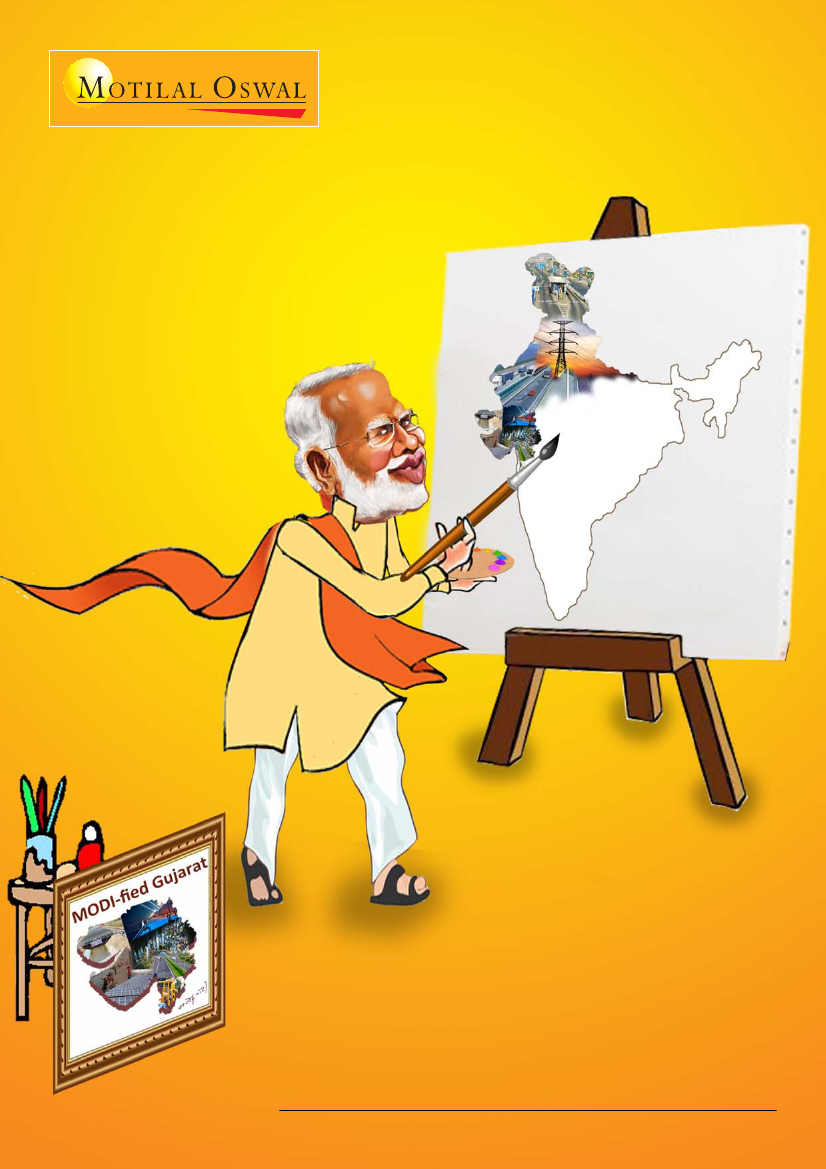
INDIA MODI-fied – Volume 1; Gujarat under Mr Modi and what we can infer for India
The Narendra Modi-led government has assumed charge, with a historic mandate after three decades of coalition politics.
Voters seem to have delivered a decisive judgment in favor of resetting India on a path of development. The first signs
emanating point to the new government’s keenness to spend this political capital on making good the promises made,
especially in the areas of infrastructure development, urbanization and agriculture, and in addressing issues related to
investment climate and sectoral bottlenecks. It has also indicated continuance of some of the focus areas of the erstwhile
government, albeit in a modified form, to ensure that the process of change is non-disruptive.
Given the nature of the mandate, the emerging structure of governance and centrality of the role played, it would not be an
exaggeration to term this a MODI-fied era. It is pertinent to look back at this juncture at the track record of the person on
whom India has placed upmost faith. In Volume-I of our “INDIA MODI-fied” series, we track the man, his personal journey so
far, his notable achievements as Chief Minister of Gujarat, both on hard economic parameters as well as in ushering landmark
projects, which have become examples for other states to follow. We have also appended our Gujarat visit notes of 2011,
highlighting the Gujarat story, which has subsequently only grown bigger, raising his stature in the Indian political scene.
Contents
Page No.
1. MODI MYTH-OLOGY
...............................................................................................................................
3
2. Gujarat MODI-fied
..................................................................................................................................
4
3. Ten showcase projects of Gujarat under Modi
...................................................................................
10
4. The Upsurge of Narendra Modi
............................................................................................................
17
5. Annexure-I: Council of Ministers........................................................................................................... 20
6. Annexure-II: Gujarat – a profile, 2011
..................................................................................................
25
Investors are advised to refer through disclosures made at the end of the Research Report.
Dipankar Mitra
(Dipankar.Mitra@MotilalOswal.com); +91 22 3982 5405
Ashish Gupta
(Ashish.Gupta@MotilalOswal.com); +91 22 3982 5544
5 June 2014
2

India Politics | INDIA MODI-fied Vol 1
1 MODI MYTH-OLOGY
Busting some myths through recent Gujarat visit
Please refer to our
comprehensive report
dated September 2011,
containing takeaways
from our Gujarat visit
We visited Gujarat recently to gauge the impressions of key bureaucrats who have
worked with Mr Modi on his much discussed functioning style. It turns out that
many of the impressions (or myths) need correction. We highlight five of these
below.
Myth #1: Narendra Modi prefers to dictate than consult
The bureaucrats we met vouched, “He is misunderstood”. Mr Modi listens to both
concrete ideas and concrete objections. He does not dictate but selects after careful
consideration. For instance, when presented with 10 options for BRT design, he
worked through the night to suggest 10 more.
Myth #2: Narendra Modi would bypass other Ministries and work with
Secretaries
This was strongly contested by the people we spoke with, as something neither
feasible nor likely. The fact that Mr Modi is no longer dependent on the center itself
would make things somewhat easier for him. However, the Ministries would remain
the key decision making units. Yet, Mr Modi is number-1 among equals.
Myth #3: Narendra Modi runs the government through a coterie
The stern message from the bureaucrats we met was, “It is not possible to hobnob
with him”. He meets officials or visitors only with a purpose. That is not the same as
being inaccessible. Mr Modi creates a team by subsuming people with the bigger
vision that he has. And like a good leader, he stands by his bureaucracy for bonafide
mistakes.
Myth #4: Narendra Modi is tilted towards discretion than rules
Among the first things Mr Modi did in Gujarat was to put in place policies related to
every sector, reducing the scope for discretionary action. For example, Gujarat set
up software (a power exchange) to buy power from all producers, thus leaving no
scope even for the Chief Minister to make discretionary power purchases from any
player.
Myth #5: Narendra Modi chases only big ideas
The bureaucrats we met in Gujarat believe Mr Modi is more pragmatic than
idealistic in his decision making. His choice to opt for BRT with a cost of only INR9b
compared to the INR300b metro project for Ahmedabad highlights one such
instance where exigencies of the day were accorded priority over the ideal long-
term solution for city transport. It was conceptualised in the early 2000s, when
Gujarat was facing challenges on multiple fronts and the government had to apply
its limited resources to create situations for an upturn. It is another matter that with
time, the small initiative has turned into a big success, to be replicated in other cities
of India.
5 June 2014
3

India Politics | INDIA MODI-fied Vol 1
2 Gujarat MODI-fied
Gujarat under Mr Modi scores on core economic parameters
Gujarat under Mr Narendra Modi accelerated its journey towards an industrial and
modern economy. All three sectors – agriculture, industry and services – grew faster
than India. Growth in Gujarat during the slowdown period equaled that of India during
the boom period.
Key to this success was industrial performance that was able to absorb surplus labor
from agriculture, in sharp contrast to the all-India stagnation in industrial
employment. At the heart of its industrial success lie efforts to improve the business
climate culminating into the “Vibrant Gujarat” summit every second year.
Modi’s Gujarat: Faster and stable growth through industrialization
There is a clear break in Gujarat’s growth path post-Modi. While GDP growth
was nearly equal to the all-India level during the eight year period before Mr
Modi assumed office, it jumped to double-digit level during his tenure, a lead of
2.5% over the all-India growth.
More significantly, Gujarat growth was higher in respect of all three sectors
agriculture, industry and services.
Agriculture growth increased somewhat during Mr Modi’s
reign, in contrast to stagnant all-India growth
Gujarat
5.8
7.5
India
6.3
GDP growth jumped to double-digit levels during Mr Modi’s
reign, accelerating well past all-India growth
Gujarat
India
10.0
6.4
6.3
3.3
3.1
Before Modi (FY95-FY02)
During Modi (FY03-FY13)
Before Modi (FY95-FY02)
During Modi (FY03-FY13)
Source: Government, MOSL
Industrialization received a big push during Mr Modi’s reign,
with double-digit growth, similar to services sector growth
Gujarat
India
10.6
7.8
6.5
6.2
Services sector growth accelerated further during Mr Modi’s
tenure from an already high level
Gujarat
India
11.0
8.9
8.0
8.0
Before Modi (FY95-FY02)
During Modi (FY03-FY13)
Before Modi (FY95-FY02)
During Modi (FY03-FY13)
Source: Government, MOSL
5 June 2014
4

India Politics | INDIA MODI-fied Vol 1
Agricultural growth accelerated to 6.3% in Gujarat under Mr Modi as compared
with 5.8% during the period before him. In contrast, agricultural growth at the
all-India level decelerated to 3.1% from 3.3% over the same period.
However, it is industrial growth, where Mr Modi’s Gujarat took a leap forward.
Industrial growth jumped to 10.6% from 6.5% earlier in Gujarat as compared
with 6.2%, quickening to 7.8% at the all-India level.
Again, in services, while pre-Modi growth rate at 8% equaled that of all-India, it
jumped to 11% as compared with 8.9% for India during Mr Modi’s regime.
Strikingly, growth during Mr Modi’s stint was not only higher than all India but it
was also more stable, especially during the slowdown phase.
Illustratively, growth rate during the slowdown phase in Gujarat equaled that
during the boom phase at the all-India level.
Key to such growth resilience was the industrial sector, which continued to grow
a high rate of 8.3% during the slowdown phase. More so, services sector growth
in Gujarat at 11.3% during the slowdown phase equaled that during the boom
period, in contrast to the deceleration seen at the all-India level.
Growth during slowdown phase in Gujarat was equivalent to
boom period at the all-India level
Gujarat
11.6
8.7
8.7
6.7
India
Gujarat growth has been higher and more stable during
slowdown phase
15
10
5
0
Gujarat (Avg: 9.7%)
India (Avg: 7.2%)
India (Avg: 8%)
Boom period (FY04-FY08)
Slowdown phase (FY09-FY14)
Source: Government, MOSL
Growth and structural transformation of the economy
The higher growth in industry and services were successful in providing a fillip to
the structural transformation of the Gujarat economy.
The share of industry in Gujarat’s economy increased to 39% from 37% during
the period under Mr Modi while it remained nearly constant at 27% at the all-
India level during the same period.
The share of services too increased to 50% from 45% during the same period.
While the share of services had grown to still higher level of 59% from 51% at
the all-India level, this was more reflective of lagging performance of agriculture
and industry at the all-India level.
As a further proof of undergoing structural transformation in the Gujarat
economy, the share of employment in the industry and services sector increased
at a faster rate than the all-India level. This enabled faster absorption of labor
released from agriculture in Gujarat.
Higher employment opportunities also resulted in much lower unemployment
rate in Gujarat than at the all-India level.
5 June 2014
5

India Politics | INDIA MODI-fied Vol 1
During Mr Modi's regime, the share of industry increased as
opposed to stagnant share at the all-India level
FY94
FY13 (Modi's last year of office)
39
37
36
FY02 (Modi assumes office)
Services sector share increased too, but to a lesser extent
than the all-India level
FY94
FY13 (Modi's last year of office)
45
50
FY02 (Modi assumes office)
59
45
51
27
27
27
39
Gujarat
India
Gujarat
India
Source: Government, MOSL
During Mr Modi's regime, the share of industrial and services Industrial development paved the way for lower
sector employment increased at sharper rate
unemployment in Gujarat
62
49
18
26
20 25
FY05
58
FY12
49
18
24
24 27
2.4
4.4
3.2
2.7
Gujarat
5.7
4.7
All India
Gujarat
India
Rural
Urban
Overall
Source: Government, MOSL
Economic stability indicators in Gujarat equal those of other states
Gujarat under Mr Modi has broadly followed the path of fiscal prudence, just
like other states. Both the revenue deficit and fiscal deficit path of Gujarat under
Mr Modi were similar to other states. This has also led to its outstanding
liabilities declining in consonance with other states.
The poverty ratio too declined in Gujarat in similar measure as the rest of India.
Poverty dropped by 15% in Gujarat from 32% in FY05 to 17% in FY12. At the all-
India level too, poverty ratio declined 15% from 37% to 22%.
Recent CPI inflation trend shows that Gujarat has seen similar extent of inflation
as across India, though urban inflation was a notch lower in Gujarat.
5 June 2014
6

India Politics | INDIA MODI-fied Vol 1
Gujarat followed fiscal discipline like most states (% of GSDP)
Gujarat RD/GSDP
All States RD/GSDP
Gujarat GFD/GSDP
All States GFD/GSDP
This has resulted in its outstanding debt coming down (% of GSDP)
Gujarat
40
35
30
25
20
All-States
10
5
0
-5
-10
Source: Government, MOSL
Decline in poverty ratio in Gujarat is similar to that witnessed Recent inflation trend (CPI index) is a notch lower in Gujarat
at the all-India level
than all-India
FY05
31.6
21.9
16.6
135
FY12
37.2
142
141
137
138
139
Gujarat
All-India
Gujarat
All-India
Rural
Urban
Source: Government, MOSL
Combined
Source: Government, MOSL
Improving business climate and showcasing ‘Vibrant Gujarat’
“Once
upon a time,
Gujarat was the gateway to
the Globe from India. Now
it is becoming the Global
Gateway to India.”
- Narendra Modi
From the above analysis, it would be apparent that the real differentiator of the
Gujarat story under Mr Modi is industrial growth combined with service sector
rejuvenation.
Various initiatives during the period under Mr Modi can be credited with an
improvement in investment climate.
In a recent study conducted by Deloitte under the aegis of Planning Commission,
Gujarat scores high on most parameters of doing business in India.
Specifically, it was on top in terms of ‘finance, tax and regulatory’ issues as well
as ‘other business regulatory’ compliances, including e-governance related
initiatives. However, contrary to wider perceptions, the approvals related to
labor and environment were listed as areas of improvement.
The flagship investors' summit,
Vibrant Gujarat,
conceived to provide a platform
to showcase investment opportunities, government policy initiatives and
investment climate, is held once in every two years, with six such events already
held. The event has also catapulted itself into an ideal platform for other states
and other countries to showcase their strengths, highlight business
opportunities and facilitate knowledge dissemination.
5 June 2014
7

India Politics | INDIA MODI-fied Vol 1
Gujarat ranked among first three in business environment
Source: Planning Commission, MOSL
5 June 2014
8

India Politics | INDIA MODI-fied Vol 1
Gujarat ahead in most indicators of doing business
Source: Planning Commission, MOSL
Gujarat ranked among first three in business environment
Source: Government of Gujarat, MOSL
5 June 2014
9

India Politics | INDIA MODI-fied Vol 1
3 Ten showcase projects of Gujarat under Modi
Creating success stories is an important part of mobilizing opinion and effort in the
direction of development. Under the leadership of Mr Narendra Modi, Gujarat has
pioneered many landmark projects that have subsequently become examples for other
states to emulate. We highlight ten such projects that have changed the face of Gujarat
over the decade. Importantly, a few of them, while initiated by the previous government,
saw their logical end during Mr Modi’s tenure.
1. Interlinking of rivers
Gujarat has only 2% of India’s available surface water, whereas it covers 5% of
its population. Besides, the rainfall patterns in various regions of the state are
uneven and erratic.
Around 71% Gujarat’s land area is water deficit, while 29% area of South and
Central Gujarat has surplus water. The National Water Policy (year 2002)
emphasized that water should be made available to water-deficit areas by
transfer from other areas having surplus water.
Inter-basin transfer of water from Narmada main canal to 11 en-route rivers has
been completed. Besides, under Sujalam Sufalam Scheme, overflowing flood
water from the Kadana dam is being diverted to Panchmahals and the North
Gujarat region.
River basins of Gujarat
Sardar Sarovar Project
Source: Media, MOSL
Source: Media, MOSL
2. Jyotigram Yojana
Jyotigram Yojana was an initiative to ensure availability of 24-hour three-phase
quality power supply to rural areas of the state and to supply power to farmers
residing in scattered farm houses through feeders having specially designed
transformers.
Under the scheme, (a) 1,847 feeders have been constructed, (b) 56,307km of HT
line and 22,146km of LT line have been laid, (c) 18,724 new transformer centers
have been built, and (d) 1.7m poles have been erected.
5 June 2014
10

India Politics | INDIA MODI-fied Vol 1
Stockholm International Water Institute (SIWI) has commended the scheme,
saying that it has radically improved the quality of village life, spurred non-farm
economic enterprises, and halved the power subsidy in agriculture.
Source: Media, MOSL
Source: Media, MOSL
3. Roads
Road density in the state stands at 146km per 0.1m of population, higher than
the all-India average of 126km per 0.1m of population.
Special emphasis was laid on 4 and 6-lane roads that have grown by more than
two and half times from only 394km in 2001 to 1,432km in 2013. Priority was
also accorded to connect the tourism circuits as also villages for providing
market access to farmers.
Roads of Gujarat are considered to be close to international standards as per
World Bank. Besides, a recent report by Independent Evaluation Group (IRG) of
World Bank said that Gujarat state highways’ International Roughness Index (IRI
– the commonly used method worldwide for evaluating quality of road) is better
than the internationally desirable level.
Source: Media, MOSL
Source: Media, MOSL
5 June 2014
11

India Politics | INDIA MODI-fied Vol 1
4. Gas grid
Gujarat has the longest gas pipe network in India. It is the only state in the
country where the gas pipeline network is being operated by more than one
player, namely, GAIL (India) Limited (GAIL), Gujarat State Petronet Limited
(GSPL) and Gujarat Gas Company Limited (GGCL).
GSPL acts as a nodal agency and is mandated to to set pipeline network of
around 3,000km in Gujarat. It currently operates a 1,550km pipeline network (a
further 350km is under construction/development), serving consumers in the
Hazira, Vapi, Halol, Bharuch, Vadodara, Ahmedabad, Morbi, Rajkot, Jamnagar,
Mehsana, Himmatnagar and Kutch regions.
Source: Media, MOSL
Source: Media, MOSL
5. Dholera Industrial Region
Seizing the opportunity thrown up by the Dedicated Freight Corridor and as part
of the plan to develop the Delhi-Mumbai Industrial Corridor, Dholera Special
Investment Region is one of the first attempts to build a self-governed global
manufacturing and trading hub of this scale.
The objective of the scheme was to focus towards creating an enabling
environment to protect local industries, enhance investment climate, improve
quality of life, upgrade human skills, create world class infrastructure and attract
global investment.
The project, with a total area of 920 square kilometers (of which 567 square
kilometers is developable), would comprise of a high-access corridor, world class
infrastructure and connectivity, proximity to airport, sea port, major cities and
other investment regions and smart cities.
5 June 2014
12

India Politics | INDIA MODI-fied Vol 1
Source: Media, MOSL
Source: Media, MOSL
6. Solar power
During 2012, Gujarat commissioned a unique 1MW grid-connected canal-top
solar power plant. This was an engineering innovation, as it serves three
purposes: (1) generation of clean energy, (2) reducing 90,000 litres of water
evaporation per year from the canal, and (3) avoiding use of precious land for
the solar power plant.
Gujarat Solar Park is another initiative where a group of solar parks is being
constructed, making Gujarat Asia's largest solar park hub, with 84 developers
registered to build a total of 968.5MW.
Gujarat has also put in place policies related to most sources of sustainable
energy.
Source: Media, MOSL
Source: Media, MOSL
5 June 2014
13

India Politics | INDIA MODI-fied Vol 1
7. GIFT city
With India’s service sector offering enormous potential for growth and the need
to provide high quality physical infrastructure to attract tech and finance firms,
Gujarat International Finance Tec-City is an underconstruction central business
district between Ahmedabad and Gandhinagar.
It will be built on 986 acres (3.99 square kilometers) of land and will have a
special economic zone (SEZ), international education zone, integrated
townships, an entertainment zone, hotels, a convention center, an international
techno park, Software Technology Parks of India (STPI) units, shopping malls,
stock exchanges and service units.
Source: Media, MOSL
Source: Media, MOSL
8. BRTS
While Pune was India’s first city to adopt BRTS and BRTS is currently at different
stages of implementation at 22 cities, it is the Ahmedabad BRTS that has been
widely held as hugely successful.
Starting in October 2009, Ahmedabad BRTS covers 75km (19km under
construction), with 12 lines and 126 stations.
Ahmedabad BRTS was showcased at 2012 United Nations Climate Change
Conference as a 'lighthouse project' as part of the United Nations Secretary
General Ban Ki-moon's Momentum for Change Initiative.
Ahmedabad BRTS would be linked with upcoming Metrolink Express for
Gandhinagar and Ahmedabad (MEGA), which is the proposed mass-transit rail
system for the cities of Ahmedabad and Gandhinagar.
5 June 2014
14

India Politics | INDIA MODI-fied Vol 1
Source: Media, MOSL
Source: Media, MOSL
9. Sabarmati riverfront
The Sabarmati Riverfront Development Project is an initiative to develop the
Sabarmati riverfront in the city of Ahmedabad.
In the first phase, a 20km stretch (around 10km already operational) is to be
developed along with reclamation of 162 hectares (400 acres) of the riverbed.
The project includes walkway development, road development along the river,
promenades, garden, construction of 4,000 houses under slum rehabilitation,
amusement parks, golf courses, water sports park, and construction of Kotarpur
Weir.
Source: Media, MOSL
Source: Media, MOSL
E-governance
A recipient of many awards, the Government of Gujarat has initiated many e-
governance projects aimed at enhancing transparency, efficiency and outreach.
Important initiatives in this regard include SWAGAT (direct grievance redressal
in the presence of Chief Minister), Vishvagram (connecting 13,695 gram
panchayats and 6,000 citizen common service centers, e-Dhara
(computerization of land records), Hospital Management Information System, E-
city (for delivery of municipal services like birth and death registration, building
plans, primary health and education, city cleanliness, water supply, sewage,
roads, street lights, parks and gardens), Integrated Workflow and Document
Management System (IWDMS; for automating government functions and
15
5 June 2014

India Politics | INDIA MODI-fied Vol 1
processes at all levels of the administrative hierarchy), E-Procurement (for all
purchases
and
procurements
in
all
government
departments,
boards/corporations and societies), and indeed, many more.
Source: Media, MOSL
Source: Media, MOSL
Source: Media, MOSL
5 June 2014
16

India Politics | INDIA MODI-fied Vol 1
4 The Upsurge of Narendra Modi
Nationalist, service-oriented mindset, diligent, avid reader
Our ideology is that the
Nation is bigger than party.
We will live and die for the
nation. Our ideology is not
about aspiring for posts, it’s
based of sacrifice –
Narendra Modi
Mr. Narendra Modi (17 Sept 1950), son of Mr. Damodardas Mulchand Modi, is the
Prime Minister of India and four-time chief minister of Gujarat. He has been a
member of Rastriya Swayamsevak Sangh (RSS) since his childhood and came into
politics in his adolescence.
Adolescence:
Narendra Modi completed his schooling in Vadnagar. He has done his
Masters in Political Science from Gujarat University. Mr. Modi was a Pracharak
(campaigner) in the RSS during his university years. As a young man, he joined the
Akhil Bhara tiya Vidyarthi Parishad, a student organisation and was involved in the
anti-corruption Nav Nirman ("Reconstruction") Movement.
Seeds of a leader:
He took up the challenging task of energizing the party cadres in
right earnest. In partnership with Shankersingh Vaghela, Mr. Modi set about
creating a strong cadre base in Gujarat. In the initial period, Mr. Vaghela was seen as
a mass leader, while Narendra Modi was recognised as a master strategist.
Narendra Modi used to write a diary but burnt the pages every 6-8 months. One day
a Pracharak saw him doing that and urged him against it; those papers took form of
‘Sakshibhaav’ (in Gujarati), a collection of thoughts of a 36-year-old Narendra Modi.
Man with the Midas touch:
In 2004-05, Kanya Kelavani and Shala Praveshotsav was
initiated with the aim to increase school enrolment, especially among girl students.
In 2006, Annual Krishi Mahotsav kicks-off. These Mahotsavs have revolutionized
agriculture across Gujarat, giving farmers cutting-edge technology, proper guidance
and resources at their doorstep. In 2009, E-Gram, Vishwa Gram Yojana was
launched with the long-term vision to take technology to every corner of Gujarat.
On Oct 31, 2013, the foundation stone for ‘Statue of Unity’ was laid by LK Advani
and Narendra Modi. The ‘Statue of Unity’ will be the world’s largest statue and a
tribute to the Iron Man of India, Sardar Vallabhbhai Patel.
He is known to be a workaholic Chief Minister and an introvert. He is a crowd puller
as a speaker.
Yoga is India’s gift to
humankind through which
we can reach out to the
entire world. Yoga is not
only about Rog Mukti but
also about Bhog Mukti
Narendra Modi … a writer and poet
Narendra Modi is a passionate writer, poet and a lover of culture. Despite his
busy, often punishing schedule, he devotes time for Yoga, writing, interacting
with people on social media etc.
He has been writing since he was young. Apart from penning numerous articles,
poems and essays, he has also authored several books on myriad topics such as
education, nature and his experiences. Mr Modi is a powerful orator, an avid
reader and an original thinker.
5 June 2014
17

India Politics | INDIA MODI-fied Vol 1
Narendra Modi over the ages
1950
1970
1990
2014
Diligent student
and teenager
RSS calling … NaMo
the organiser
Rise of NaMo:
The leader
Narendra Modi (63) was born
on
Sept 17, 1950
in the by-
lanes of Vadnagar, a small
town in North Gujarat’s
Mehsana district.
Third of the sixth children of
Damodardas Modi and
Hiraba Modi.
Penchant for debating and
reading in school days. He
would spend hours reading
in the school library.
Had a wide range of friends
from all the communities.
Developed an inclination
towards renunciation and
asceticism from a young age.
He gave up eating salt,
chilies, oil and jaggery.
1967
- At the age of 17,
made an extraordinary
decision to leave home and
travel across India.
Among the places that he
traveled included the
Himalayas (where he stayed
at Garudachatti), Ramkrishna
Ashram in West Bengal and
even the Northeast.
One word that characterized
Narendra Modi and is with
him for the rest of his life is
‘Service’.
In
1972,
he became a
Pracharak, giving his full time
to the RSS.
He was at the core of the
anti-emergency movement
in
1975.
He became the
General Secretary of the
Gujarat Lok Sangharsh Samiti
(GLSS), which was formed to
resist tyranny. His primary
role was to coordinate
between the activists across
the state.
Around 1980,
Narendra
Modi was made the
‘Sambhag Pracharak’
(equivalent of a regional
organiser) as an appreciation
of his activism and
organisational work.
He became the General
Secretary in Gujarat BJP in
1987
and was the force
behind organising the Nyay
Yatra in
1987
and Lok Shakti
Yatra in
1989.
Both these
Yatras became a focal point
in the quest for justice for
the people of Gujarat, under
a repressive and corrupt
Congress regime.
In
1990,
Modi facilitated the
first stretch of the Somnath-
Ayodhya yatra undertaken by
LK Advani.
In
1995,
Narendra Modi was
in Delhi, working as the
National Secretary of BJP of
five major states in India – a
rare distinction.
Gujarat, at the same time,
was facing successive natural
calamities that combined
with poor relief work
alienated people from BJP.
It was in these trying times
that he was asked to become
Chief Minister of Gujarat in
Oct 2001.
Post Godhra fiasco, assembly
was dissolved and elections
were announced in 2002.
Narendra Modi campaigned
hard but unlike earlier times,
he was the face of the
campaign – a strategy he
adopted again during Lok
Sabha elections. The result
was a spectacular win for BJP
in
2002
with 127 seats.
In 2012, Narendra Modi
leads BJP to yet another
victory and becomes CM for
the fourth time.
On
Sep 13, 2013,
Narendra
Modi was named NDA’s
Prime Ministerial candidate
and sworn as PM on
May 26,
2014
with overwhelming
majority.
5 June 2014
18

India Politics | INDIA MODI-fied Vol 1
Quote Shoot
On 16th May 2014 the people of India gave
their verdict. They delivered a mandate for development,
good governance and stability. As we devote ourselves to
take India's development journey to newer heights, we seek
your support, blessings and active participation. Together we
will script a glorious future for India. Let us together dream
of a strong, developed and inclusive India that actively
engages with the global community to strengthen
the cause of world peace and development
Narendra Modi
PM Narendra Modi has chosen an energetic,
promising team that has the potential to fulfil
the aspirations of our people and change the
fortune of our country
Kumar Mangalam Birla | CHAIRMAN, ADITYA
BIRLA GROUP
"We have decided to provide
automatic exchange of tax
information with India."
Mauritius Prime Minister Navin
Ramgoolam
The key positions, as expected, are with Arun Jaitley,
Rajnath Singh and Nitin Gadkari. Both transport and
shipping are with the same minister and so are power
and coal. I think this is an excellent idea and will
improve coordination as the power ministry cannot
blame the coal ministry and vice versa
Deepak Parekh | Chairman, HDFC
The eclectic mix gathered at the
swearing-in ceremony was a
wonderful tribute to the diversity of the
subcontinent. Team Modi definitely has
one of the finest talent mix ever.
Harsh Goenka
Chairman, RPG Group
"Your victory rewards your tireless
commitment to serving the people of India. It
recognises your inspirational qualities of
leadership and represents the hopes and
aspirations of the Indian polity,"
Mahinda Rajapaksa,
Sri Lankan Prime Minister
Both governments have a strong mandate.
This could help in turning a new page in our
relations…I stressed to Prime Minister Modi that
we have a common agenda of development and
economic revival, which is not possible to achieve
without peace and stability in the region,
Nawaz Sharif on India-Pak relations
in the Modi era
We need expeditious action on pending
reforms. Nothing is more energizing than the
govt showing a commitment to act. Labour & land
reforms would bring back investor confidence.
– Pawan Munjal, MD & CEO,
Hero MotoCorp
5 June 2014
Source: Various media articles
19

India Politics | INDIA MODI-fied Vol 1
5. Annexure-I: Council of Ministers
Sr.
No.
1.
Name of the
minister (Age)
Rajnath Singh (63)
Portfolio
Ministry
Affairs
of
Home
Brief background
Associated with the Rashtriya Swayamsevak Sangh (RSS) since the age of
13 years
Served as Cabinet Minister, Surface Transport in 1999 and also held
Agriculture & Food Processing ministries from May 2003 till May, 2004
Appointed as the BJP President in 2013
Implemented the National Highway Development Programme (NHDP),
which included the Golden Quadrilateral and the North South East West
corridor
Introduced projects like Farm Income Insurance Scheme and Kisan Call
Centre and also brought down the rate of interest on agricultural loans
from 14-18% to 8%
2.
Arun Jaitley (62)
Ministry of Finance;
Ministry of Corporate
Affairs & Ministry of
Defence
Rajya Sabha member from Gujarat and elected as Leader of the
opposition in Rajya Sabha in June 2009
Appointed Minister of State for Information and Broadcasting
(Independent Charge) in Oct 1999
Also appointed Minister of State for Disinvestment (Independent
Charge), a new Ministry created for the first time. Additional charge of
the Ministry of Law, Justice and Company Affairs in July 2000 following
the resignation of Ram Jethmalani.
3.
Sushma Swaraj (62)
Ministry
Affairs
;
of
External
of
Served as Union Cabinet Minister, Information & Broadcasting during
various BJP-led governments at the Centre in 1996, 1998 and 1999-04
Appointed as Union Minister of Health and Family Welfare and
Parliamentary Affairs from Jan 2003 till May 2004
Declared production and distribution of films as an industry, which
made them eligible for finance from financial institutions
As Health Minister, set up six AIIMS (All India Institute of Medical
Sciences) at Bhopal (MP), Bhubaneshwar (Odisha), Jodhpur (Rajasthan),
Patna (Bihar), Raipur (Chhattisgarh) and Rishikesh (Uttarakhand).
4.
Venkaiah Naidu (64)
Ministry
of
Urban
Bachelor’s Degree in Politics & Law with specialization in International
Law
National President of the BJP from 2002 to 2004
Union Cabinet Minister for Rural Development in the Vajpayee
government
Aggressively pushed for reforms in Rural development and introduced
many schemes such as the ‘Pradhan Mantri Gram Sadak Yojana’
Development; Ministry
of Housing and Urban
Poverty Alleviation and
Ministry
Parliamentary Affairs
of
Ministry
Overseas Indian Affairs
5 June 2014
20

India Politics | INDIA MODI-fied Vol 1
5.
Nitin Gadkari (57)
Ministry of Road
Transport and
Highways; Ministry of
Shipping
Ministry of Rural
Development; Ministry
of Panchayati Raj and
Ministry of Drinking
Water and Sanitation
Promoted to National President of BJP in 2010, holding the position till
2013
Has never held a Union ministerial portfolio but has served as Minister
for Public Works in the BJP-Shiv Sena government in Maharashtra
Widely credited with the inception and swift execution of major road
projects like the Mumbai-Pune expressway
Established Maharashtra State Road Development Corporation (MSRDC)
through which funds were raised from open market for infrastructure
projects for the first time in India
Showed strong support for privatization in the infrastructure areas and
pioneered the Public Private Partnership (PPP) model of infrastructure
projects
6.
Harsh Vardhan (59)
Ministry of Health and
Family Welfare
An MBBS and MS in otolaryngology from Kanpur college
Pioneer of Pulse Polio Programme, which he launched first in Delhi in
1993, which was then adopted throughout India
Has won all 5 Delhi Legislative Assembly elections since 1993
Former Union Railway Minister in 1996
Union Minister for Communications in NDA government from 1999 till
2001, following which he was shifted to the Coal Ministry, a portfolio he
held till April, 2002
7.
Ram Vilas Paswan
(67)
Ministry of Consumer
Affairs, Food and
Public Distribution
Minister for Chemicals and Fertilizers and Minister of Steel in the first
Congress-led UPA government
8.
Uma Bharati (55)
Ministry of Water
Resources, River
Development and
Ganga Rejuvenation
Held various state-level and cabinet level portfolios of Human Resource
Development, Tourism, Youth Affairs & Sports, and finally Coal & Mines
in the BJP-led NDA government from 1999 till 2003
9.
Maneka Gandhi (57)
Ministry of Women
and Child Development
Became India’s youngest minister in the Janata Dal government holding
the Ministry of Environment & Forests in two successive governments
Introduced legislations such as Coastal Zone Regulation Act and The
Public Liability Act for Hazardous Chemicals
Served as Minister for Social Justice and Empowerment in 1999-2004
Instrumental in creating India’s Animal Welfare Ministry - a first in the
world, and serving as its first Minister
Also served as Minister for Culture and Minister for Programme
Implementation
5 June 2014
21

India Politics | INDIA MODI-fied Vol 1
10.
Sadananda Gowda
(61)
Ministry of Railways
Appointed as Chief Minister of Karnataka in August 2011
Introduced various schemes such as Sakaala, aimed at providing time
bound services at government offices
11.
Najma Hepatullah
(74)
Ministry of Minority
Affairs
Grand niece of prominent freedom fighter Maulana Abdul Kalam Azad
Deputy Chairperson of the Rajya Sabha twice- January, 1985 to January,
1986 and 1998 to 2004
Joined BJP in 2004 and was named as head of the Indian Council of
Cultural Affairs, leading many Indian delegations abroad
12.
Kalraj Mishra (73)
Ministry of Micro,
Small and Medium
Enterprises
As Minister of Public Works and Tourism, he formulated the Road
Development Policy in Uttar Pradesh
Several link roads were constructed in a number of villages under the
Dindayal Link Road Scheme’
13.
Anant Kumar (54)
Ministry of Chemicals
and Fertilizers
Won six consecutive Lok Sabha terms from the Bangalore South
constituency
Served as Minister of Civil Aviation, Tourism, Sports & Youth Affairs,
Culture, Urban Development and Poverty Alleviation during the NDA
government from 1999 to 2004
14.
Ravi Shankar Prasad
(59)
Ministry of
Communications and
Information
Technology; Ministry
of Law and Justice
Earned BA Hons, MA (Political Science) and LLB degrees from Patna
University and practiced as a Patna High Court and Supreme Court
advocate
Served as Minister of State (Coal and Mines) in 2001 and accelerated
the reforms process in mining and coal sector
Was given additional charge of Minister of State in Ministry of Law and
Justice in July 2002. Within a fortnight had prepared a bill amending the
Representation of People Act.
15.
Ashok Gajapathi
Raju (63)
Ministry of Civil
Aviation
Sped up the process of fast-track courts
Comes from Pusapati Royal family
Held the Excise Minister and Commercial Taxes and the Finance and
Legislative and the Revenue ministries in the Andhra Pradesh
government
16.
Anant Geete (62)
Ministry of Heavy
Industries and Public
Enterprises
MP from Maharashtra's Raigad
Served as former union minister of power in the previous NDA
government from Aug 2002 to May 2004
Also Chairman of the Committee on Chemicals and Fertilizers and
Member of Committee on Petitions in 2004
5 June 2014
22

India Politics | INDIA MODI-fied Vol 1
17.
Harsimrat Kaur
Badal (47)
Ministry of Food
Processing Industries
Married to the Deputy Chief Minister of Punjab, Sukhbir Singh Badal
Started a project named "Nanhi Chhan" (innocent lives), a movement to
save girl child and trees
18.
Narendra S Tomar
(57)
Ministry of Mines;
Ministry of Steel and
Ministry of Labour and
Employment
Two-time MP Served as Cabinet Minister in Madhya Pradesh
government between 2003-07 and was later tasked to head the state
party unit in November 2006
19.
Jual Oram (53)
Ministry of Tribal
Affairs
Worked for about six years in a public sector company with his diploma
in electrical engineering before joining politics
A firebrand tribal leader who created history by becoming India's first
tribal affairs minister in Vajpayee government
Presently national vice-president of BJP; has held several important
posts including MLA and MP
A five-term MP from Motihari, Bihar since 1989
Bihar unit chief from 2006 to 2009 and BJP's Kisan Morcha Vice-
President and incharge of Uttar Pradesh and Uttarkhand units
Served as member of various committees on ministries of Railways,
Communications, Petroleum and Natural Gas, Surface Transport and
External Affairs
20.
Radha Mohan Singh
(64)
Ministry of Agriculture
21.
Thawar Chand
Ghelot (66)
Ministry of Social
Justice and
Empowerment
Rajya Sabha member and BJP’s national general secretary
Has held several positions in Madhya Pradesh and was also head of
BJP’s Scheduled Castes Cell
Deputed as the central observer of the party for Gujarat and is
considered close to Modi
22.
Smriti Irani (38)
Ministry of Human
Resource Department
Popular television actress till the mid-2000s before she shifted her focus
to politics
Served as All India President of the BJP Mahila Morcha and raised
various issues like women empowerment in Indian Military and crime
against women
NA: Not available; Source: Various media reports, MOSL
5 June 2014
23

India Politics | INDIA MODI-fied Vol 1
Minister of States (MoS) (Independent charge)
Name of the minister
Portfolio
(Age)
Dharmendra Pradhan
MoS (Ind charge) of
(44)
Petroleum and Natural Gas
Brief background
A post graduate in Anthropology from Utkal University in Odisha
Rajya Sabha MP from Bihar
A vocal opponent of religion based reservation in jobs
Organisational in-charge of party affairs in the states of Karnataka, Uttarakhand,
Jharkhand and Odisha
Prakash Javadekar (63)
MoS (Ind charge) of
Information and Broadcasting;
MoS (Ind charge) of
Environment, Forest and
Climate
Change and MoS of
Parliamentary
Affairs
Nirmala Sitharaman (54)
MoS (Ind charge) of
Commerce and Industry; MoS
of Finance and Corporate
Affairs
Was a member of the Maharashtra Legislative Council for two terms from 1990
to 2002 before being elected to Rajya Sabha in 2008
Former banker; has been awarded “Sir Purshottam Das Thakur Memorial"
National Award, for research papers on ‘Rural Development & Banks role in co-
ordinated approach’
Works as part of a team of six spokespersons headed by Ravi Shankar Prasad
Likely to be nominated to the Upper House by BJP
Former member of National Commission for Women
Piyush Goyal (49)
MoS (Ind charge) of Power;
MoS (Ind charge) of Coal and
MoS (Ind charge) of New and
Renewable Energy
Strong academic record with all-India second rank holder Chartered Accountant
and second rank holder in Law in Mumbai University
Participated in Leadership Programs at Yale University (2011), Oxford University
(2012) and Princeton University (2013) and is currently pursuing the Owner /
President Management (OPM) Program at Harvard Business School
Well-known investment banker; advised top corporates on management
strategy and growth; also served on the Board of the State Bank of India and
Bank of Baroda.
Nominated by the Government of India to the prestigious Task Force for
Interlinking of Rivers.
Source: Various media reports, MOSL
5 June 2014
24

6. Annexure-II: Gujarat – a profile, 2011
the
26 September 2011
P
olicy
M
aker
Insights from bureaucrats
Gujarat: In full throttle on all fronts
Industrialization, Innovation, Inclusion
Recently, we visited Gujarat and interacted with several key policy
makers led by the state CEO himself, Chief Minister Mr Narendra Modi.
Starting off as a predominantly industrialized state, we believe Gujarat
has now laid the foundation for many years of balanced development.
Combined this with the Gujarati entrepreneurial spirit and you have a
formidable growth engine – a shining role model for 'India Shining'.
Special report: Gujarat
The Inside Story
Summary findings and assessment
...........................................................................................................
2
Chief Minister Speak
..............................................................................................................................
3-4
Industry:
Growth SIR-ge .......................................................................................................................
5-12
Agriculture:
Marrying the micro and the mega ......................................................................................
13-16
Services:
Eyeing the GIFT facelift .........................................................................................................
17-18
Annexure:
Gujarat state profile ............................................................................................................
20-21
Dipankar Mitra
(Dipankar.Mitra@MotilalOswal.com) +91 22 3982 5405

P
olicy
M
aker
Gujarat: In full throttle on all fronts
Industrialization, Innovation, Inclusion
Growing at 2-2.5% higher than all-India average with 20%
higher per capita income, Gujarat has chalked out a two-
pronged strategy for the next phase of its growth boom:
1) Capitalize on its existing strength of industry and
entrepreneurship; and
2) Achieve new breakthroughs in agriculture and services
sectors.
the
Services: Eyeing the GIFT facelift
IT and finance remained the only gap facing the state in
the gamut of the service sector activities. This is now being
corrected with the GIFT City initiative that is a globally
benchmarked international financial centre (IFC) which,
when completed, would be many a multiple of scale
compared to global peers.
Industry: Growth SIR-ge
Gujarat's successful industrialization drive owes a lot to:
(1) facilitating role played by the government by way of
simplified procedures, investment platforms such as
Vibrant Gujarat, etc, which helped in reduction in
transaction costs for business, and
(2) effective resolution of a key issues involving land, water,
environment and labour.
Now, Gujarat is poised to push the boundaries of industrial
development to higher orbit in different phases e.g.
SIR-ging scale:
Making the most of the Central sector
projects like Dedicated Freight Corridor (DFC) and Delhi
Mumbai Industrial Corridor (DMIC), Gujarat has now
have initiated planned industrial development of special
investment regions (SIR). One such SIR at Dholera is
planned to surpass Shenzhen China in its scale.
Energetic turnaround:
On the energy front, Gujarat
has scripted a remarkable turnaround story in SEB
(state electricity board) finance without major increase
in power tariff while at the same time ensuring 24x7
power supply to each village and town of Gujarat.
Our assessment: Industrialization,
Innovation, Inclusion
From industrialization by default …:
We see a
fascinating story in Gujarat. Inherent natural
disadvantage (of infertile land and lack of irrigation)
and advantage (of mines and ports) led to Gujarat
choosing an industrialization-based growth model
almost by default.
… to innovation by design …:
But then, it ushered
in several landmark innovations in diverse areas e.g.
establishment of a gas grid, interlinking of rivers,
industrial zoning and investment regions, push to PPP,
turnaround in the co-operative system, corporatization
of SHG model, cattle care to improve livestock,
promotion of clean energy, environmental regeneration,
etc.
… and inclusion by diligence:
And now, Gujarat is
increasing focus on various social indicators including
skill improvement of the workforce, women
empowerment, lower mortality rates, large scale
plantation, etc. While rapid growth helps address these
issues in part, efforts are needed to upscale the state's
flagship programs to a comprehensive framework of
social sector improvement.
Shining role model for 'India Shining':
Together
with the many initiatives of scale that only Gujarat can
possibly think now, the foundation is being laid for many
years of balanced development. Combined this with
the Gujarati entrepreneurial spirit and you have a
formidable growth engine - a shining role model for
'India Shining'.
Agriculture: Marrying the micro & the mega
Completion of the command area development of the
mega Sardar Sarovar project by FY15 would raise gross
irrigated area from 30% to 46% of gross cropped area.
Further, it would help reap 81% of the ultimate irrigation
potential (currently 53%) and nearly achieve full
potential (93% v/s 56% at present) so far as irrigation
through surface water is concerned.
This comes on top of a close to double digit growth for
nearly a decade on the back of cumulative efforts
towards micro irrigation, water conservation and soil
improvement.
26 September 2011
I
30

P
olicy
M
aker
Chief Minister Speak: Mr Narendra Modi
Tale of 3 B's: Business-like, Best practices, Balanced growth
the
Mr Narendra Modi
Chief Minister, Gujarat
Three biggest challenges while assuming office
(1) Earthquake, (2) Drought (both in 2001), and (3) Failure of Madhabpura Co-operative
Bank along with 123 other urban co-operative banks. The entire administrative machinery
was pooled together to deal with the first two situations along with common people. Against
the World Bank' estimate of seven-year average time to recover from an earthquake of that
magnitude, Gujarat turned around in three years flat. Rainfall was good next year to solve
the water problem. However, to restore credibility of co-operative movement, some harsh
decisions needed to be taken (including banning loans to Directors, 50% cut in staff strength
and 50% cut in salary). Such unpopular steps were taken even in the face of impending
election in 2002, but eventually the sector turned up again.
,,
,,
,,
Governance cynicism is overdone
Rules should leave
minimum scope
for grey areas
,,
,,
Reemphasised that the currently prevailing cynicism regarding widespread corruption, failure,
and lack of governance is overdone. Underscoring the need for positive thinking, the CM
drew attention on Gujarat as a role model for governance. Rules should leave minimum
scope for grey areas.
Investment in agricultural is critical
India is primarily an agricultural economy, and real wealth is generated in rural areas. The
agricultural investment in 11th Five-Year Plan (ending FY12) failed to keep pace with inflation.
Farmers are under stress and this is not sustainable.
Skill-oriented education
It is true that only 13% of the people in Gujarat migrate from elementary education to
higher education. But higher education is not necessary for everyone - the focus should be
on skill development. The government has identified about 976 such skill sets that are
required to live through in every village; these have been grouped and skill centres established.
At all stages, dignity of labor needs to be maintained.
Higher education is not
the focus should be on
skill development
necessary for everyone -
Cross-pollination of ideas among states
Gujarat bureaucrats are constantly on the look-out for best practices of various states that
are relevant to Gujarat. Every year, one state is invited to Gujarat to present its best practices.
Likewise, several states visit Gujarat regularly to understand its programs and the best
practices. Visits happen at all levels, central/state officials, MPs, MLAs, political party leaders,
etc. It is only a matter of time before some of these good practices get adapted and
implemented. However, no one state can fully replicate the model of another. Even within
Gujarat, in the initial stages, the development model for the city of Bhavnagar had to be
thought through differently than that for Ahmedabad.
No one state can fully
another. Even within
Gujarat, the
replicate the model of
development model for
Bhavnagar is different
than that for
Ahmedabad
,,
26 September 2011
I
31

P
olicy
M
aker
the
,,
,,
,,
The culture of business
In Gujarat, PSUs and
even the government
approach
itself have a business-like
,,
In Gujarat, PSUs and even the government itself have a business-like approach. This ensures
viability of projects undertaken and infuses professionalism. Besides, in Gujarat, PSUs are
both encouraged and induced to deliver on their corporate social responsibilities as well.
Other issues
Compulsory voting needs
to be seriously
considered as we are too
concerned about our
about our duties
rights but too negligent
,,
,,
Teamwork and motivation:
His team motivates him and he in turn motivates them.
Besides, regular interactions in informal setting help achieve breakthroughs in many
critical decisions.
GST and Lokpal:
Federal system of India ensures autonomy to states and this should
not be altered. A Lokpal system needs to be introduced.
Compulsory voting:
Compulsory voting needs to be seriously considered as we are
too concerned about our rights but too negligent about our duties.
Sports:
Cited how China has banned telecasting cartoons on TV so that kids engage in
sports. Gujarat government has taken several steps in sports including popularization
of chess.
Failure:
Despite good performance, the media does quite often portray a negative
image. However, such negative publicity has served the opposite end with Gujarat getting
established as a benchmark for other states.
Examples
1) Milk wastage:
Nearly 20% of milk used to get wasted due to lack of refrigeration in
the production and distribution chain. This was corrected through the Jyotigram scheme
which ensured 24x7 electricity in all villages, and installation of small chillers for
transportation. This led to 66% higher realization too much extra effort.
2) Livestock improvement:
Gujarat is perhaps the only state to organize camps for
cataract operations and dental treatment of cattle.
3) Mission Mangalam:
Through Mission Mangalam, 150,000 self-help groups have
been connected to 2.2m members, primarily women, in the BPL segment (below
poverty line). It's now been converted into INR10b company now and plans to grow
to INR50b by 2014. Each partner of the company, viz., the government, NGOs and the
corporate brings in a unique set of skills for the success of the program.
Small initiatives
reap big benefits
26 September 2011
I
32

India Politics | INDIA MODI-fied Vol 1
NOTES
5 June 2014
26

Disclosures
This report is for personal information of the authorized recipient and does not construe to be any investment, legal or taxation advice to you. This research report does not constitute an offer, invitation or
inducement to invest in securities or other investments and Motilal Oswal Securities Limited (hereinafter referred as MOSt) is not soliciting any action based upon it. This report is not for public distribution
and has been furnished to you solely for your information and should not be reproduced or redistributed to any other person in any form.
Unauthorized disclosure, use, dissemination or copying (either whole or partial) of this information, is prohibited. The person accessing this information specifically agrees to exempt MOSt or any of its
affiliates or employees from, any and all responsibility/liability arising from such misuse and agrees not to hold MOSt or any of its affiliates or employees responsible for any such misuse and further agrees
to hold MOSt or any of its affiliates or employees free and harmless from all losses, costs, damages, expenses that may be suffered by the person accessing this information due to any errors and delays.
The information contained herein is based on publicly available data or other sources believed to be reliable. While we would endeavour to update the information herein on reasonable basis, MOSt and/or
its affiliates are under no obligation to update the information. Also there may be regulatory, compliance, or other reasons that may prevent MOSt and/or its affiliates from doing so. MOSt or any of its
affiliates or employees shall not be in any way responsible and liable for any loss or damage that may arise to any person from any inadvertent error in the information contained in this report. MOSt or any
of its affiliates or employees do not provide, at any time, any express or implied warranty of any kind, regarding any matter pertaining to this report, including without limitation the implied warranties of
merchantability, fitness for a particular purpose, and non-infringement. The recipients of this report should rely on their own investigations.
India Politics | INDIA MODI-fied Vol 1
This report is intended for distribution to institutional investors. Recipients who are not institutional investors should seek advice of their independent financial advisor prior to taking any investment decision
based on this report or for any necessary explanation of its contents.
MOSt and/or its affiliates and/or employees may have interests/positions, financial or otherwise in the securities mentioned in this report. To enhance transparency, MOSt has incorporated a Disclosure of
Interest Statement in this document. This should, however, not be treated as endorsement of the views expressed in the report.
Disclosure of Interest Statement
1. Analyst ownership of the stock
2. Group/Directors ownership of the stock
3. Broking relationship with company covered
4. Investment Banking relationship with company covered
Companies where there is interest
No
No
No
No
The views expressed in this research report accurately reflect the personal views of the analyst(s) about the subject securities or issues, and no part of the compensation of the research analyst(s) was, is,
or will be directly or indirectly related to the specific recommendations and views expressed by research analyst(s) in this report. The research analysts, strategists, or research associates principally
responsible for preparation of MOSt research receive compensation based upon various factors, including quality of research, investor client feedback, stock picking, competitive factors and firm revenues.
Analyst Certification
This report is not directed or intended for distribution to or use by any person or entity resident in a state, country or any jurisdiction, where such distribution, publication, availability or use would be contrary
to law, regulation or which would subject MOSt & its group companies to registration or licensing requirements within such jurisdictions.
Regional Disclosures (outside India)
This report is intended for distribution only to persons having professional experience in matters relating to investments as described in Article 19 of the Financial Services and Markets Act 2000 (Financial
Promotion) Order 2005 (referred to as "investment professionals"). This document must not be acted on or relied on by persons who are not investment professionals. Any investment or investment activity
to which this document relates is only available to investment professionals and will be engaged in only with such persons.
For U.K.
Motilal Oswal Securities Limited (MOSL) is not a registered broker - dealer under the U.S. Securities Exchange Act of 1934, as amended (the"1934 act") and under applicable state laws in the United
States. In addition MOSL is not a registered investment adviser under the U.S. Investment Advisers Act of 1940, as amended (the "Advisers Act" and together with the 1934 Act, the "Acts), and under
applicable state laws in the United States. Accordingly, in the absence of specific exemption under the Acts, any brokerage and investment services provided by MOSL, including the products and services
described herein are not available to or intended for U.S. persons.
This report is intended for distribution only to "Major Institutional Investors" as defined by Rule 15a-6(b)(4) of the Exchange Act and interpretations thereof by SEC (henceforth referred to as "major
institutional investors"). This document must not be acted on or relied on by persons who are not major institutional investors. Any investment or investment activity to which this document relates is only
available to major institutional investors and will be engaged in only with major institutional investors. In reliance on the exemption from registration provided by Rule 15a-6 of the U.S. Securities Exchange
Act of 1934, as amended (the "Exchange Act") and interpretations thereof by the U.S. Securities and Exchange Commission ("SEC") in order to conduct business with Institutional Investors based in the
U.S., MOSL has entered into a chaperoning agreement with a U.S. registered broker-dealer, Motilal Oswal Securities International Private Limited. ("MOSIPL"). Any business interaction pursuant to this
report will have to be executed within the provisions of this chaperoning agreement.
The Research Analysts contributing to the report may not be registered /qualified as research analyst with FINRA. Such research analyst may not be associated persons of the U.S. registered broker-
dealer, MOSIPL, and therefore, may not be subject to NASD rule 2711 and NYSE Rule 472 restrictions on communication with a subject company, public appearances and trading securities held by a
research analyst account.
For U.S.
Motilal Oswal Capital Markets Singapore Pte Limited is acting as an exempt financial advisor under section 23(1)(f) of the Financial Advisers Act(FAA) read with regulation 17(1)(d) of the Financial
Advisors Regulations and is a subsidiary of Motilal Oswal Securities Limited in India. This research is distributed in Singapore by Motilal Oswal Capital Markets Singapore Pte Limited and it is only directed
in Singapore to accredited investors, as defined in the Financial Advisers Regulations and the Securities and Futures Act (Chapter 289), as amended from time to time.
In respect of any matter arising from or in connection with the research you could contact the following representatives of Motilal Oswal Capital Markets Singapore Pte Limited:
Anosh Koppikar
Kadambari Balachandran
Email:anosh.Koppikar@motilaloswal.com
Email : kadambari.balachandran@motilaloswal.com
Contact(+65)68189232
Contact: (+65) 68189233 / 65249115
Office Address:21 (Suite 31),16 Collyer Quay,Singapore 04931
For Singapore
Motilal Oswal Securities Ltd
5 June 2014
Motilal Oswal Tower, Level 9, Sayani Road, Prabhadevi, Mumbai 400 025
Phone: +91 22 3982 5500 E-mail: reports@motilaloswal.com
27