Strategy | 18 August 2014
India Politics
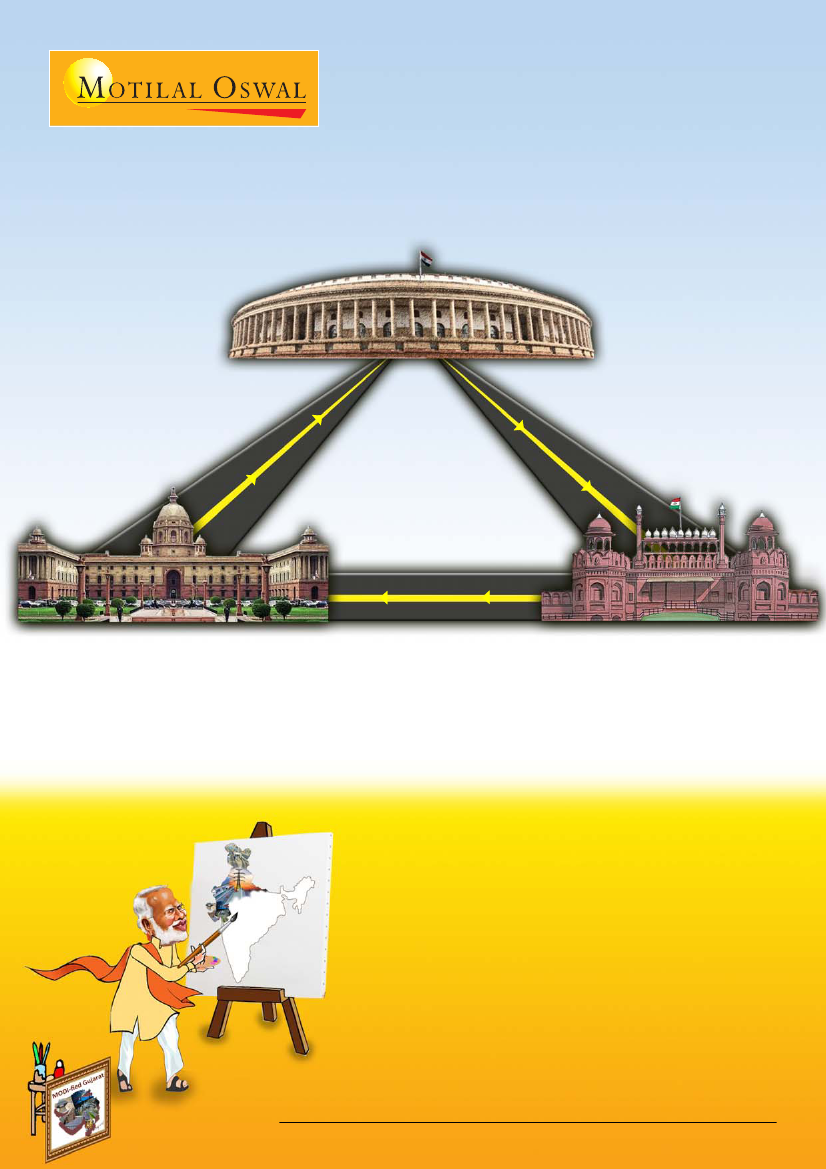
Parliament of India
12 bills passed
More sittings, fewer interruptions
The
First
Propulsion
North Block
Bureaucracy gears up for higher
efficiency
Inflation, sectoral bottlenecks
receives priority
Red Fort
Modi identifies six key areas of
focus
Singles out core social issues
INDIA MODI-fied | Vol 3
Research Team
(Rajat@MotilalOswal.com)

India Politics | INDIA MODI-fied Vol 3
INDIA MODI-fied: Volume-3; The First Propulsion
The Narendra Modi-led government has assumed charge, with a historic mandate after three decades of coalition politics.
Voters have delivered a decisive judgment in favor of resetting India on a path of development. The first signs emanating
point to the new government’s keenness to spend this political capital on making good the promises made, especially in the
areas of infrastructure development, urbanization, and agriculture, and in addressing issues related to investment climate
and sectoral bottlenecks. It has also indicated continuance of some of the focus areas of the erstwhile government, albeit in a
modified form, to ensure that the process of change is non-disruptive.
In volume-3 of our India MODI-fied series, we take a note of the ‘first propulsion’ that the combination of legislative and
executive action has given to the policy making. We highlight how days of parliamentary logjam and policy paralysis are
giving way to renewed resolve to make a difference. The Parliament has passed 12 bills (including the budget), deliberated on
several issues, and worked for more than its usual time, with improved efficiency. The Prime Minister signifies enhanced
government capacity, as articulated in his maiden Independence Day speech that called for going back to basics on aspects of
governance, economy, and society.
Contents
Page No.
A. Parliament succeeds in pushing through legislative agenda
................................................................
3
B. Modi extols economic and social basics in his maiden Red Fort speech
..............................................
8
C. Flashback on 3 months of MODI-fied India
.........................................................................................
10
First state opinion polls suggests a BJP-led alliance
.................................................................................
11
Annexure: Chronology of policy measures by new government
.............................................................
12
Investors are advised to refer through disclosures made at the end of the Research Report.
Dipankar Mitra
(Dipankar.Mitra@MotilalOswal.com); +91 22 3982 5405
Ashish Gupta
(Ashish.Gupta@MotilalOswal.com); +91 22 3982 5544
18 August 2014
2

India Politics | INDIA MODI-fied Vol 3
The First Propulsion
Parliament makes new beginning; Modi extols economic and social basics
We have possibly moved some distance from the days of parliamentary logjam and policy
paralysis. In the second session of the newly constituted Lok Sabha (the first being the
oath taking ceremony), besides the budget, the Parliament passed 11 bills, which among
others seek to give more teeth to the SEBI, broadbase the appointment of higher judiciary,
and do away with some archaic laws. Also, the Parliament worked longer and more
efficiently. Signifying the improved capacity of the Executive, Prime Minister Narendra
Modi’s maiden Independence Day speech called for a return to the basics of governance,
economy, and society.
A. Parliament succeeds in pushing through legislative agenda
The Parliament is back to legislating! This is a welcome change from the usual scene of
political squabbles and pandemonium. The Parliament passed 12 bills (including the
budget) in its second session, with the more important ones aimed at according more
powers to the SEBI, broadbasing the appointment of higher judiciary, and repealing some
archaic laws. Though the Insurance Bill was deferred, initial progress was made on the
labor laws front. Overall, the Parliament worked harder and smarter, with fewer
disruptions and improved efficiency in clearing bills. In its second session, the newly
created Lok Sabha outperformed the previous two terms of UPA.
Parliamentary sovereignty:
India follows a system of Parliamentary sovereignty,
and to that extent, the Parliament is the highest institution of the country.
However, of late, the Parliament has been a victim of political squabbles,
incapacitating itself of its ability to frame laws relevant for the nation’s progress.
Bills passed increase:
After the first session of the newly constituted 16th Lok
Sabha, which was largely convened for the oath taking ceremony, the second
session witnessed meaningful uptick in the business transacted. In all, 12 bills
were passed by both Houses of the Parliament (Lok Sabha and Rajya Sabha).
This exceeds the second session performance of the previous two Lok Sabhas by
a wide margin.
Key bills passed:
Apart from the budget and other finance related bills
(including Delhi budget) the three most significant bills passed were (i) the
Securities Laws (Amendment) offenders and take measures against promoters
of Ponzi schemes), (ii) the Judicial Appointments Commission Bill (that seeks to
broadbase selection process for appointments of higher Judiciary from the
current Collegium system), and (iii) Repealing and Amending Bill, 2014 (that
seeks to do away with archaic laws).
Progress in labor laws:
The Parliament made some progress in introducing
changes in labor laws, including (i) Factories (Amendment) Bill, 2014, and (ii)
Apprentices (Amendment) Bill, 2014. The second being passed in the Lok Sabha
and introduced in Rajya Sabha.
Insurance bill deferred:
The Parliament could not take up the long awaited
Insurance bill (that proposes to increase the limit on foreign investment to 49%
from the current 26%) due to opposition from various parties. The Rajya Sabha
has referred it to a 15-member Select Committee, which is expected to submit
its report on the last day of the first week of the next session.
3
18 August 2014

India Politics | INDIA MODI-fied Vol 3
The second session of the 16th Lok Sabha marks an improvement in number of bills passed
Bills passed by both houses of Parliament
12
8
6
14th Lok Sabha
(UPA-I)
15th Lok Sabha
(UPA-II)
16th Lok Sabha
(NDA)
Source: Parliament, MOSL
Many important bills introduced and passed by Parliament in the 2nd session
Sr
No
1
2
3
4
5
6
7
8
9
10
11
12
13
14
15
16
17
18
19
20
21
Name of the Bills
The National Institute of Design Bill, 2013
The Finance (No. 2) Bill, 2014
The Scheduled Castes and the Scheduled Tribes (Prevention of Atrocities)
Amendment Bill, 2014
The Securities Laws (Amendment) Bill, 2014
The Telecom Regulatory Authority of India (Amendment) Bill, 2014
The Andhra Pradesh Reorganisation (Amendment) Bill, 2014
The Railways (Amendment) Bill, 2014
The Factories (Amendment) Bill, 2014
The Apprentices (Amendment) Bill, 2014
The Constitution (Scheduled Castes) Orders (Amendment) Bill, 2014
The Repealing and Amending Bill, 2014
The Juvenile Justice (Care and Protection of Children) Bill, 2014
The Indian Institutes of Information Technology Bill, 2014
The Central Universities (Amendment) Bill, 2014
The Constitution (121st Amendment) Bill, 2014
The National Judicial Appointments Commission Bill, 2014
The Delhi Appropriation (No.2) Bill, 2014
The Appropriation (No.3) Bill, 2014
The Appropriation (No.2) Bill, 2014
The Appropriation (Railways) No. 3 Bill, 2014
The Appropriation (Railways) No.2, 2014
Total
Bills Introduced
Lok
Rajya Sabha
Sabha
20
Bills Passed
Lok Sabha
Rajya Sabha
12
13
12
Source: Parliament, MOSL
A good beginning made:
In comparison with past two Lok Sabhas, the current
Lok Sabha has made a good beginning. As this was one of the longest session
and also the first business session (after the session of oath taking), a
comparison of second sessions across previous Lok Sabhas provides a useful
insight. It turns out that, while the last session has made a good beginning, a
ramp up of performance is needed in the forthcoming sessions to outdo the
performance of previous Lok Sabhas.
18 August 2014
4

India Politics | INDIA MODI-fied Vol 3
NDA has started off well in the Parliamentary session
14th Lok Sabha (UPA-I)
15th Lok Sabha (UPA-II)
16th Lok Sabha (NDA)
28
28
26
21
21
20
20
19
19
17
16
18 20
15
14
14
16
13
14
12 12
12
11
10
8
7
6
6
2
000
Source: Parliament, MOSL
Good start to the current Lok Sabha session
Lok Sabha (LS)
1st LS
2nd LS
3rd LS
4th LS
5th LS
6th LS
7th LS
8th LS
9th LS
10th LS
11th LS
12th LS
13th LS
14th LS
15th LS
16th LS
Period
Apr 52 to Apr 57
Apr 57 to Mar 62
Apr 62 to Mar 67
Apr 67 to Dec 70
Mar 71 to Jan 77
Mar 77 to Aug 79
Oct 80 to Dec 84
Dec 84 to Nov 89
Dec 89 to Mar 91
Jun 91 to Oct 96
May 96 to Dec 97
Mar 98 to Apr 99
Oct 99 to Feb 04
May 04 to Feb 09
May 09 to Feb 14
May 14 onwards
No. of sessions
15
16
16
12
18
9
15
14
7
16
6
4
14
15
7
No. of sittings
677
581
578
469
613
267
464
485
109
423
125
88
356
332
86
No. of bills introduced
282
286
268
196
379
161
378
270
71
248
67
71
252
219
64
No. of bills passed
333
327
272
216
487
135
336
355
63
284
64
60
302
261
48
2
33
12
12
Note: Information for current (16th) Lok Sabha updated till Aug-14; Source: Parliament, MOSL
Time lost due to interruptions see trend reversal in current budget session (%)
80
60
40
20
0
10th LS
11th LS
12th LS
13th LS
14th LS
15th LS
16th LS
Hours disrupted as % of no. of hours sitting
Note:
Information for current (16th) Lok Sabha updated till Aug-14
Source: Lok Sabha Secretariat, Parliament, MOSL
18 August 2014
5

India Politics | INDIA MODI-fied Vol 3
Parliament worked harder and smarter
More sittings:
During the second session of the newly constituted 16
th
Lok
Sabha, the Parliament has worked for 27 sittings. This is the highest number of
sittings for the second session for the last four Lok Sabhas.
Fewer interruptions:
The ratio of time lost due to interruptions also came down
drastically. Although the Lok Sabha lost about 14 hours due to disruptions, it
more than made up the loss by sitting extra for 28 hours and 10 minutes. In the
Rajya Sabha, 34 hours were lost due to interruptions and adjournments, but it
made up by late sittings and skipping the lunch recess, accounting for 38 hours.
More work hours with higher efficiency:
The current Lok Sabha sat more hours
during its second session than any of the previous three. Yet, the average time
taken per bill was less than the previous two Lok Sabhas of the UPA regime. This
enabled more bills to be cleared. The picture was similar for the Rajya Sabha.
nd
16 Lok Sabha: Highest sittings in the 2 session
No of sittings in second session
27
26
24
th
The least disrupted 2 session in the last three Lok Sabhas
% of time disrupted
50
nd
15
8
14th Lok Sabha
(UPA-I)
15th Lok Sabha
(UPA-II)
16th Lok Sabha
(NDA)
14th Lok Sabha
(UPA-I)
15th Lok Sabha
(UPA-II)
16th Lok Sabha
(NDA)
Source: Parliament, MOSL
Average time taken per bill less than earlier
No. of actual hours (Lok Sabha)
Hours spent to pass one bill (RHS)
20
15
14
The same was true for Rajya Sabha too
No. of actual hours (Rajya Sabha)
Hours spent to pass one bill (RHS)
18
11
12
93
14th Lok Sabha
(UPA-I)
162
15th Lok Sabha
(UPA-II)
167
16th Lok Sabha
(NDA)
67
14th Lok Sabha
(UPA-I)
148
15th Lok Sabha
(UPA-II)
142
16th Lok Sabha
(NDA)
Source: Parliament, MOSL
Legislative time increases:
The current Lok Sabha session was also marked with
an increase in time allocated on legislation in comparison with other business.
This bodes well for both improving the quality of legislations passed and the
consensus building process that have gone in to legislating.
Broadbasing of participation:
Another feature of the last session of the
Parliament has been the broadbasing of the participation in debates and
discussion. Whereas the share of women MPs remained same at 11% in the last
three Lok Sabhas, only the last session, their share in debate time exceeded
their seat share. Similarly, first time MPs made their voices heard both among
regional as well as national parties.
6
18 August 2014

India Politics | INDIA MODI-fied Vol 3
More time spent on legislative reforms in 2014 budget session
Budget session (2004)
0%
9%
14%
27%
Budget session (2009)
2%
8%
12%
Budget session (2014)
3%
12%
Legislative
Questions
13%
38%
Financial
Non-legislative
41%
36%
50%
33%
Others
Source: PRS, MOSL
Participation of women MPs highest in 2nd session
Participation of women MPs in debates (%)
Women MPs in Parliament (%)
12%
11%
11%
11%
9%
8%
Active participation by first-time MPs in debates
Participation of first-time MPs in debates
97%
92% 92%
78%
78%
40%
80%
100%
14th Lok Sabha
(UPA-I)
15th Lok Sabha
(UPA-II)
16th Lok Sabha
(NDA)
Source: PRS, MOSL
Source: PRS, MOSL
Highs and lows of current parliament session
Insurance bill stuck
TDP & TMC members
fight for office space
SEBI gaining more teeth
Judicial Accountability
Repealing archaic bills
Progress in labor laws
Young and women member
become active
Source: Media, MOSL
18 August 2014
7

India Politics | INDIA MODI-fied Vol 3
B. Modi extols economic and social basics in his maiden Red Fort speech
Prime Minister Narendra Modi delivered his maiden August 15 speech from the rampart of
the Red Fort. The extempore speech was marked in its emphasis on going back to basics on
issues of governance, economy, and society. Rather than listing numerous schemes, the
PM outlined six key areas of focus. Besides explaining his own effort to improve the
capacity of the government machinery to deliver, he called for larger actions by the
population to ward off various economic and social handicaps. The speech was also
marked by succinct expressions that summarized complex issues in easy phrases, greatly
enhancing public accountability.
Governance:
The Prime Minister sought to explain his approach to improve the
functioning of the bureaucracy. Describing himself as the Prime Servant (as
opposed to Prime Minister), he expressed his desire and willingness to take the
opposition along. He has attempted to break the Chinese wall within the
bureaucracy, driving it towards a common mission. He called upon society to
give up the selfish attitude of "Mera Kya, Mujhe Kya” (What is in it for me? How
do I care?). Mr Modi also gave a call to extremist groups to shun violence.
Economy:
Making a departure from the practice of announcing numerous
schemes and updates, Mr Modi announced six areas of focus, including (i)
financial inclusion (Pradhanmantri Jan-Dhan Yojana to provide for a bank
account, a debit card and an insurance amount of INR100,000 for the poor), (ii)
IT (digitally linking India through broadband to all villages), (iii) new institution to
replace Planning Commission, (iv) model villages (Saansad Adarsh Gram Yojana),
(v) toilets for all schools within a year, and (vi) cleanliness drive (Swachh Bharat
to be launched on October 2
nd
). Besides, he also (i) emphasized the need for
creating a manufacturing hub, (ii) emphasized quality and environmental
consciousness (“zero defect, zero effect”); (iii) welcomed FDI (“make in India”),
and (iv) stressed skill development.
Mr Modi’s six-point agenda replaces numerous announcements
Financial
inclusion
Digital
Infrastructure
Clean India
Toilets in all
schools
MP Ideal Village
NDRC/Planning
Commission
Source: Parliament, MOSL
18 August 2014
8

India Politics | INDIA MODI-fied Vol 3
Social issues:
Perhaps the greatest thrust of the speech was on social issues,
where Mr Modi articulated most forcefully areas of improvement that included
(i) women’s safety, (ii) female foeticide, (iii) toilets, and (v) cleanliness. As
indicated earlier, the last two would be rolled out as economic schemes.
PM speech through quotes
I. GOVERNANCE
Attitude
Whose nation
Opposition
Bureaucracy
I can assure you. If you work 12 hours, I will work 13. Why? Because I am not a Pradhan Mantri, but a
Pradhan Sevak.
Politicians haven't made this nation, parties haven't made this nation, governments haven't made this
nation. Instead it is the farmers, scientists and common people who have built this nation
We don't want to go ahead with the strength of numbers; we want to go ahead with unanimity. This could
be seen in the just concluded Parliament session. We have taken the Opposition in agreement at every step.
I am an outsider in New Delhi. I have been away from the elite in this city. In the 2 months I have been here
I now have an insider view. I was astonished. I saw many governments functioning within a government.
One department fighting the other. So we are trying to break this wall; we want to have one mission and
target: Take the nation forward.
We have had enough of divisiveness and communal wounds inflicted on Mother India. Peace and
brotherhood will give strength to take the country forwards. I am sure it can be done. Lets fix a moratorium
of 10 years to shun violence.
The world has changed. India is not alone, cannot operate alone. Economic powers have changed. We have
to think differently. The government has taken some measures. We have to improve our manufacturing
sector. We invite world nations and the Diaspora, 'Come Make in India'.
The mantra of our country's youth should be to at least make 1 product that we import. Don't compromise
in manufacturing; Stress on Zero defect, Zero effect (impact of environment).
We are nation of the young. Have we ever thought of harnessing the power of the youth? We need skilled
workers. The youth needs to imparted with skills that earn them fame around the world. We want to
develop job creators.
We have to head towards a digital India. We today import a huge proportion of electronic items. If we
dream of a digital India, we have to aim for good governance via e-governance.
Why are farmers committing suicide? Who will protect the poor? We are rolling out a PM Jan Dhan Yojana
will connect the poor with bank accounts. They will be given a debit card. Every account holder will be
provided with Rs 1 lakh insurance.
Many programmes are running in the names of PMs and other leaders. Today, I announce a Sansad Adarsh
Gram Yojana. Let each MP adopt a village and take care of its sanitation, education and other needs. Make
model villages. I will place the blueprint for this programme before MPs and state government on October
11 of Jai Prakash Narayan's birth anniversary
Have these parents ever asked their sons where they have been, who they have been meeting? Rapists are
somebody's sons as well! Parents must take the responsibility to ensure that their sons don't go the wrong
direction.
India's sex ratio is 1000 boys for 940 girls. Who creates this disparity? Don't fill your coffers at the altar of
the mother's womb. People feel that sons will take care of them when they are old. But I have seen aged
parents in old-age homes or single daughter taking care of old parents. Indian athletes made us proud in the
Commonwealth Games. 29 of the medals were won by girls. Let's honour them.
Do we want to live in unhygienic conditions? Can't our nation be clean? If billions of Indians pledge to keep
the surroundings clean, can't this nation be cleaner? What do we give Mahatma Gandhi on his October 2?
People's participation is necessary to ensure that our schools, hospitals, roads and infrastructure are clean.
Can't we arrange public toilets? Why do our womenfolk need to wait till dark to use the toilets? MPs must
use their MPLAD funds to set up toilets in schools; so should corporates.
Violence
II. ECONOMY
Welcome FDI
Manufacturing
Skill Development
Digital India
Financial inclusion
Model village
III. SOCIAL ISSUES
Women safety
Female foeticide
Clean India
Toilets
18 August 2014
9

India Politics | INDIA MODI-fied Vol 3
C. Flashback on three months of MODI-fied India
The first three months of the new government since the historic election mandate
have been focused on enhancing the efficiency of the bureaucracy, controlling the
menace of inflation, and making India the most favored destination for capital
investment. While investors may be disappointed at the lack of big-bang policy
announcements, there have been plenty of policy actions to address policy
bottlenecks and move the investment cycle.
The government has been especially responsive to foreign policy exigencies,
whether pertaining to bringing Indian nurses back or otherwise. The PM’s attempts
to improve foreign relations were evident in his visits to Nepal and Bhutan, and
should show up in his upcoming visits to Japan and the US.
Key announcements/measures by the new government
Particulars
Announces "Pradhanmantri Jan-Dhan Yojana" to provide for a bank account, a debit card and an
insurance amount of INR100,000 for the poor
New institution to replace Planning Commission
Modeled on the best practices of PURA (providing urban amenities in rural areas) scheme, the
RURBAN mission was launched
Key bills such as Securities Laws (Amendment) Bill, 2014; Judicial Appointment Commission Bill,
Factories (Amendment) Bill, 2014 were cleared by parliament
FDI in insurance referred to a select committee by Rajya Sabha
INR125b worth of transmission projects approved
Approved road projects worth about INR400b
Fast track clearances for 3 rail lines for coal linkage
Railway fares hiked; higher fares for passenger with Fuel adjustment charge
7 big-ticket projects of INR210b cleared
Gas price deferred for 3 months to consult with all stakeholders
Firm resolve to GST implementation
FDI in defence raised from 26% to 49%. Railway operations and projects were allowed to receive up
to 100% FDI
24 Airports identified for development as Domestic Air Cargo Terminals
PSU Bank consolidation and greater autonomy
Transfer of units of debt mutual funds to be taxed at 20% (vs 10% earlier)
Conducive tax regime for REITS and Infrastructure Investment Trusts
New scheme targeting feeder separate for DISCOMs
Online environmental clearances
Large number of infrastructure projects announced (16 ports, 8,500kms of road project completion,
developing airports in Tier 2 and 3 cities, developing 100 smat cities)
Construction under EPC vs. PPP earlier
Impacted sector
Financials
Economy
Economy
Economy
Economy
Power
Infrastructure
Power
Economy
Infrastructure
Energy
Economy
Economy
Infrastructure
Financials
Economy
Infrastructure
Infrastructure
Infrastructure
Economy
Infrastructure
Impact
Positive
Positive
Positive
Positive
Negative
Positive
Positive
Positive
Positive
Positive
Negative
Positive
Positive
Positive
Positive
Negative
Positive
Positive
Positive
Positive
Positive
Source: Pib, Media reports, MOSL
18 August 2014
10

India Politics | INDIA MODI-fied Vol 3
First state opinion polls suggests a BJP-led alliance
ABP News-Nielsen suggests sweep for BJP in Maharashtra and Haryana
There seems to be a BJP wave in the upcoming state elections of Maharashtra and
Haryana based on the first opinion polls survey of ABP News-Nielsen. However, the
BJP may not be able to form the government on its own and would need some
alliance partners. The ABP News-Nielsen survey took place between July 22, 2014 to
August 6, 2014 covering a sample size of 21,711 people.
Maharashtra is likely to see the BJP, Shiv Sena, RPI and SWP alliance to bag 210
seats of the 288-seats Maharashtra assembly with BJP leading the alliance with 122
seats.
In Haryana, if BJP is to continue with its current alliance partner (HJC), the alliance is
likely to bag 56 seats of the 90-seats assembly; BJP will bag 46 seats in this scenario.
However, if it were to join the ruling INLD party to form an alliance, the number of
seats is likely to increase to 75.
Maharashtra: BJP to get clear majority (current NDA alliance) Maharashtra: BJP seats (with no alliance parties)
Particulars
NDA
BJP
Shiv Sena
Others
UPA
Congress
NCP
Other parties
MNS
Others
Total
2009
91
46
44
1
144
82
62
53
13
40
288
ABP News-
Nielsen
210
122
82
6
55
NA
NA
23
10
13
288
Lok Sabha
2014
42
23
18
1
6
2
4
0
0
0
48
Particulars
BJP
Shiv Sena
Others
Congress
NCP
MNS
Others
Total
2009
46
44
1
82
62
13
40
288
ABP News-
Nielsen
112
62
0
45
38
11
20
288
Lok Sabha
2014
23
18
1
2
4
0
0
48
Source: ABP News-Nielsen, MOSL
Haryana: BJP to form majority (with current NDA alliance)
Particulars
BJP +
Haryana Janhit Congress
BJP
Congress +
Congress
INLD
Others
Total
2009
10
6
4
71
40
31
9
90
ABP News-
Nielsen
56
10
46
32
13
19
2
90
Lok Sabha
2014
7
0
7
3
1
2
0
10
Haryana: BJP to form majority (with current NDA alliance)
Particulars
BJP +
BJP
INLD
Congress
Haryana Janhit Congress
Others
Total
2009
4
4
31
40
6
9
90
ABP News-
Nielsen
75
NA
NA
10
3
2
90
Lok Sabha
2014
7
7
2
1
0
0
10
Source: ABP News-Nielsen, MOSL
18 August 2014
11

India Politics | INDIA MODI-fied Vol 3
Annexure: Policy measures initiated by government since assuming
power
Chronology of measures initiated by the government
Date
13-Aug-14
8-Aug-14
Area
SEZ
Measures undertaken
Recommends restoration of SEZ benefits:
Ministry of Commerce and Industry (Department of Commerce) has
recommended the restoration of original exemption from MAT and DDT to SEZ developers and units.
8-Aug-14
8-Aug-14
27-Jul-14
25-Jul-14
25-Jul-14
18-Jul-14
18-Jul-14
15-Jul-14
RURBAN Mission launched:
Modeled on the best practices of PURA (providing urban amenities in rural areas)
Rural Infra scheme. In the first phase, INR1b will be spent on three identified projects in Warangal District of Andhra
Pradesh and Sangli and Buldhana Districts of Maharashtra.
Limiting scope for MSP procurement:
Central government would limit the procurement of foodgrains only to
the extent required for targetted PDS and other schemes in food surplus states carrying their own procurement
Food inflation
operations. Other states will have to take care of entire MSP operations in case they announce bonus over and
above MSP.
Amends All India Services (Conduct) Amendment Rules, 2014:
Rules for bureaucrats to ensure that all their
Law
policy decisions are guided solely by "public interest" and they operate with total "political neutrality
Doing business
Food inflation
Acquire ships abroad:
The Government has taken a policy decision to allow shipping enterprises based in India
to acquire ships abroad and also flag them in the country of their convenience.
APMC Act:
The government advised the States to allow free movement of fruits and vegetables by delisting
them from the APMC Act
8-Jul-14
8-Jul-14
7-Jul-14
4-Jul-14
3-Jul-14
Food inflation
Hoarding:
Government proposed amendments to make hoarding non-bailable offence
Essential commodities:
Government has proposed amendment in Essential Commodities Act to make it more
Food inflation
stringent.
Fusion between MGNREGA and agriculture:
Government has notified 30 new works under MGNREGA
MGNREGA
programmes majority of which relate to agriculture and allied activities.
From PPP to EPC:
Government is trying to take forward road construction project worth INR1.8t and address
Roads and
huge NPAs of INR2.4t from the sector. Government may take up highway building under EPC model instead of
waterways
PPP for at least two years.
Checking price rise in essential commodities:
Measures include, i) reduced import duty for wheat, onion and
pulses to zero, ii) banned export of edible oils and pulses, iii) imposed stock limit for essential commodities such
Food inflaiton
as pulses, edible oil and seeds, iv) suspended futures in rice, urad and tur, v) implementation of National
Mission on Oilseeds and Oil Palm, etc.
Model APMC Act:
As per the Committee recommendations, states are urged to amend their respective State
Agriculture
Agriculture Produce Market Committee (APMC) Acts on lines of Model Act
Labour laws
Amendment proposed to Factories Act, 1948
Common National Market for select essential commodities and Price Stabilization Fund for Market intervention
proposed
Defers hiking state specific costs on kerosene, LPG:
The Petroleum and Natural Gas Ministry deferred hiking
Energy
State-specific costs (SSC) till a review was done with the States. The SSC was announced by the UPA
Government in 2012.
Outbound investment eased:
RBI restored the limit on their overseas direct investments (ODIs) under the
Investments automatic route to 400% of net worth. The limit was cut by 3/4th to 100% in August, 2013 after the rupee
touched all-time low.
Raising minimum export price on onion export:
The Inter-Ministerial Committee has unanimously decided to
Food inflation
increase the MEP at USD500/MT FOB (INR30/kg) from USD300/MT
Food inflation
Ease of doing business:
The period of validity of Industrial License is being extended from two years to three
Doing business years. This is applicable for extension of validity of Industrial license in cases where the license holder has not
commenced production of the items within three years of issue of license.
Food inflation
Energy
Inclusion of onion and potato under Essential Commodities Act:
This will empower the State Governments to
undertake de-hoarding operations and to control the prices of onions and potatoes
3-Jul-14
2-Jul-14
2-Jul-14
2-Jul-14
1-Jul-14
1-Jul-14
29-Jun-14
26-Jun-14
18 August 2014
Hike in LPG and ATF prices:
Price of non-subsidised cooking gas (LPG) was hiked by INR16.50/cylinder and that
of jet fuel by over 0.5%.
Suspension of sugar export subsidy:
The Food Ministry has sought approval to end the subsidy for raw sugar
Food inflation exports one year earlier (by September 2014) as it is being availed only by a few sugar mills. A CCEA note has
been moved in this regard.
Industrial parks:
Government entered into a landmark agreement with China to set up at least four Chinese
Investments
industrial parks in India
Food security
Extension of 3 months for Food Security Act:
Deadline for implementation of National Food Security Act expires
on July 4, which is extended by 3 months
12

India Politics | INDIA MODI-fied Vol 3
26-Jun-14
25-Jun-14
25-Jun-14
25-Jun-14
25-Jun-14
25-Jun-14
24-Jun-14
Food inflation Imposition of Minimum Export Price (MEP) on Potato Export of USD 450 PMT FOB
Extension of excise duty cut for auto industry:
The government extended by another six months till December
Taxation
the cut in excise duty levied on the automobile industry
Enegy
Roads
MSP for
foodgrains
Power
Gas price hike put-off for 3 months:
The Cabinet Committee on Economic Affairs (CCEA) deferred
implementation of the domestic natural gas pricing guidelines for wider consultations.
Road blocks cleared: Ministry
of road transport and highways has approved road projects worth about
INR400b, besides setting a target of building 30 km of roads a day from 2016.
Low MSP hike:
Government effected one of the lowest hike in MSP for Kharif crops for FY15 season.
Approves INR125b transmission projects:
Ministry of Power has approved 9 new transmission projects with
cost of over INR125b
Contingency fund for low rainfall:
Minister for agriculture has directed that 10% allocation under each and
Agriculture and
every scheme in the agriculture will be set aside as contingency fund to meet the sudden expenditure arising
food prices
out of the less rainfall in the country.
Sugar
Rail fare
Foreign
investment
Raises import duty of sugar:
Food Ministry increased the import duty of sugar to 40% from 15% earlier. Subsidy
on raw sugar exports extended until September. The government will also increase ethanol blending with petrol
to 10% from current 5%. Industry experts see forex savings of USD1.6b-1.7b on ethanol blending at 10%.
Govt hikes railway fares:
Fares of all classes are set to rise by 14.2%, while the freight rates will go up by 6.5%.
23-Jun-14
21-Jun-14
21-Jun-14
19-Jun-14
19-Jun-14
19-Jun-14
18-Jun-14
12-Jun-14
10-Jun-14
5-Jun-14
27-May-14
Definition of FDI and FII:
Government has now accepted the definition of FDI and FII advanced by the
Committee, whereby in line with the international practices, where an investor has a stake of 10% or less in a
company, it will be treated as FII and, where an investor has a stake of more than 10%, it will be treated as FDI.
Cabinet reconstruction:
The Government reconstituted six Committees of the Cabinet i.e. Appointments
Committee of the Cabinet, Cabinet Committee on Accommodation, Cabinet Committee on Economic Affairs,
Governance
Cabinet Committee on Parliamentary Affairs, Cabinet Committee on Political Affairs and Cabinet Committee on
Security.
NBFCs' fund raising:
Government allowed Infrastructure Finance companies and Infrastructure Debt Fund Non-
Debt market/ Banking Financial Companies (ID-NBFCs) to issue secured debentures for a period up to thirty years. Similarly,
Infrastructure Housing Finance companies have been allowed relaxed terms for maintaining Debenture Redemption Reserve
on lines similar to NBFCs registered with RBIs.
Approvals
Inflation
7 big-ticket projects of INR210b cleared which were held up for decades
i)
Imposes minimum export price on onion export at USD 300 per MT FOB.
ii)
Release food stock:
Government, through FCI, would release more supplies to State Governments
Railways for coal linking:
Railways and Power & Coal Ministries hold joint meeting to put three critical coal
Infrastructure connectivity projects on fast track. Multi Disciplinary Project Monitoring Unit is also being formed for better
coordination.
Governance
Minimum Government:
PM discontinues four Standing Committees of Cabinet including UIDAI
Doing Business
Environmental clearances:
Online applications for environmental clearances made operational
Governance
Black money:
Government constituted a Special Investigation Team (SIT) to unearth black money in compliance
with the judgement of Hon’ble Supreme Court.
Source: Pib, MOSL
18 August 2014
13

Disclosures
This research report has been prepared by MOSt to provide information about the company(ies) and sector(s), if any, covered in the report and may be distributed by it and/or its affiliated company(ies). This
report is for personal information of the select recipient and does not construe to be any investment, legal or taxation advice to you. This research report does not constitute an offer, invitation or inducement to
India Politics |
for public distribution and
Vol 3
invest in securities or other investments and Motilal Oswal Securities Limited (hereinafter referred as MOSt) is not soliciting any action based upon it. This report is not
INDIA MODI-fied
has been
furnished to you solely for your general information and should not be reproduced or redistributed to any other person in any form. This report does not constitute a personal recommendation or take into
account the particular investment objectives, financial situations, or needs of individual clients. Before acting on any advice or recommendation in this material, investors should consider whether it is suitable
for their particular circumstances and, if necessary, seek professional advice. The price and value of the investments referred to in this material and the income from them may go down as well as up, and
investors may realize losses on any investments. Past performance is not a guide for future performance, future returns are not guaranteed and a loss of original capital may occur.
MOSt and its affiliates are a full-service, integrated investment banking, investment management, brokerage and financing group. We and our affiliates have investment banking and other business
relationships with a significant percentage of the companies covered by our Research Department Our research professionals provide important input into our investment banking and other business selection
processes. Investors should assume that MOSt and/or its affiliates are seeking or will seek investment banking or other business from the company or companies that are the subject of this material and that
the research professionals who were involved in preparing this material may participate in the solicitation of such business. The research professionals responsible for the preparation of this document may
interact with trading desk personnel, sales personnel and other parties for the purpose of gathering, applying and interpreting market information. Our research professionals are paid in part based on the
profitability of MOSt which include earnings from investment banking and other business. MOSt generally prohibits its analysts, persons reporting to analysts, and members of their households from
maintaining a financial interest in the securities or derivatives of any companies that the analysts cover. Additionally, MOSt generally prohibits its analysts and persons reporting to analysts from serving as an
officer, director, or advisory board member of any companies that the analysts cover. Our salespeople, traders, and other professionals or affiliates may provide oral or written market commentary or trading
strategies to our clients that reflect opinions that are contrary to the opinions expressed herein, and our proprietary trading and investing businesses may make investment decisions that are inconsistent with
the recommendations expressed herein. In reviewing these materials, you should be aware that any or all o the foregoing, among other things, may give rise to real or potential conflicts of interest . MOSt and
its affiliated company(ies), their directors and employees may; (a) from time to time, have a long or short position in, and buy or sell the securities of the company(ies) mentioned herein or (b) be engaged in
any other transaction involving such securities and earn brokerage or other compensation or act as a market maker in the financial instruments of the company(ies) discussed herein or act as an advisor or
lender/borrower to such company(ies) or may have any other potential conflict of interests with respect to any recommendation and other related information and opinions.
Unauthorized disclosure, use, dissemination or copying (either whole or partial) of this information, is prohibited. The person accessing this information specifically agrees to exempt MOSt or any of its
affiliates or employees from, any and all responsibility/liability arising from such misuse and agrees not to hold MOSt or any of its affiliates or employees responsible for any such misuse and further agrees to
hold MOSt or any of its affiliates or employees free and harmless from all losses, costs, damages, expenses that may be suffered by the person accessing this information due to any errors and delays. The
information contained herein is based on publicly available data or other sources believed to be reliable. Any statements contained in this report attributed to a third party represent MOSt’s interpretation of the
data, information and/or opinions provided by that third party either publicly or through a subscription service, and such use and interpretation have not been reviewed by the third party. This Report is not
intended to be a complete statement or summary of the securities, markets or developments referred to in the document. While we would endeavor to update the information herein on reasonable basis, MOSt
and/or its affiliates are under no obligation to update the information. Also there may be regulatory, compliance, or other reasons that may prevent MOSt and/or its affiliates from doing so. MOSt or any of its
affiliates or employees shall not be in any way responsible and liable for any loss or damage that may arise to any person from any inadvertent error in the information contained in this report. MOSt or any of
its affiliates or employees do not provide, at any time, any express or implied warranty of any kind, regarding any matter pertaining to this report, including without limitation the implied warranties of
merchantability, fitness for a particular purpose, and non-infringement. The recipients of this report should rely on their own investigations.
Recipients who are not institutional investors should seek advice of their independent financial advisor prior to taking any investment decision based on this report or for any necessary explanation of its
contents.
MOSt and/or its affiliates and/or employees may have interests/positions, financial or otherwise in the securities mentioned in this report. To enhance transparency, MOSt has incorporated a Disclosure of
Interest Statement in this document. This should, however, not be treated as endorsement of the views expressed in the report.
Disclosure of Interest Statement
Analyst ownership of the stock
Companies where there is interest
No
Analyst Certification
The views expressed in this research report accurately reflect the personal views of the analyst(s) about the subject securities or issues, and no part of the compensation of the research analyst(s) was, is, or
will be directly or indirectly related to the specific recommendations and views expressed by research analyst(s) in this report. The research analysts, strategists, or research associates principally responsible
for preparation of MOSt research receive compensation based upon various factors, including quality of research, investor client feedback, stock picking, competitive factors and firm revenues.
Regional Disclosures (outside India)
For U.K.
This report is not directed or intended for distribution to or use by any person or entity resident in a state, country or any jurisdiction, where such distribution, publication, availability or use would be contrary to
law, regulation or which would subject MOSt & its group companies to registration or licensing requirements within such jurisdictions.
This report is intended for distribution only to persons having professional experience in matters relating to investments as described in Article 19 of the Financial Services and Markets Act 2000 (Financial
Promotion) Order 2005 (referred to as "investment professionals"). This document must not be acted on or relied on by persons who are not investment professionals. Any investment or investment activity to
which this document relates is only available to investment professionals and will be engaged in only with such persons.
Motilal Oswal Securities Limited (MOSL) is not a registered broker - dealer under the U.S. Securities Exchange Act of 1934, as amended (the"1934 act") and under applicable state laws in the United States.
In addition MOSL is not a registered investment adviser under the U.S. Investment Advisers Act of 1940, as amended (the "Advisers Act" and together with the 1934 Act, the "Acts), and under applicable state
laws in the United States. Accordingly, in the absence of specific exemption under the Acts, any brokerage and investment services provided by MOSL, including the products and services described herein
are not available to or intended for U.S. persons.
This report is intended for distribution only to "Major Institutional Investors" as defined by Rule 15a-6(b)(4) of the Exchange Act and interpretations thereof by SEC (henceforth referred to as "major institutional
investors"). This document must not be acted on or relied on by persons who are not major institutional investors. Any investment or investment activity to which this document relates is only available to major
institutional investors and will be engaged in only with major institutional investors. In reliance on the exemption from registration provided by Rule 15a-6 of the U.S. Securities Exchange Act of 1934, as
amended (the "Exchange Act") and interpretations thereof by the U.S. Securities and Exchange Commission ("SEC") in order to conduct business with Institutional Investors based in the U.S., MOSL has
entered into a chaperoning agreement with a U.S. registered broker-dealer, Motilal Oswal Securities International Private Limited. ("MOSIPL"). Any business interaction pursuant to this report will have to be
executed within the provisions of this chaperoning agreement.
The Research Analysts contributing to the report may not be registered /qualified as research analyst with FINRA. Such research analyst may not be associated persons of the U.S. registered broker-dealer,
MOSIPL, and therefore, may not be subject to NASD rule 2711 and NYSE Rule 472 restrictions on communication with a subject company, public appearances and trading securities held by a research
analyst account.
Motilal Oswal Capital Markets Singapore Pte Limited is acting as an exempt financial advisor under section 23(1)(f) of the Financial Advisers Act(FAA) read with regulation 17(1)(d) of the Financial Advisors
Regulations and is a subsidiary of Motilal Oswal Securities Limited in India. This research is distributed in Singapore by Motilal Oswal Capital Markets Singapore Pte Limited and it is only directed in Singapore
to accredited investors, as defined in the Financial Advisers Regulations and the Securities and Futures Act (Chapter 289), as amended from time to time.
In respect of any matter arising from or in connection with the research you could contact the following representatives of Motilal Oswal Capital Markets Singapore Pte Limited:
Anosh Koppikar
Kadambari Balachandran
Email:anosh.Koppikar@motilaloswal.com
Email : kadambari.balachandran@motilaloswal.com
Contact(+65)68189232
Contact: (+65) 68189233 / 65249115
Office Address:21 (Suite 31),16 Collyer Quay,Singapore 04931
For U.S.
For Singapore
Motilal Oswal Securities Ltd
18 August 2014
Motilal Oswal Tower, Level 9, Sayani Road, Prabhadevi, Mumbai 400 025
Phone: +91 22 3982 5500 E-mail: reports@motilaloswal.com
14