14 August 2015
1QFY16 Results Update | Sector: Metals
SAIL
BSE SENSEX
28,067
Bloomberg
Equity Shares (m)
M.Cap. (INRb)/(USDb)
52-Week Range (INR)
1, 6, 12 Rel. Per (%)
Avg Val/Vol ‘000
Free float
Financials & Valuation (INR b)
Y/E Mar
Sales
EBITDA
NP
Adj. EPS
EPS Gr(%)
BV/Sh.INR
RoE (%)
P/E (x)
P/BV
EV/EBITDA(x)
2015 2016E 2017E
461.2 469.9 561.9
51.8
21.1
5.1
25.1
-10.7
-2.6
66.2
8.4
2.0
S&P CNX
8,519
SAIL IN
4,130.1
231.3/3.6
91/54
-3/-21/-41
303/4033
25.0
CMP: INR56
TP: INR33 (-41%)
Sell
First EBITDA loss in 12-13 years; focus on operations still missing
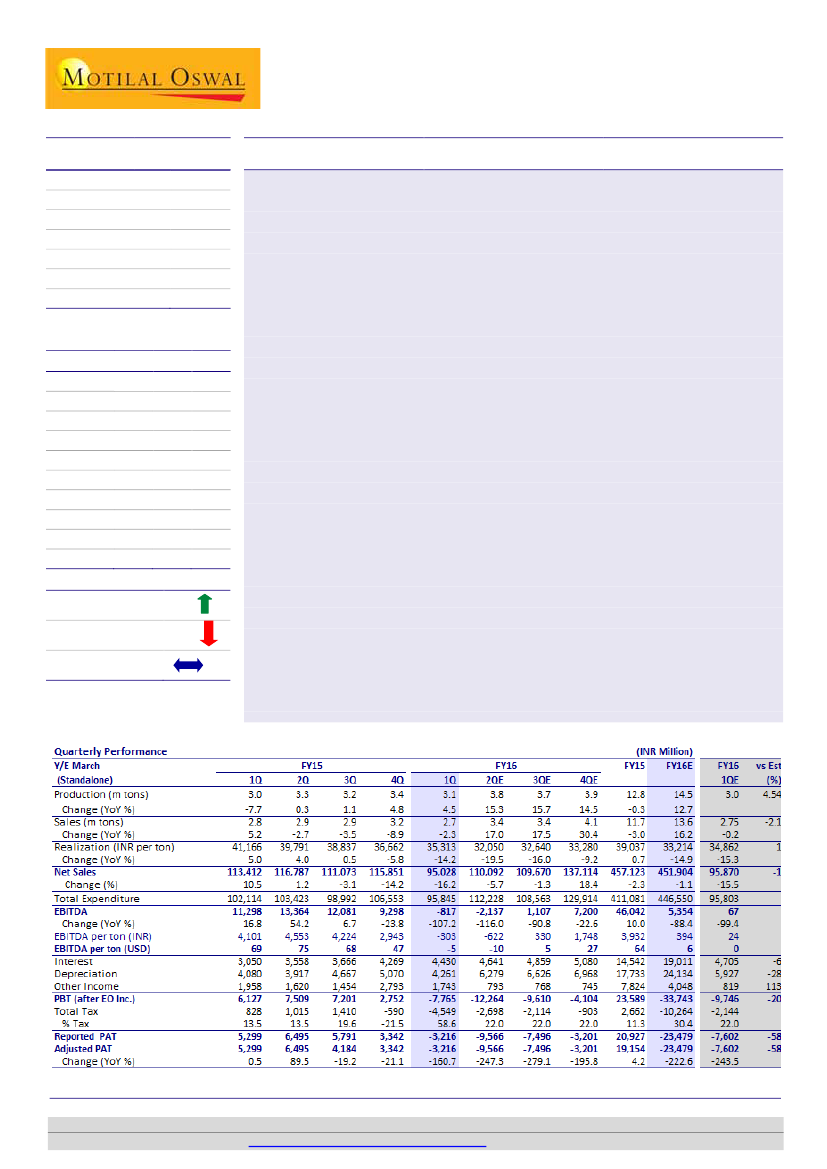
SAIL reported EBITDA loss of INR817m (est. INR67m) under pricing pressure and poor
sales volumes. NSR declined 4% QoQ and volumes 2% YoY. The company added 250kt
to the inventories. Depreciation was lower by INR839m due to increase in useful life
of assets on reassessment. Further, the interest and depreciation were down on
lower capitalization. Loss before tax at INR7.8b was lower than our estimate of
INR9.5b. Although the cash taxes were nil, there was a deferred tax asset on account
of investment-related tax benefit. Loss after tax was INR3.2b.
n
Operating matrix disappoints again:
It is disappointing to see that there is no
reduction in production cost despite weak trend in input costs. Further, SAIL is
still struggling to increase steel production despite commissioning of two new
blast furnaces over last few years. Although the company is guiding for 13%
growth in production to 14.5mt for FY16, this appears to be an uphill task—given
the high inventories, continued pricing and import pressure.
n
Will safeguard duty help SAIL?
Indian steel industry is lobbying for a safeguard
duty to protect against cheaper imports; while this will provide interim relief,
provided import prices become stable, it will not address the challenges SAIL
faces because of high fixed costs. We are not sure whether the safeguard duty
will really protect Indian steel industry in the medium to long run because
international prices will flow through backdoor in the guise of cheaper steel scrap
imports. Globally, scrap melting is becoming unviable. Recently, Tata Steel’s
Southeast Asian arm substituted scrap by cheaper Chinese billets.
n
Focus on operational efficiencies still missing:
SAIL needs to focus aggressively
on reducing costs and inventories, increasing production to take advantage of
operating leverage, and manage working capital more efficiently by bringing in
supply chain automation; so far, we don’t see any of these initiatives.
Sell
11.1 -150.9 -178.4
106.9 101.9 101.6
4.8
5.4
0.5
9.8
-2.5
0.4
0.5
23.0
2.0
4.2
0.6
9.7
Estimate change
TP change
Rating change
7%
-10%
Sanjay Jain
(SanjayJain@MotilalOswal.com); +91 22 3982 5412
Dhruv Muchhal
(Dhruv.Muchhal@MotilalOswal.com); +91 22 3027 8033
Investors are advised to refer through disclosures made at the end of the Research Report.
Motilal Oswal research is available on
www.motilaloswal.com/Institutional-Equities,
Bloomberg, Thomson Reuters, Factset and S&P Capital.