20 August 2015
C
orner
O
ffice
the
Interaction with the CEO
‘Puzzle solved’: Establishing a robust TV ratings system in India
We expect ZEE to benefit, given its stronger rural/semi-urban distribution
Our meeting with Mr. Partho Dasgupta—CEO of Broadcast Audience Research Council (BARC),
India’s new TV ratings system—helped us gain an insight into the viewership and market share
data for broadcasters. BARC is an INR2.8b joint initiative of three flagship industry bodies
representing Broadcasters (IBF; 60% stake), Advertisers (ISA; 20% stake), and Advertising
agencies (AAAI; 20% stake). BARC, launched as recently as April 2015, is becoming the default
TV rating currency—with ~95% coverage of broadcasters/advertising agencies in terms of
viewership/ad spends. With reporting panel sample size for released ratings expected to
increase from ~10,700 households currently (only covering towns with 0.1m+ population) to
~20,000 households by September 2015, ratings contribution from metros is set to decline
significantly from 51% to 29%. We believe that channels and networks having better
rural/semi-urban distribution (Star and Zee, in our view) and showcasing strong content in the
early prime-time are likely to benefit. ZEE remains our top pick in the sector.
BARC
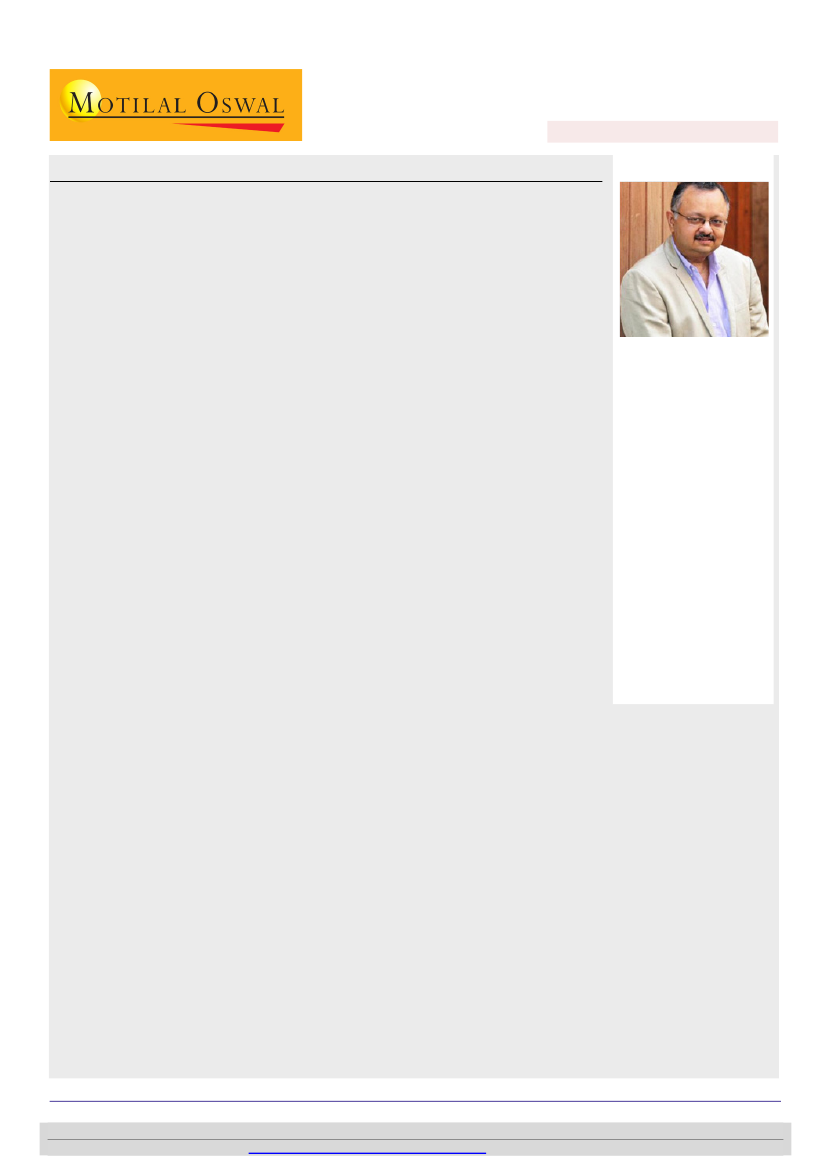
Mr Partho Dasgupta
CEO – BARC
Partho joined BARC in June
2013 and is the first CEO of
BARC, India’s new and only
registered TV audience
measurement system. A
general
management
professional, Partho has
experience
in
diverse
consumer industries and
media management. He was
earlier in the leadership
team of Educomp and has
led startup teams and
management
teams
of
Times Now, Future Media,
The Economic Times and
Times Multimedia. Partho is
a
qualified
mechanical
engineer and also holds a
PGCGM degree from IIM,
Calcutta.
A unique system based on next generation technology:
BARC’s ratings system is based
on a unique next generation watermarking technology adopted in France in 2007 and
the US in 2013. Almost 400 channels in India are already ‘watermarked’ by BARC with
their content being monitored by the ‘BAR-O-meters’ installed in sample households.
The meters use innovative technology and are manufactured domestically at a
significantly lower cost — ~INR25,000 v/s ~INR150,000 in case of imported meters.
Fidelity well established; several new initiatives lined up post stabilization:
The system
is responding well to the changes in TV content, with the ratings accurately depicting
the viewership spikes during recent events like the Nepal earthquake (for news
channels BARC’s system) and India v/s Bangladesh cricket series (for Doordarshan).
BARC does not ‘smoothen’ data and, hence, presents the actual picture despite this
leading to volatility in the reported ratings. Post stabilizing its reporting size of ~20,000
households, BARC intends to add ~10,000 households annually and reach ~50,000 households in three years
compared with the current reporting size of ~10,000 for TAM (the earlier incumbent ratings system). Other key
initiatives lined-up for future include measurement systems for ‘split beams’ (same channel carrying different
advertisements based on the market where content is being consumed) and online video.
Hindi GEC ratings in line with TAM, but stark difference for certain regional/niche channels:
While the overall
viewership and relative share of Hindi General Entertainment Channels (GEC) as reported by BARC has been broadly
similar to TAM, there has been a stark difference in case of regional/niche genres. For example, BARC ratings are
showing significantly lower viewership for Marathi and English genres; however, this might not significantly impact
the advertising rates for these genres as they are primarily driven by perception and target group requirements. The
ratings difference likely stems from the use of latest census data for town classification. BARC maintains a minimum
sample size cut-off of 200 for reporting, thus leading to lower errors at a higher confidence level.
Segment classification based on NCCS to provide accurate segmentation:
BARC is currently capturing data only
from towns with 0.1m+ population; these towns have a universe size of 55m compared with total cable & satellite
universe of ~154m in India (78m urban; 76m rural). BARC uses New Consumer Classification System (NCCS), which is
a single system for urban/rural markets based on education of the Chief Wage Earner (CWE) of the family and
number of consumer durables (pre-defined list of 11 items) owned by the household. While only 26% of the overall
Indian households belong to NCCS AB classification, 57% of the TV households belong to the NCCS AB. In the earlier
SEC classification, only 37% of the TV households belonged to SEC AB.
Shobhit Khare
(Shobhit.Khare@MotilalOswal.com); +91 22 3982 5428
Jay Gandhi
(Jay.Gandhi@MotilalOswal.com); +91 22 3089 6693
Investors are advised to refer through disclosures made at the end of the Research Report.
Motilal Oswal research is available on
www.motilaloswal.com/Institutional-Equities,
Bloomberg, Thomson Reuters, Factset and S&P Capital.