Sector Update | 16 June 2016
Aviation
Aviation
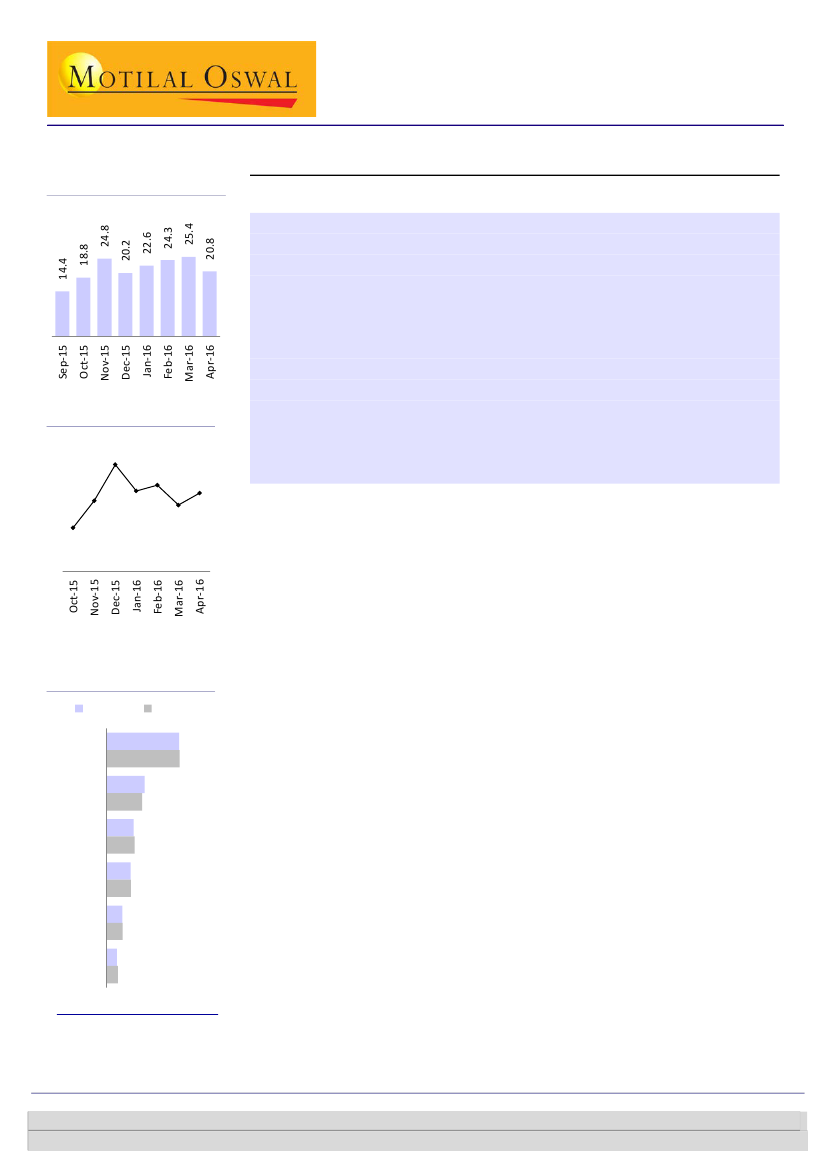
Domestic Passenger
growth (YoY %)
New Civil aviation policy: Taking flying to masses
Targeting 300m passengers by 2022; 5/20 rule changed to 0/20 rule
Indian government’s new civil aviation policy takes an integrated approach to take
flying to masses and has set an ambitious target of 300m domestic passengers by 2022
from ~85m in FY16.
The policy focuses on driving traffic growth in un-served/under-served airport
locations. While this growth will be driven by scaling of India’s airport infrastructure,
the policy announces several initiatives to overhaul India’s aviation eco-system.
All airlines will benefit from (a) initiatives to develop MRO (Maintenance, repair and
overhaul) sector in India - can lower costs in the long run, (b) freedom in ground
handling – will bring in efficiencies and (c) boost to air cargo segment - will increase
Load
factor (%)
airline profitability.
While clarity is yet to emerge on finer aspects of the policy, successful implementation
of RCS (Regional connectivity scheme) and other initiatives will nevertheless boost
84.1
87.0
83.3
80.5
84.3
84.9
82.8
growth of the Indian aviation market, in our view.
0/20 v/s earlier 5/20 rule with a view to give level playing field
Passenger
Market Share (%)
Civil aviation policy has given respite to newer airlines by scrapping minimum 5
years domestic operations requirement for flying on international routes.
However, airlines will still have to deploy at least 20 aircraft or 20% of their total
capacity on domestic routes.
While private operators such as IndiGo, SpiceJet and Jet Airways already have
international operations; AirAsia India (fleet size: 6) and Vistara (fleet size: 11)
will be the key beneficiaries as and when they expand their fleet to 20.
Mar-16
IndiGo
Jet
AI
Spice
Jet
GoAir
Others
Apr-16
35.8
38.8
21.4
18.9
15.7
14.8
13.3
12.9
8.4
8.6
5.5
5.9
Airport upgrades and Regional Connectivity Scheme to drive pax volumes
The policy clearly states government’s desire of including masses in aviation
growth and has set a target of 300m passengers by 2022. This growth will
primarily be achieved through scaling of India’s airports. Airports with scheduled
commercial operations will increase to 127 by 2019 from 77 in 2016.
The government will launch a Regional Connectivity Scheme (RCS) in 2QFY17
targeting un-served/under-served airports; fares on these specific routes will be
capped at ~INR2,500 per hour.
Airlines flying on RCS routes will be subsidized for losses through Viability gap
funding (VGF), which will be financed through levies on existing routes.
MRO and ground handling initiatives to lower costs for airlines
Government has announced a number of incentives to develop India’s MRO
sector. Incentives include fiscal relaxations and land adequacy.
Freedom in ground handling services will benefit airlines to reduce turnaround
time, lower costs and ensure fair competition.
We believe these initiatives will reduce the cost pressures on Indian airlines.
Harshad Borawake
(HarshadBorawake@MotilalOswal.com); +91 22 3982 5432
Rajat Agarwal
(Rajat.Agarwal@MotilalOswal.com); +91 22 3982 5558
Investors
16 June 2016
are
advised to refer through important disclosures made at the last page of the Research Report.
1
Motilal Oswal research is available on www.motilaloswal.com/Institutional-Equities, Bloomberg, Thomson Reuters, Factset and S&P Capital.