F
UEL
R
E
NGINES
5 January 2018
F
RIEND
O
F
T
HE
E
CONOMY
What does RBI’s consumer confidence survey suggest?
Adjustments to widening divergences key to future growth
Inflationary expectations, as reflected by the households survey conducted by Reserve Bank of India (RBI), has always
been an important variable taken into consideration during the monetary policy meetings. However, the consumer
confidence survey (CCS) for November 2017, which is conducted among households across various cities, has revealed
some conflicting trends.
According to the results of the recent survey, while households’ one-year-ahead expectations of income and
employment are at the lowest level in four years, an overwhelming majority of respondents (second highest on record)
expects spending to improve next year. Moreover, while the current perception (vis-à-vis a year ago) on income and
employment is the worst on record (more respondents expect a decrease than increase), a record-high proportion of
respondents has reported higher spending.
Such widening divergence (i) between current situation and households’ expectations of income/employment and (ii)
between consumption spending and income/employment is unsustainable. The adjustments to these divergences will
determine the future trajectory of economic growth. If the outlook on income/employment does not alter positively,
consumers will most likely revise down their spending outlook, creating more risks to real GDP growth.
Over the past few years,
while consumers have
grown more wary of the
current situation, they have
remained optimistic about
the future
Consumer confidence at second lowest level in seven years:
According to the
results of the recent round of the RBI’s consumer confidence survey (CCS)
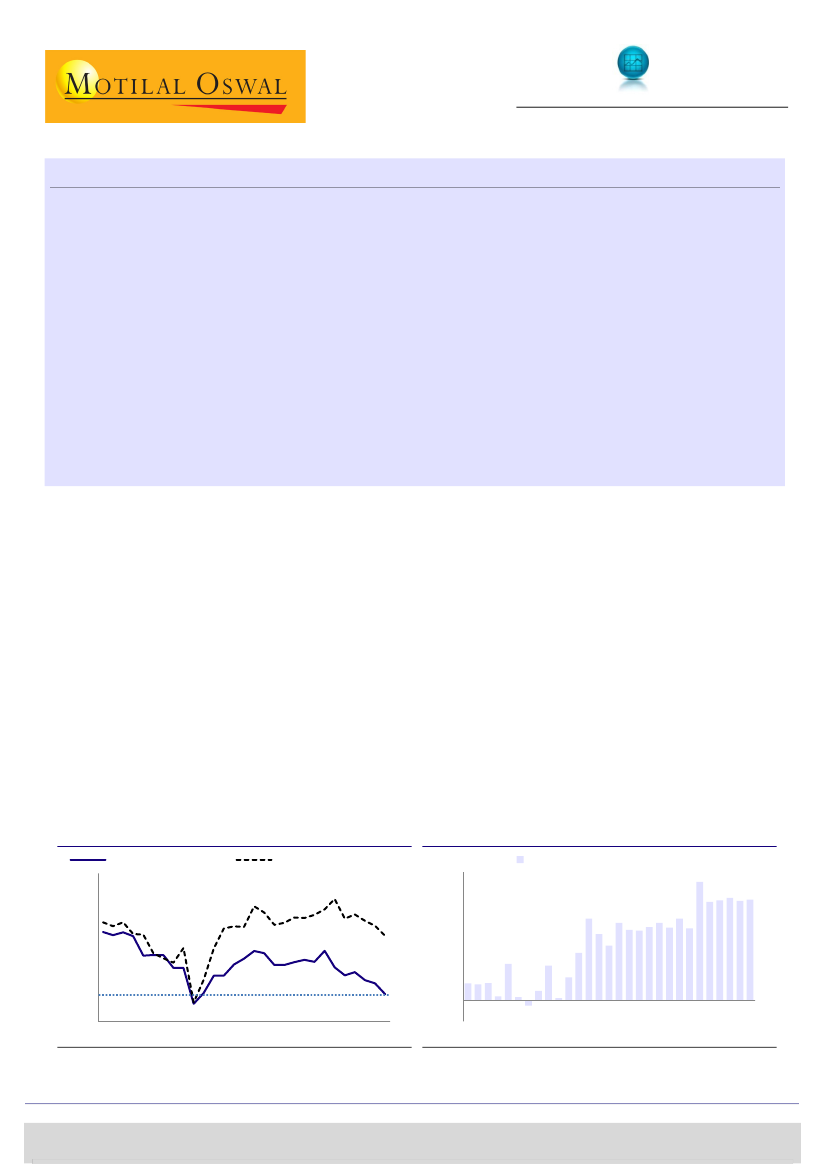
conducted in November 2017, the current situation index (CSI) fell from 95.5 in the
previous survey to 91.1
(Exhibit 1).
This is the lowest reading in four years and the
second lowest level on record (data available since 3QFY11 or quarter-ending
December 2010). Likewise, the future expectations index (FEI) has also fallen to a
four-year lowest level; however, it remains better than the level seen in 2012-2013.
Over the past few years, while consumers have grown more wary of the current
condition, they have remained optimistic about the future, as reflected in the
growing difference between FEI and CSI. While the two indices were very close to
each other until 2013, consumers have turned more confident about future from
2014. The present condition, however, started deteriorating after some
improvement seen in FY15. The difference between FEI and CSI was 23.6 points in
the recent survey, one of the highest since the record began in FY11
(Exhibit 2).
Exhibit 2: …and the divergence with future expectations
index (FEI) is among the highest
30
25
20
15
10
5
0
(5)
Difference between FEI and CSI
Exhibit 1: Consumers’ current situation index (CSI) is among
the lowest on record, according to CCS
140
Current Situation index
Future expectation index
120
100
80
Jun-11 Jun-12 Jun-13 Jun-14 Jun-15 Jun-16 Mar-17 Nov-17
Source: Reserve Bank of India (RBI), MOSL
Nikhil Gupta
– Research analyst
(Nikhil.Gupta@MotilalOswal.com); +91 22 3982 5405
Rahul Agrawal
– Research analyst
(Rahul.Agrawal@motilaloswal.com); +91 22 3982 5445
Investors are advised to refer through important disclosures made at the last page of the Research Report.
Motilal Oswal research is available on www.motilaloswal.com/Institutional-Equities, Bloomberg, Thomson Reuters, Factset and S&P Capital.

For the first time, more
respondents reported a
decline than increase in
income level vis-à-vis a year
ago
Current perception on income/employment the worst on record…:
The CSI is an
index based on its various components: economic conditions, income, spending,
employment and price level. The primary reason for the sharp deterioration in CSI is
the record-low readings in two of its components – income and employment. The
current perception of consumers on income has fallen to its lowest-ever level. For
the first time, more respondents reported a decline than increase in income level
vis-à-vis a year ago. While only 24.4% of respondents perceived their income rising
during the last one year, 28% of respondents – highest ever – perceived a decline in
their incomes
(Exhibit 3).
Similarly, the current perception on employment was also the lowest on record.
While the perception on employment has never been very high and has been in
negative territory earlier also, almost half of the respondents – highest on record –
perceived that the employment situation worsened during the last year
(Exhibit 3).
…however, record-high proportion of respondents reported higher spending:
Household income is one of the most important determinants of spending ability.
Economic theory tells us the higher the income, the higher the consumption.
However, CCS responses fail to match such economic theory. Although the current
perception of consumers about income (and employment) was at the lowest on
record (more respondents perceived a decline in income last year than increase), we
note that an overwhelming majority of consumers (~85% on net basis) reported
higher spending
(Exhibit 4).
Not only the share of respondents reporting higher
spending has increased in the past few surveys, but it has also increased to a record-
high of 84.3% in the recent survey.
Is this a coincidence that
when a record-high number
of respondents turned
pessimistic about income
and employment, the
highest number of
respondents reported
higher spending?
Is this just a coincidence that when a record-high number of respondents turned
pessimistic about income/employment, the highest number of respondents
reported higher spending, or is this the peak of irrationality? If consumer confidence
survey is not credible enough to be considered seriously, how credible then are the
inflationary expectations of households, which are considered an important input in
monetary policies, especially when both the surveys are based on responses from
about 5,000 households?
Exhibit 4: …however, spending perception improves to
record-high in November 2017 (% of net responses)
90
80
70
Consumer confidence survey: Current situation
Spending
(LHS)
40
30
20
10
Income
(RHS)
0
Exhibit 3: Current perception on income and employment at
record-low level (% of net responses)…
50
40
30
20
10
0
(10)
(20)
Employment
Income
Consumer confidence survey: Current situation
-3.6
60
50
(30)
Jun-11 Jun-12 Jun-13 Jun-14 Jun-15 Jun-16 Mar-17 Nov-17
-19.3
40
(10)
Jun-12 Jun-13 Jun-14 Jun-15 Jun-16 Mar-17 Nov-17
Source: RBI, MOSL
Net response = % of respondents with increase - % of respondents
with decrease
5 January 2018
2

Only ~33% of respondents –
on net basis – expect higher
income next year, down
from ~40% in 2016
Outlook for income/employment has also deteriorated significantly…:
Not only has
the current perception, but the one-year-ahead expectations have also witnessed a
serious dent in the past few surveys. According to the recent survey, only ~33% of
respondents – on net basis – expect higher income next year, down from ~40% in
2016
(Exhibit 5).
This is the second lowest reading on record.
Similarly, less than one-fifth of respondents expect an improvement in employment
condition over the next year, which is the lowest optimism in four years
(Exhibit 5).
Only ~45% of respondents – lower than ~60% in 2014 – expect an improvement in
employment conditions over the next year, while 27.4% – as against less than 10% in
2014 – anticipate a deterioration in the employment situation.
…however, future perception on spending still very robust:
Once again, however,
the survey fails to provide any support to the economic theory. While the one-year
ahead outlook for income and employment has fallen sharply and close to multi-
year lows, the future perception of consumer spending is close to its all-time highs.
While only about 2% of respondents – lowest on record – expect a decline in
spending over the next year, ~87% of respondents – close to the record high of
88.5% in March 2017 survey – expect an increase in consumer spending. Thus,
84.6% of respondents – on net basis – perceive an increase in consumer spending
over the next one year
(Exhibit 6).
Only ~45% of respondents –
lower than ~60% in 2014 –
expect an improvement in
employment condition over
the next year
Like the past year,
consumers are more
optimistic about the
spending next year than
their income and
employment prospects
Not only has the proportion of respondents – on net basis – expecting an increase in
spending over the next year has increased during the past few surveys (it was 80.7%
in June 2017 survey), but it is also close to the all-time high reading on record
(85.4% in March 2017 survey).
In short, like the past year, consumers are more optimistic about the spending
outlook next year than their income and employment prospects.
Exhibit 6: …however, spending outlook remains buoyant (%
of net responses)
100
80
60
40
Employment
20
0
Spending
Income
CCS: One-year expectations
Exhibit 5: One-year-ahead perception on income and
employment has also fallen (% of net responses)…
70
60
50
40
30
20
10
0
Jun-11 Jun-12 Jun-13 Jun-14 Jun-15 Jun-16 Mar-17 Nov-17
CCS: : One-year expectations
Income
(20)
Jun-11 Jun-12 Jun-13 Jun-14 Jun-15 Jun-16 Mar-17 Nov-17
Source: RBI, MOSL
5 January 2018
3

The divergence between
the present situation and
the future expectations for
income and employment
has also widened
considerably
Divergence between the present and future has widened:
As we noted the growing
divergence between consumers’ income/employment situation and their spending,
it is also important to note that the divergence between the present situation and
future expectations for income and employment has widened considerably.
In line with growing pessimism on the current situation, consumers have also
revised down their future expectations on income and employment. However, the
alteration in the future prospects is still mild relative to the present situation. While
more number of respondents reported a decline in income than increase last year,
about a third of respondents – on net basis – expect higher income next year. The
gap between the present situation and the future outlook has widened to 37
percentage points (pp), the highest on record
(Exhibit 7).
Similarly, while the one-year-ahead expectations on employment have also been
revised downward, about 18% of respondents expect employment to improve next
year and ~20% respondents – on net basis – reported deterioration in employment
during last year
(Exhibit 8).
The gap, thus, has widened to about 38pp.
Continuation of high
spending amid slower
income growth indicates
toward further fall in
household savings
Nevertheless, consumer spending remained buoyant during the past year and is
expected to remain as buoyant over the next year
(Exhibit 9).
While this is
perplexing, a continuation of high spending amid slower income growth indicates a
further fall in household savings.
Exhibit 8: Employment outlook is also expected to improve
substantially (% of net respondents)
80
60
40
37pp
20
0
(20)
Perception on employment
Compared to year ago
One-year expectations
Exhibit 7: Consumers expect better income in future amid
very weak present (% of net respondents)
80
60
22pp
40
20
0
(20)
Perception on Income
Compared to year ago
29pp
Jun-11 Jun-12 Jun-13 Jun-14 Jun-15 Jun-16 Mar-17 Nov-17
Jun-12
Jun-13
Jun-14
Jun-15
Jun-16 Mar-17 Nov-17
Source: RBI, CEIC, MOSL
Exhibit 9: Confidence on spending remains undeterred by
income/employment outlook (% of net respondents)
100
80
60
40
20
0
(20)
Jun-11 Jun-12 Jun-13 Jun-14 Jun-15 Jun-16 Mar-17 Nov-17
Exhibit 10: Lower number of respondents expect higher
inflation over the next year (% of net respondents)
100
90
80
70
60
50
Jun-11 Jun-12 Jun-13 Jun-14 Jun-15 Jun-16 Mar-17 Nov-17
Source: RBI, CEIC, MOSL
Perception on Price level
Compared to year ago
One-year expectations
Perception on spending
Compared to year ago
One-year expectations
5 January 2018
4

Adjustments to growing divergences key to future growth:
As we have discussed
earlier too (here and
here),
such divergences between income/employment and
consumption spending is unlikely to sustain for a long period of time. Pre-2013, the
proportion of respondents – on net basis – expecting higher income and spending
was close to each other. During 2013-14, while consumers turned wary of their
spending perception (which was also reflected in weak GDP growth), their income
outlook was still healthy.
Post-2014, however,
expectations have reversed.
While consumers turned
more optimistic on
spending, their income
outlook started worsening,
which has continued till
date
Post-2014, however, expectations have reversed. While consumers turned more
optimistic on spending, their income outlook started worsening, which has
continued till date. Consequently, while real GDP growth has maintained, household
savings have fallen drastically from ~23% of GDP in FY12 to ~18% in FY17 (Exhibit
11). Since savings are the primary raw material for domestic investments, it is not
surprising that domestic investments have fallen from ~40% of GDP in FY12 to ~33%
in FY17
(Exhibit 12).
Exhibit 12: Investments rate has fallen even more
dramatically during the past 5-6 years
Gross capital formation (% of GDP)
39.6
20 20 19
18
39.2
35.4
35.7
34.9
33.2
Exhibit 11: Household savings have fallen sharply toward
~18% in FY17
Household savings (% of GDP)
23 22
FY 99 FY01 FY03 FY05 FY07 FY09 FY11 FY13 FY15 FY17E
E = Our estimate for Physical savings
FY12
FY13
FY14
FY15
FY16
FY17
Source: CSO, RBI, CEIC, MOSL
If the outlook on
income/employment does
not alter positively,
consumers will have to
revise down their spending
outlook, creating risks for
real GDP growth
Since such divergences between income/employment and consumption must
disappear over time, the future course of economic growth will depend on the way
of convergence. If the economic environment improves, consumers are more likely
to turn optimistic about their income/employment perceptions and continue
spending more with higher savings. On the other hand, if the outlook on
income/employment does not alter positively, consumers will have to revise down
their spending outlook sooner rather than later. While the former scenario is the
most desirable case, the latter will create more risks to real GDP growth. According
to our base case, the possibility of the second scenario is more than the occurring of
the desirable (first) scenario.
5 January 2018
5

Disclosures:
The following Disclosures are being made in compliance with the SEBI Research Analyst Regulations 2014 (herein after referred to as the Regulations).
Motilal Oswal Securities Ltd. (MOSL) is a SEBI Registered Research Analyst having registration no. INH000000412. MOSL, the Research Entity (RE) as defined in the Regulations, is engaged in the business of providing Stock
broking services, Investment Advisory Services, Depository participant services & distribution of various financial products. MOSL is a subsidiary company of Motilal Oswal Financial Service Ltd. (MOFSL). MOFSL is a listed
public company, the details in respect of which are available on
www.motilaloswal.com.
MOSL is registered with the Securities & Exchange Board of India (SEBI) and is a registered Trading Member with National Stock
Exchange of India Ltd. (NSE) and Bombay Stock Exchange Limited (BSE), Metropolitan Stock Exchange Of India Ltd. (MSE) for its stock broking activities & is Depository participant with Central Depository Services Limited
(CDSL) & National Securities Depository Limited (NSDL) and is member of Association of Mutual Funds of India (AMFI) for distribution of financial products. Details of associate entities of Motilal Oswal Securities Limited are
available on the website at
http://onlinereports.motilaloswal.com/Dormant/documents/Associate%20Details.pdf
Pending Regulatory Enquiries against Motilal Oswal Securities Limited by SEBI:
SEBI pursuant to a complaint from client Shri C.R. Mohanraj alleging unauthorized trading, issued a letter dated 29th April 2014 to MOSL notifying appointment of an Adjudicating Officer as per SEBI regulations to hold
inquiry and adjudge violation of SEBI Regulations; MOSL requested SEBI to provide all documents, records, investigation report relied upon by SEBI which were referred in Show Cause Notice and also sought personal
hearing. The matter is currently pending.
MOSL, it’s associates, Research Analyst or their relative may have any financial interest in the subject company. MOSL and/or its associates and/or Research Analyst may have beneficial ownership of 1% or more securities in
the subject company at the end of the month immediately preceding the date of publication of the Research Report.
MOSL and its associate company(ies), their directors and Research Analyst and their relatives may; (a)
from time to time, have a long or short position in, act as principal in, and buy or sell the securities or derivatives thereof of companies mentioned herein. (b) be engaged in any other transaction involving such securities and
earn brokerage or other compensation or act as a market maker in the financial instruments of the company(ies) discussed herein or act as an advisor or lender/borrower to such company(ies) or may have any other
potential conflict of interests with respect to any recommendation and other related information and opinions.; however the same shall have no bearing whatsoever on the specific recommendations made by the analyst(s),
as the recommendations made by the analyst(s) are completely independent of the views of the associates of MOSL even though there might exist an inherent conflict of interest in some of the stocks mentioned in the
research report.
Research Analyst may have served as director/officer, etc. in the subject company in the last 12 month period. MOSL and/or its associates may have received any compensation from the subject company in
the past 12 months.
In the last 12 months period ending on the last day of the month immediately preceding the date of publication of this research report, MOSL or any of its associates may have:
a)
managed or co-managed public offering of securities from subject company of this research report,
b)
received compensation for investment banking or merchant banking or brokerage services from subject company of this research report,
c)
received compensation for products or services other than investment banking or merchant banking or brokerage services from the subject company of this research report.
d)
Subject Company may have been a client of MOSL or its associates during twelve months preceding the date of distribution of the research report.
MOSL and it’s associates have not received any compensation or other benefits from the subject company or third party in connection with the research report. To enhance transparency, MOSL has incorporated a Disclosure
of Interest Statement in this document. This should, however, not be treated as endorsement of the views expressed in the report. MOSL and / or its affiliates do and seek to do business including investment banking with
companies covered in its research reports. As a result, the recipients of this report should be aware that MOSL may have a potential conflict of interest that may affect the objectivity of this report. Compensation of Research
Analysts is not based on any specific merchant banking, investment banking or brokerage service transactions.
Terms & Conditions:
This report has been prepared by MOSL and is meant for sole use by the recipient and not for circulation. The report and information contained herein is strictly confidential and may not be altered in any way, transmitted to,
copied or distributed, in part or in whole, to any other person or to the media or reproduced in any form, without prior written consent of MOSL. The report is based on the facts, figures and information that are considered
true, correct, reliable and accurate. The intent of this report is not recommendatory in nature. The information is obtained from publicly available media or other sources believed to be reliable. Such information has not
been independently verified and no guaranty, representation of warranty, express or implied, is made as to its accuracy, completeness or correctness. All such information and opinions are subject to change without notice.
The report is prepared solely for informational purpose and does not constitute an offer document or solicitation of offer to buy or sell or subscribe for securities or other financial instruments for the clients. Though
disseminated to all the customers simultaneously, not all customers may receive this report at the same time. MOSL will not treat recipients as customers by virtue of their receiving this report.
Analyst Certification
The views expressed in this research report accurately reflect the personal views of the analyst(s) about the subject securities or issues, and no part of the compensation of the research analyst(s) was, is, or will be directly or
indirectly related to the specific recommendations and views expressed by research analyst(s) in this report.
Disclosure of Interest Statement
Analyst ownership of the stock
Companies where there is interest
No
A graph of daily closing prices of securities is available at
www.nseindia.com, www.bseindia.com.
Research Analyst views on Subject Company may vary based on Fundamental research and Technical Research. Proprietary
trading desk of MOSL or its associates maintains arm’s length distance with Research Team as all the activities are segregated from MOSL research activity and therefore it can have an independent view with regards to
subject company for which Research Team have expressed their views.
Regional Disclosures (outside India)
This report is not directed or intended for distribution to or use by any person or entity resident in a state, country or any jurisdiction, where such distribution, publication, availability or use would be contrary to law,
regulation or which would subject MOSL & its group companies to registration or licensing requirements within such jurisdictions.
For Hong Kong:
This report is distributed in Hong Kong by Motilal Oswal capital Markets (Hong Kong) Private Limited, a licensed corporation (CE AYY-301) licensed and regulated by the Hong Kong Securities and Futures Commission (SFC)
pursuant to the Securities and Futures Ordinance (Chapter 571 of the Laws of Hong Kong) “SFO”. As per SEBI (Research Analyst Regulations) 2014 Motilal Oswal Securities (SEBI Reg No. INH000000412) has an agreement with
Motilal Oswal capital Markets (Hong Kong) Private Limited for distribution of research report in Hong Kong. This report is intended for distribution only to “Professional Investors” as defined in Part I of Schedule 1 to SFO. Any
investment or investment activity to which this document relates is only available to professional investor and will be engaged only with professional investors.” Nothing here is an offer or solicitation of these securities,
products and services in any jurisdiction where their offer or sale is not qualified or exempt from registration. The Indian Analyst(s) who compile this report is/are not located in Hong Kong & are not conducting Research
Analysis in Hong Kong.
For U.S.
Motilal Oswal Securities Limited (MOSL) is not a registered broker - dealer under the U.S. Securities Exchange Act of 1934, as amended (the"1934 act") and under applicable state laws in the United States. In addition MOSL is
not a registered investment adviser under the U.S. Investment Advisers Act of 1940, as amended (the "Advisers Act" and together with the 1934 Act, the "Acts), and under applicable state laws in the United States.
Accordingly, in the absence of specific exemption under the Acts, any brokerage and investment services provided by MOSL, including the products and services described herein are not available to or intended for U.S.
persons. This report is intended for distribution only to "Major Institutional Investors" as defined by Rule 15a-6(b)(4) of the Exchange Act and interpretations thereof by SEC (henceforth referred to as "major institutional
investors"). This document must not be acted on or relied on by persons who are not major institutional investors. Any investment or investment activity to which this document relates is only available to major institutional
investors and will be engaged in only with major institutional investors. In reliance on the exemption from registration provided by Rule 15a-6 of the U.S. Securities Exchange Act of 1934, as amended (the "Exchange Act") and
interpretations thereof by the U.S. Securities and Exchange Commission ("SEC") in order to conduct business with Institutional Investors based in the U.S., MOSL has entered into a chaperoning agreement with a U.S.
registered broker-dealer, Motilal Oswal Securities International Private Limited. ("MOSIPL"). Any business interaction pursuant to this report will have to be executed within the provisions of this chaperoning agreement.
The Research Analysts contributing to the report may not be registered /qualified as research analyst with FINRA. Such research analyst may not be associated persons of the U.S. registered broker-dealer, MOSIPL, and
therefore, may not be subject to NASD rule 2711 and NYSE Rule 472 restrictions on communication with a subject company, public appearances and trading securities held by a research analyst account.
For Singapore
Motilal Oswal Capital Markets Singapore Pte Limited is acting as an exempt financial advisor under section 23(1)(f) of the Financial Advisers Act(FAA) read with regulation 17(1)(d) of the Financial Advisors Regulations and is a
subsidiary of Motilal Oswal Securities Limited in India. This research is distributed in Singapore by Motilal Oswal Capital Markets Singapore Pte Limited and it is only directed in Singapore to accredited investors, as defined in
the Financial Advisers Regulations and the Securities and Futures Act (Chapter 289), as amended from time to time. In respect of any matter arising from or in connection with the research you could contact the following
representatives of Motilal Oswal Capital Markets Singapore Pte Limited:
Disclaimer:
The report and information contained herein is strictly confidential and meant solely for the selected recipient and may not be altered in any way, transmitted to, copied or distributed, in part or in whole, to any other person
or to the media or reproduced in any form, without prior written consent. This report and information herein is solely for informational purpose and may not be used or considered as an offer document or solicitation of
offer to buy or sell or subscribe for securities or other financial instruments. Nothing in this report constitutes investment, legal, accounting and tax advice or a representation that any investment or strategy is suitable or
appropriate to your specific circumstances. The securities discussed and opinions expressed in this report may not be suitable for all investors, who must make their own investment decisions, based on their own investment
objectives, financial positions and needs of specific recipient. This may not be taken in substitution for the exercise of independent judgment by any recipient. Each recipient of this document should make such investigations
as it deems necessary to arrive at an independent evaluation of an investment in the securities of companies referred to in this document (including the merits and risks involved), and should consult its own advisors to
determine the merits and risks of such an investment. The investment discussed or views expressed may not be suitable for all investors. Certain transactions -including those involving futures, options, another derivative
products as well as non-investment grade securities - involve substantial risk and are not suitable for all investors. No representation or warranty, express or implied, is made as to the accuracy, completeness or fairness of
the information and opinions contained in this document. The Disclosures of Interest Statement incorporated in this document is provided solely to enhance the transparency and should not be treated as endorsement of the
views expressed in the report. This information is subject to change without any prior notice. The Company reserves the right to make modifications and alternations to this statement as may be required from time to time
without any prior approval. MOSL, its associates, their directors and the employees may from time to time, effect or have effected an own account transaction in, or deal as principal or agent in or for the securities
mentioned in this document. They may perform or seek to perform investment banking or other services for, or solicit investment banking or other business from, any company referred to in this report. Each of these entities
functions as a separate, distinct and independent of each other. The recipient should take this into account before interpreting the document. This report has been prepared on the basis of information that is already
available in publicly accessible media or developed through analysis of MOSL. The views expressed are those of the analyst, and the Company may or may not subscribe to all the views expressed therein. This document is
being supplied to you solely for your information and may not be reproduced, redistributed or passed on, directly or indirectly, to any other person or published, copied, in whole or in part, for any purpose. This report is not
directed or intended for distribution to, or use by, any person or entity who is a citizen or resident of or located in any locality, state, country or other jurisdiction, where such distribution, publication, availability or use would
be contrary to law, regulation or which would subject MOSL to any registration or licensing requirement within such jurisdiction. The securities described herein may or may not be eligible for sale in all jurisdictions or to
certain category of investors. Persons in whose possession this document may come are required to inform themselves of and to observe such restriction. Neither the Firm, not its directors, employees, agents or
representatives shall be liable for any damages whether direct or indirect, incidental, special or consequential including lost revenue or lost profits that may arise from or in connection with the use of the information.
The
person accessing this information specifically agrees to exempt MOSL or any of its affiliates or employees from, any and all responsibility/liability arising from such misuse and agrees not to hold MOSL or any of its affiliates or
employees responsible for any such misuse and further agrees to hold MOSL or any of its affiliates or employees free and harmless from all losses, costs, damages, expenses that may be suffered by the person accessing this
information due to any errors and delays.
Registered Office Address: Motilal Oswal Tower, Rahimtullah Sayani Road, Opposite Parel ST Depot, Prabhadevi, Mumbai-400025; Tel No.: 022-3980 4263; www.motilaloswal.com. Correspondence Address: Palm Spring
Centre, 2nd Floor, Palm Court Complex, New Link Road, Malad (West), Mumbai- 400 064. Tel No: 022 3080 1000. Compliance Officer: Neeraj Agarwal, Email Id:
na@motilaloswal.com,
Contact No.:022-30801085.
Registration details of group entities.: MOSL: SEBI Registration: INZ000158836; CDSL: IN-DP-16-2015; NSDL: IN-DP-NSDL-152-2000; Research Analyst: INH000000412. AMFI: ARN 17397. Investment Adviser: INA000007100.
Motilal Oswal Asset Management Company Ltd. (MOAMC): PMS (Registration No.: INP000000670) offers PMS and Mutual Funds products. Motilal Oswal Wealth Management Ltd. (MOWML): PMS (Registration No.:
INP000004409) offers wealth management solutions. *Motilal Oswal Securities Ltd. is a distributor of Mutual Funds, PMS, Fixed Deposit, Bond, NCDs, Insurance and IPO products. * Motilal Oswal Commodities Broker Pvt. Ltd.
offers Commodities Products. * Motilal Oswal Real Estate Investment Advisors II Pvt. Ltd. offers Real Estate products. * Motilal Oswal Private Equity Investment Advisors Pvt. Ltd. offers Private Equity products
5 January 2018
6