Thematic | July 2018
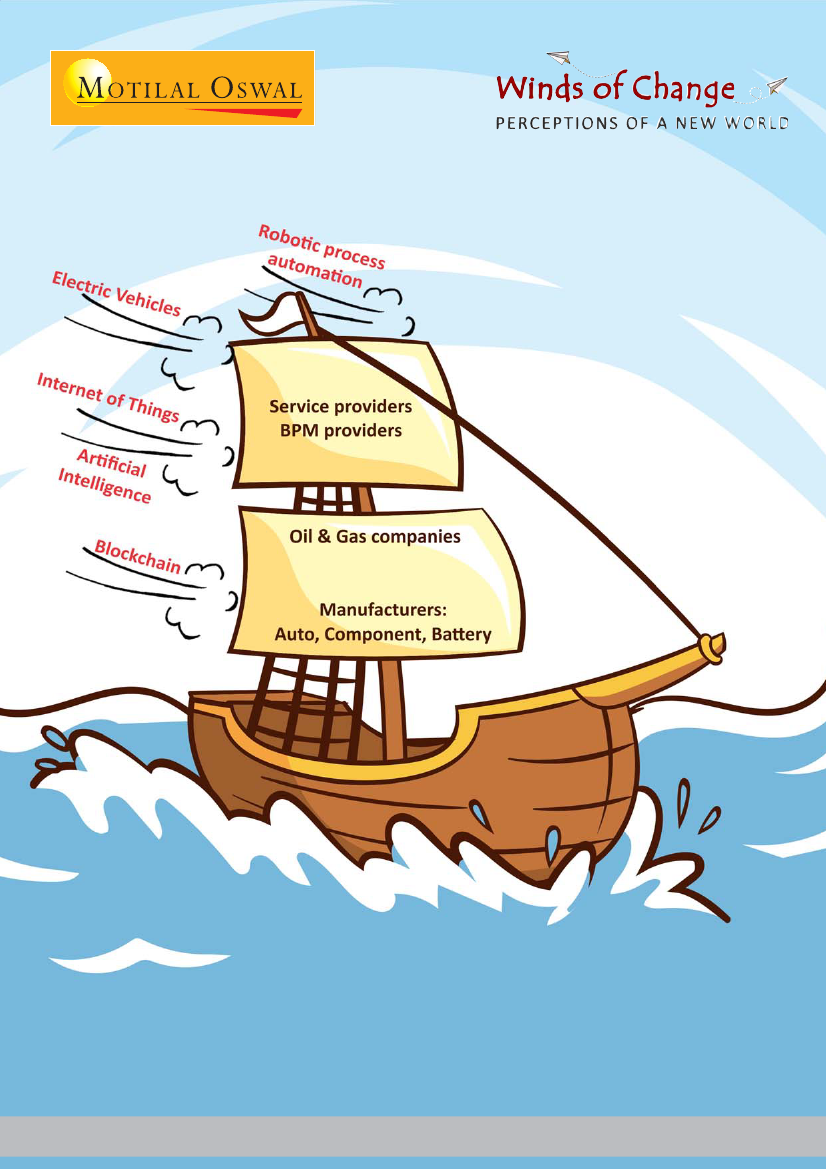
Imminent disruptions
Research Team (Gautam.Duggad@MotilalOswal.com)
Investors are advised to refer through important disclosures made at the last page of the Research Report.
Motilal Oswal research is available on www.motilaloswal.com/Institutional-Equities, Bloomberg, Thomson Reuters, Factset and S&P Capital.
 Motilal Oswal Financial Services
| Thematic
Contents: Imminent disruptions
Summary............................................................................................................................... 2
Technology | Indian IT’s Future Tense?................................................................................. 4
BLOCKCHAIN and the future of ENTERPRISE adoption .......................................................... 5
Internet of Things ............................................................................................................... 13
Why Digital is not a secular tailwind for service providers? ................................................ 16
Automobiles ....................................................................................................................... 24
Electrification inevitably the way forward .......................................................................... 25
India and electrification dream ........................................................................................... 29
Various estimates put EV penetration at 25-40% by 2030 ................................................... 32
What changes does electrification bring? ........................................................................... 36
Oil & Gas ............................................................................................................................. 40
Hydrocarbons – death by the electrons?............................................................................. 41
Conference takeaways ........................................................................................................ 45
12 July 2018
1
 Motilal Oswal Financial Services
12
| Thematic
July 2018
Technology
Imminent disruptions
Electric Vehicles & Digitization
“In the long history of mankind (and animal kind, too), those who learned to
collaborate and improvise most effectively have prevailed.”
-
Charles Darwin
Disruption in any part of the value chain has the potential to send centuries-old firmly-
rooted companies/industries into oblivion. A classic example is that of Kodak. It
invented photographic film and retained its dominant position for nearly a century.
However, inability to correctly align with the winds of change brought about by digital
photography resulted in bankruptcy.
In this report, we look at two disruptive forces shaping up today – Electric Vehicles
(EVs) and Digitalization, which may have a profound impact on automobile, oil and
gas, and technology sectors – how soon or late, only time will tell.
Motilal Oswal values your
support in the Asiamoney
Brokers Poll 2018 for India
Research, Sales and Trading
team. We
request your ballot.
Digitalization - Indian IT’s future tense?
Labor arbitrage, efficient processes and quality delivery as recipe of success for
Indian IT companies are passé. There is a clear need to adopt agile methods of
development, greater productivity through automation and new-age digital
platforms.
Driven by a new focus on digital transformation, companies are investing more
in new technologies like Smart Analytics, Robotic Process Automation (RPA),
Artificial Intelligence (AI) and blockchain among others.
Blockchain itself is expected to offer USD10-50b of market for service providers
in next few years. Both Internet of Things (IoT) and AI intersect with blockchain.
Early adopters of these new-age technologies will have the ability to partner
with their clients in these fast changing times.
Electric vehicles and fossil fuels – the ultimate race!
Research Analyst
Swarnendu Bhushan
(Swarnendu.Bhushan@MotilalOswal.com);
+91 22 6129 1529
Jinesh Gandhi
(Jinesh.Gandi@MotilalOswal.com);
+91 22 6129 1524
Ashish Chopra
(Ashish.Chopra@MotilalOswal.com);
+91 22 6129 1530
Rising pollution drives necessity:
Transportation accounts for as much as ~30%
of greenhouse gases (GHGs) in developed economies. In developing economies
like India and China, the share is much lower at 6-7%. However, urban areas
share the same fate. In Delhi, transportation accounts for 83% of CO, 36% of
NOx, 20% of PM2.5, and 9% of PM10. Winter aggravates the problem.
Electrification inevitably the way forward:
Electric Vehicles (EVs) by virtue of
zero discharge offer immense potential. Although costlier than Internal
Combustion Engines (ICEs) now, regulatory push and government incentives are
likely to drive adoption till the time economics catches up.
Shifting lanes:
In India, component manufacturers are likely to witness highest
disruption. Largest opportunity lies for Li-ion based battery manufacturers,
potentially USD42b market by 2030!
12 July 2018
2
 Motilal Oswal Financial Services
| Thematic
Growth of petrol/diesel consumption could be severely impacted in the longer
term:
In the near-medium term, with increase in road and vehicle density, we
expect ~10%/5% consumption growth in petrol and diesel. We do not envisage a
major impact in the near-medium term. In the longer term, if the market share
of EVs were to rise to 30% of new vehicle sales, this would bring down the
consumption growth to 7% and 3.5%, respectively. What happens to the older
existing stock of vehicles would determine further impact.
CNG could be threatened:
CNG has gained prominence in areas like Delhi and
Mumbai that have been facing severe pollution problems. Since EVs are zero-
emission vehicles (ZEVs), transport fleets – both private and public – may be the
first to adopt EVs. ~25% of IGL’s CNG volumes come from buses; these volumes
could be adversely impacted if public transport shifts to EVs.
Winds of change- the conference highlights
We also invited few interesting companies in IT, Auto and Oil and gas space to
interact with leading investors.
New age digital technologies have sprung several companies and are witnessing
adoption by bigger players.
EVs in India would be largely market driven rather than incentive driven. New
business models like battery swapping, vehicle leasing would emerge.
While EVs would eventually threaten oil companies, we still need to prepare for
the short-medium term. Gas companies would be the least affected.
12 July 2018
3
 Motilal Oswal Financial Services
| Thematic
Thematic
|
Technology
Indian IT’s Future Tense?
New technologies have been fast emerging in recent years, and
their impact has unfolded on every small and big walk of life. As
the list of the ‘next-big-things’ gets longer, business models are
falling by the side and many industries are losing relevance. Not
least at risk has been Indian IT, whose labor arbitrage, efficient
processes and quality delivery have been already termed as relics
of the era past.
The new era of services hovers around agile method of
development, with an approach of greater productivity through
Automation. It is touted to be about leveraging technologies such
as Blockchain, IoT and Cognitive AI to build next-gen smart and secure Enterprises.
As the bread-and-butter pie for Indian IT gradually shrinks, there is an urgent need
to up-skill their employees and pivot their business models to new-age Digital.
Two schools of thoughts emerge in the context of the industry’s preparedness
when it comes to addressing the Digital opportunity –
[1] Next set of technologies means next wave of opportunities and
[2] Structural shift of business models, which only those most prepared, will
transition through, while many others will succumb.
This section not only deliberates briefly on the end-game from the Indian context,
but also elaborates two of the many buzz terms capturing the imagination of the
Technology landscape at large: [1] The more immediate Internet of Things, and [2]
The next-big-trend of Blockchain.
3 Emerging technologies for the future
Service providers
BPM providers
Ashish Chopra – Research analyst
(Ashish.Chopra@MotilalOswal.com); +91 22 3982 5424
12 July 2018
Sagar Lele – Research analyst
(Sagar.Lele@MotilalOswal.com); +91 22 3982 5585
4
 Motilal Oswal Financial Services
| Thematic
BLOCKCHAIN and the future of ENTERPRISE adoption
As the old technology models pave way for the new models driven by the agenda of
Digital Transformation, clients’ value focus is driving investments in the following
areas:
[1] Smart Analytics
[2] RPA
[3] AI
[4] Global Sourcing
[5] Blockchain
[6] Digital business models
We hereby have laid out one of the hottest and newest buzz in the fray –
Blockchain.
What is Blockchain?
A blockchain is a
peer-to-peer distributed ledger
that is
cryptographically
secure,
append-only, immutable, and updatable only via consensus or
agreement among peers.
It is an interlinked and continuously expanding list of records stored securely
across a number of interconnected systems. This makes blockchain technology
resilient since the network has no single point of vulnerability.
Additionally, each ‘block’ is uniquely connected to the previous blocks via a
digital signature, which means that making a change to a record without
disturbing the previous records in the chain is not possible, rendering the
information tamper-proof.
The key innovation in blockchain technology is that it allows its participants to
transfer assets across the internet without the need for a centralized third-
party.
12 July 2018
5
 Motilal Oswal Financial Services
| Thematic
Six features that give it a disruptive potential
1.
It is a system of
distributed shared data
with no central administrator, no single
point of failure.
2.
Consensus-driven
trust that cuts out the middle-mam. Trust is driven by an
algorithm. No overpriced intermediaries.
3.
The
immutability
also builds trust. Each block contains a timestamp and link to
previous block, which makes it inherently resistant to modification.
4.
Integrity
and security
are generated by encrypting every record, creating strong
resilience to cyber security concerns.
5.
Smart contracts
allow contracts to auto-execute based on some preset rules
and conditions. It allows for much higher levels of straight through processing.
Millions of IoT devices will find this relevant. Hence, the linkage between IoT
and Blockchain.
6.
Permission and permission-less flavors
give enterprises the flexibility to choose
what their solution is, based on needs and references. Like public and private
clouds – each has its advantages and use case.
A hot-bed of activity: Courtesy HFS Research
The buzz around Blockchain is currently evidenced by ~1,000 investors and
~2,000 start-ups in the segment.
Current market size in blockchain ranges from USD400-800m. However, the
potential is to grow to USD10-50b in the next few years.
Exhibit 1:
Blockchain could grow to USD10-50b market from current size of <USD1b
Source: ISG
12 July 2018
6
 Motilal Oswal Financial Services
| Thematic
Exhibit 2:
Cryptocurrencies have dominated the use of Blockchain thus far
Source: HFS Research
Blockchain adoption by enterprises today
Still early days, as 90-95% of usage of Blockchain technology is centered around
strategy formulation and POC. 5% or even lesser is beyond a pilot and into
production.
Once we get into production-ready blockchain solutions, there will be a huge
market for systems integration across blockchain and legacy ERP and IT
technology from the IT Services perspective.
As per HFS, Blockchain is going through the classic 90-9-1 challenge, where 90%
of enterprises lack understanding of what a distributed ledger technology is and
what its use cases are. 9% understand but don’t know where to start from – RoI
visibility, consortia-related challenges. 1% struggle with regulatory uncertainty,
talent availability.
There are real technical, latency and cross-version challenges. The community is
still working on addressing these. It will be a 5-to-7 year journey to deliver on
promise-land of disintermediating and creating new revenue streams.
Exhibit 3:
Global blockchain initiatives
Source: Company, MOSL
12 July 2018
7
 Motilal Oswal Financial Services
| Thematic
The use cases are quickly expanding to more industries and governments, and a lot
of activity is seen across the board from different kinds of players. Yet, it’s still in an
early growth stage. However, organizations are finding more and more ways to
capture the business value in it. Creating new value is a prime focus for most
companies, so blockchain will be highly disruptive and the adoption pace will quickly
accelerate.
Exhibit 4:
Global blockchain initiatives in government and public sector space
12 July 2018
8
 Motilal Oswal Financial Services
| Thematic
Source: Company, MOSL
Exhibit 5:
Some challenges remain for BFSI institutions seeking to implement blockchain
Source: Company, MOSL
Intersection with three current technology trends
IoT
is the emerging technology intersecting with blockchain – notably in the
area of smart contracts, where connected devices in a blockchain network may
trigger and execute transactions in a secure manner without human
intervention
Another emerging area witnessing blockchain intersection is
AI.
A lot of data
gets created with blockchain. AI and ML, NLP technologies are needed to
understand and make sense from this data.
The question of energy consumption
Bitcoin is an example of proof-of-work. If one wants to record any transaction on a
blockchain, he/she has to show a lot of work. In computational terms, it means lot
of computational power needed to create one block in bitcoin. Hence, bitcoin is not
one of the most popular use cases in enterprise adoption terms, despite all the
noise around it. It is not the best platform since it is so power hungry. However, the
technology does have the throughput needed by enterprises, and hence will find
deployment.
Market players (platform providers)
Two players dominate today (as per ISG): MS (public blockchain) and IBM (private).
Appended below are the anecdotes of work done
12 July 2018
9
 Motilal Oswal Financial Services
| Thematic
IBM
– tied up with Nestle, Walmart to trace movement of food and reduce
contamination
Microsoft
– partnered with BofA to transform highly manual trade finance
structure
HFS, on the other hand, has identified 20+ solution provider leaders in the early
stage of blockchain
Ethereum and hyperledger
account for majority of the enterprise blockchain
adoption use cases, according to HfS.
Adoption of hyperledger fabric should pick up even more with new production-
ready solutions.
Exhibit 6:
The market of Blockchain players
Source: Company, MOSL
Players from a myriad of industries are trying to solve problems using the blockchain
ecosystem. The three layers of blockchain, according to HFS, are:
1.
At the bottom is the platform or rules of the game – bitcoin, ethereum, hyper-
ledger, etc.
2.
Above that are the technology players – Consensys, IBM and Oracle, which use
these rules of the game to create solutions.
3.
Right at the top are service providers, consortiums and start-ups, which are
using these technologies to help solve business problems. Legal firms,
academicians also play a crucial role.
12 July 2018
10
 Motilal Oswal Financial Services
| Thematic
The play for service providers
For service providers, the opportunity is very similar to that in the cloud. This
will entail building applications on massive scale platforms and support new
operating models that these next gen apps create. Even the cloud native
environment required new type of thinking and managed services. The same
pattern will emerge with blockchain.
So, application builders on industry
specific-use cases will win it.
There are budding examples of the role played by service providers in the
ecosystem:
Virtusa
– Has worked on a blockchain platform for
media industry;
enabling
consortium companies to better share customer data.
Accenture
and
DHL
have developed a pharmaceutical prototype that tracks
drugs from seller to the consumer.
Walmart
is experimenting in the supply chain. Today, it is very hard to figure
out where the product lost its quality along the value chain. It is a
compliance issue. With blockchain, the product can be traced from the farm
to the consumer. That will be hugely impactful in the food safety context.
Primarily the market for SPs is all about SI projects right now. Most are pilots,
which is a relatively small opportunity today. Some pilots doing well, others
getting shuttered. Project-based work right now. But that's what cloud was
several years ago.
The consulting big-4 are becoming winners in this space, as this requires
consultancy through the 90-9-1 challenge.
What is in it for BPM providers?
The pure-play BPM providers bring process and domain expertise. They need to
partner with technology firms rather than focusing on building technology
themselves.
BPM providers can help clients understand how blockchain will or will not help.
Take that consultative approach to help customers through the hype.
How the market for blockchain services will shape up
HfS Research expects maturity to happen over three phases:
1.
Payment and transaction settlement. Financial services will find deployment in
use cases such as payment systems and transaction settlement are becoming
mature now.
2.
In the second phase are a plethora of pilots, and trials will take place in areas
outside FS. These include supply chains, point-of-sale cases for retail and
copyright access for media companies. Second phase will largely comprise of
these pilots.
3.
This will see realization beyond the pilot mode. Scam detection, smart contracts
and digital identity management are some examples of applications.
2018 is the year when blockchain is expected to move outside the FS industry into
any organization where recording and verification of information is required.
12 July 2018
11
 Motilal Oswal Financial Services
| Thematic
The investors’ perspective
Blockchain is one of the biggest bubbles today. However, they are potentially as
significant as the internet, even though revenues from enterprise blockchain
adoption here are still small. Compare that to the other hype that is Robotic Process
Automation (RPA)!
Exhibit 7:
Blockchain and the investment community – bubble already?
Source: Company, MOSL
12 July 2018
12
 Motilal Oswal Financial Services
| Thematic
Internet of Things
If we had computers that knew everything there was to know about things – using
data they gathered without any help from us – we would be able to track and
count everything, and greatly reduce waste, loss and cost. We would know when
things needed replacing, repairing or recalling, and whether they were fresh or
past their best.
Poised for exponential growth
IoT is poised for exponential growth globally, with the number of connected
devices expected to grow 5.5x to 20.8 billion.
The global IoT market will grow from USD157b in 2016 to USD457b by 2020,
attaining a CAGR of 28.5%, according to GrowthEnabler.
Discrete manufacturing, transportation and logistics, and utilities will lead all
industries in IoT spending by 2020, averaging USD40b each.
Bain predicts B2B IoT segments will generate more than USD300b annually by
2020, including ~USD85b in the industrial sector.
Internet Of Things market is likely to reach USD267b by 2020, according to
Boston Consulting Group.
Various technological, economic and behavioral factors are driving the uptake of IoT
globally:
Low-cost sensors, declining cost of connectivity, and reduced cost and time of
processing will play a key role in the rise and adoption of IoT.
Use of big data analytics and cloud computing will enable processing and
analysis of unstructured data to move from insights to foresights.
Consumer interest in IoT technologies is also rising due to increased reliance on
mobile devices.
Exhibit 8:loT
revenue* by category (USD billion), 2014-2020
Source: Company, MOSL
12 July 2018
13
 Motilal Oswal Financial Services
| Thematic
Opportunities
Energy
Industrials
Safety and security
Consumer
Agriculture
Use management, smart meters, grid control
Discrete and process manufacturing, transportation
Video surveillance, access control, environmental monitoring
Payment solutions, in-store experience, smart devices and appliances
Input application, growth and health monitoring, and traceability assurance
IoT economic value-add of USD1.9t by 2022, 80% of supplier revenue will be derived
from services.
Taking the example of two companies:
HCLT’s IoT works – first comprehensive IoT framework among ISPs
Exhibit 9:
Relative potential of revenues from service segments over lifecycle of a typical loT project*
Source: Company, MOSL
Exhibit 10:
IoT @HCLT
Source: Company, MOSL
12 July 2018
14
 Motilal Oswal Financial Services
| Thematic
Exhibit 11:
Zinnov predicts multi-year growth in IoT spending by Enterprises
Source: Company, MOSL
IOT – a key focus area for Persistent Systems
Even though there are numerous proprietary IoT platforms currently available,
with a wide variety in both functionality and implementation, there are common
basic elements in most.
Persistent believes in providing end-to-end IoT platform that is foundational,
scalable and extensible. It also emphasizes on security considerations, which are
paramount in the design of an IoT platform. This encompasses almost every
component of an IoT platform. It is absolutely necessary to design every
component and every interface in an IoT system with security considerations in
mind – everything from data security and privacy to data integrity and network
security.
In line with market demand and the need to focus on IoT, PSYS has brought
together market-facing IoT groups from its Alliance and Accelerite as one unit.
This will strengthen the IoT offering by leveraging the IP, solutions and device
and sensor partnerships across a wider set of platform partners.
PSYS had entered into an agreement with IBM in FY16 to support and extend
the IBM Continuous Lifecycle Management and Continuous Engineering product
suite. New sites were established in Gadalajara, Mexico- Rehovot,
Israel- Ottawa, Canada and Edinburgh, Scotland during the year.
In terms of market potential, IDC forecasts that the worldwide market for IoT
solutions will grow from USD1.9t in 2013 to USD7.1t in 2020. An IoT platform
implies the integration of a set of different functionalities provided by individual
components.
12 July 2018
15
 Motilal Oswal Financial Services
| Thematic
Why Digital is not a secular tailwind for service providers?
Appended below is our learning from industry interactions as to why Digital looks
like a structural shift very capable of driving industry consolidation, as and when
many companies will fall prey to the complexities hurting growth in business along
with profitability.
Technology challenge – transient issues or structural erosion of relative
capabilities
Gradual slowdown of dollar revenue growth, pricing pressure in traditional services,
margin limitations in the newer services and concerns around transformation to
remain in clients’ relevant set have now been well documented concerns that have
dominated the IT industry landscape for over an year – driving material
underperformance to the index.
The acquisitive rush at the likes of Accenture and Cognizant, sizeable bets at Wipro,
and likewise intent (albeit little action) at INFO and others is another example of the
gaps that companies clearly feel the need to bridge – gaps that are at the heart of
industry’s gradually dipping performance. How surmountable are the challenges
from a medium-to-long term perspective? Digital will get industrialized at some
point and that is when India’s cost advantage will find its way back into the
equation. However, in our view, this is oversimplification of industry’s business
drivers.
Exhibit 12:
Acquisitions or not, direction of revenue growth is secular
Revenue YoY CC (%)
1QFY16
2QFY16
3QFY16
4QFY16
1QFY17
Acquisitions
Acquisitions
Acquisitions
TCS
INFO
WPRO
HCLT
TECHM
Source: Company, MOSL
12 July 2018
16
 Motilal Oswal Financial Services
| Thematic
Exhibit 13:
The changing models are telling on the RoICs
Source: Company, MOSL
The right comparison set of the past
Digital is not an overnight phenomenon but will evolve over the next 5+ years. The
more important question is:
1)
Is this akin to the next new opportunity like IMS, e-commerce and ERP in the
past; or
2)
a more deep-rooted change like the shift toward low-cost destinations
witnessed amid the prime of labor arbitrage.
This is key because it will determine the secularity with which the industry embraces
the opportunity. Scenario-2 is obviously the more complex one, as it is one thing to
know the imperatives and completely another to master the change! As Everest CEO
Peter Bendor Samuel put it – years ago, most leaders of the IT Services industry such
as ACS, CSC and EDS understood the components that comprised the switch to the
labor arbitrage model, but the firm could not master the business model change.
Only Accenture and IBM succeeded in this effort because they were the only two
that actually managed to have sufficient will to execute on the new model, despite
the ostensible ‘cannibalization’ of their mainstream business.
Why we think the transformation is much more complex?
Below are some of the anecdotes around Digital business imperatives, and this is
not an exhaustive list:
1)
Digital is all about consultative proactive selling, and not about responding to
RFPs.
2)
The deal sizes are negligible to start with, and then they grow on to become
bigger. However, you don’t have USD50-100m deals here (on the other hand,
traditional large deals undergo some contraction with every renewal).
3)
The business models will depend upon the solution: fixed price, license (for own
IP), linked to client outcomes, subscription (usage) based etc.
4)
Buyer organization is different – CXO, marketing team, supply chain team,
product team, etc. and not just the CIO organization.
12 July 2018
17
 Motilal Oswal Financial Services
| Thematic
5)
Onsite centricity is an imperative for the clients to gain comfort in the business.
6)
Automation is an absolute must – people-centric model will transform to people
+ software combine.
7)
Capability in agile development and iterative solution building is the approach–
fail-fast. Traditional methodology was longer-term contracts that were delivered
fail-proof.
Exhibit 14:
Digital v/s traditional – contrasting styles of working
Source: Company, MOSL
Almost everything, starting from targeted point of sale, type of selling, capabilities in
selling, delivery approach and the business model, is different.
Here, the natural challenge for the established habitat is to operate two business
models simultaneously. Achieving a balance is by no means a given, and thus, the
fear that some organizations may fall by the wayside is not dismissive to say the
least.
Everyone wants to have AI, be a pioneer
The potential corporate market for AI software, hardware and services is vast –
around USD58b by 2021, compared to USD12b last year, according to IDC, a
research firm. Given the novelty, buying AI takes time, can feel like hard work, and
the results are often imperfect. Yet, a number of vendors are scurrying to come to
would-be users’ aid:
The leaders are the West’s biggest providers of cloud storage:
Amazon, Google
and Microsoft.
All three firms offer pre-trained models that corporate clients
can use to build AI-enabled systems.
12 July 2018
18
 Motilal Oswal Financial Services
| Thematic
The cloud providers will increasingly compete with
management consultancies,
which charge fat fees for helping clients navigate technological disruption.
McKinsey
has been investing heavily to beef up its expertise in data, for
example by buying QuantumBlack, an advanced-analytics firm, for an
undisclosed sum in 2015.
IBM
is trying to bridge the gap between the tech wizards and the conventional
consultants.
Startups,
too, are hoping to jump on the AI bandwagon. Many offer services like
helping clean up and label data, and take on specific tasks that large tech firms
are not yet offering, like helping firms recruit, scan job descriptions and improve
customer service.
Instances of corporates using the big three for AI needs
Uber, the ride-hailing firm, worked with Microsoft’s toolset to design a system that scans drivers’ faces to confirm their
identity when they start a shift.
C-Span, a television network, used Amazon’s vision system to compile a database of politicians so it can quickly name
them when they appear on screen.
As BPO transforms, challengers and leaders are a different set
A reasonable anecdote of the challenge facing the industry today is a snapshot of
the leaderboard in Robotic Process Automation (RPA) capabilities. RPA is the biggest
transformation that is currently underway in the BPO services industry. As long as
manual staff catered to this industry through voice and e-mails, India and
Philippines dominated the fray. Companies such as TCS, Accenture, INFO, CTSH,
Genpact and WNS were the leaders for years.
However, appended below is Everest’s PEAK matrix for RPA Products – determined
on the basis of market success, portfolio mix and value delivered. Interestingly,
EdgeVerve – an Infosys subsidiary, is the only entity among the above names that
qualifies as a major contender
Exhibit 15:
Everest’s peak matrix for RPA
Source: Company, MOSL
12 July 2018
19
 Motilal Oswal Financial Services
| Thematic
Currently, legacy arbitrage companies have been focused on acquiring small new
digital companies – about as much consolidation as we have come to witness in the
industry. Accenture has already purchased over 37 companies to date this year, and
other mature service providers are looking for acquisition targets and trying to
match its rate of spend. There are many more acquisitions happening in the
disruptive digital space than in the legacy arbitrage space. This is understandable
because:
1. Providers are trying to buy their way into the new digital market
2. The companies for sale are small or affordable
3. Incumbent legacy service providers are very profitable, and facing growth issues
not cash flow issue.
The collapse of margins for the incumbent arbitrage-based providers could be a key
driver of consolidation among the traditional providers. To date, margins have
eroded but very gradually, and companies have had a reprieve because of the INR
depreciating. Margins, however, are increasingly coming under pressure from
multiple angles – operating model changes, clients looking for lower prices and
clients’ increased desire for providers’ resources to work onshore. All these things
will inevitably push margins down and consolidation up, perhaps.
Exhibit 16:
Currency depreciation or not, the margin slide is secular
1QCY14 (INR61.4/USD)
30.9
28.3 28.0
1QCY16 (INR67.7/USD)
2QCY17 (INR64.5/USD)
One should not rule out gradual consolidation
27.8
24.9
26.7
24.2
20.6 19.6
26.7
22.2 22.1
21.2
16.9
12.7
TCS
INFO
WPRO
HCLT
TECHM
Source: Company, MOSL
Exhibit 17:
Impact on IT companies
Company Disruption Threat on
TCS
INFO
WPRO
HCLT
TECHM
SMAC/AI
SMAC/AI
SMAC/AI
SMAC/AI
SMAC/AI
Existing revenue base
Threat to existing business
Next 3-5yrs
5-10yrs
>10yrs
Medium
High
High
Medium
High
High
Medium
High
High
Medium
High
High
Medium
High
High
Remarks
Risk would reduce as
companies adapt and
turn threats into
opportunities
Existing strengths which
may be used to adapt
Increasing revenue from
Digital (>20% of revenue),
Historic ability to adapt
to technology waves.
Source: Company, MOSL
12 July 2018
20
 Motilal Oswal Financial Services
| Thematic
Exhibit 18:
Indian IT has put in its stride…
Source: Company, MOSL
12 July 2018
21
 Motilal Oswal Financial Services
| Thematic
…as India remains the hotbed for investments
Companies are investing heavily in innovation, ranging from teams dedicated to
driving innovation and innovation labs like those they have in Bangalore. Accenture,
for example, is leveraging the strong and relatively low-cost digital talent available in
the Indian market to make its investment go further and has 4,000 people driving
innovation. Hence, India has emerged as its largest hub for digital investment and
quickly become the center of excellence for key technologies such as AI, machine
learning, analytics and cybersecurity.
Exhibit 19:
Digital service market share by FTEs
1
Source: Company, MOSL
Exhibit 20:
Partnering for technology/platform
Source: Company, MOSL
12 July 2018
22
 Motilal Oswal Financial Services
| Thematic
Exhibit 21:
Incubation platforms for innovative start-ups
Source: Company, MOSL
Exhibit 22:
Acquisitions for technology and platforms
Source: Company, MOSL
12 July 2018
23
 Motilal Oswal Financial Services
| Thematic
Thematic
|
Automobiles
Automobiles
Electrification inevitably the way forward
Automobiles
The future of electric vehicles (EVs) appears very promising with
governments across the world trying to create widespread
awareness about EVs for greater mass appeal. Moreover, internal
combustion engine (ICE)-powered vehicles are likely to lose
attractiveness on account of stringent government regulations.
We believe that EV penetration will not only be driven by
regulatory push to deal with environmental issues, but also
because of the attractiveness of EVs among customers – multiple
factors are likely to work in favor of EVs to lower the cost
differential between an EV and an ICE-powered vehicle. However,
this would play out only gradually.
In the interim, push mechanisms are essential to promote EV
usage.
India and electrification dream
Besides the Indian government’s supportive policy framework and provision of various incentives, the key
drivers for EVs would be availability of charging infrastructure, aftersales service, and battery price and
performance.
While there are several challenges in the adoption of e-mobility, we, in this report, have enlisted some possible
solutions to overcome those.
Charging infrastructure would be pivotal in promoting e-mobility.
While a collaborative action from all stakeholders is necessary for mass adoption of EVs, the government would
have to assume a central role.
Various estimates put EV penetration at 25-40% by 2030
ICE-powered vehicles are expected to continue accounting for a major chunk of overall vehicle sales over the
next several years. During this period, we should see EVs evolving both in terms of viability and preference.
Relevance of hybrids and plug-in hybrids would increase from 2020-2025, especially in less-developed countries.
2025-2030 would see exponential growth in battery electric vehicle (BEV) sales due to low battery prices and a
favourable EV ecosystem.
China would lead the EV transition, with various layers of municipal policies and its ‘New Energy Vehicle’ policy
providing momentum to EV adoption.
Strong hybrids are likely to play an important role in India to comply with the Corporate Average Fuel Economy
(CAFE) norms.
Pace of electrification will vary across segments in India – 2Ws and 3Ws to be early adopters.
Fleet PVs are likely to witness highest adoption of electrification by 2030.
What changes does electrification bring?
The shift toward EVs has the potential to disrupt competitive positioning for OEMs.
Component manufacturers are likely to witness highest disruption, with ICE and transmission parts witnessing
obsolescence in EVs.
New entrants in the value chain (such as lithium-ion battery manufacturers and producers of other EV
components like motors and controllers) would have a big opportunity to gain a large share of the EV value
chain.
Lithium-ion battery manufacturers would witness the largest opportunity. Based on our assumptions for
electrification level by 2030, we see ~USD42b opportunity being created for li-ion batteries in India.
12 July 2018
Jinesh Gandhi - Research Analyst
(Jinesh@MotilalOswal.com); +91 22 6129 1524
24
Deep A Shah - Research Analyst
(Deep.S@MotilalOswal.com);+912261291533/
Suneeta Kamath
(Suneeta.Kamath@MotilalOswal.com)
 Motilal Oswal Financial Services
| Thematic
Electrification inevitably the way forward
Could it surprise positively?
The future of electric vehicles (EVs) appears very promising with governments across
the world trying to create widespread awareness about EVs for greater mass appeal.
Moreover, internal combustion engine (ICE)-powered vehicles are likely to lose
attractiveness on account of stringent government regulations.
We believe that EV penetration will not only be driven by regulatory push to deal with
environmental issues, but also because of the attractiveness of EVs among customers
– multiple factors are likely to work in favor of EVs to lower the cost differential
between an EV and an ICE-powered vehicle. However, this would play out only
gradually.
In the interim, push mechanisms are essential to promote EV usage.
Efforts are underway globally to make the move from traditional, ICE-powered
vehicles, to electric ones. Moreover, to deal with the long-standing issue of air
pollution, government regulations now favor substitution of oil with a wide
range of environment-friendly alternative fuels for vehicles.
Globally, the market share of EVs (new car sales) is expected to reach 25-40% by
2030 (according to various sources) from 1% currently.
EVs still largely remain a choice of the regulator rather than one of consumers.
However, we anticipate a gradual shift in consumer preference toward EVs due
to the following factors:
Increasing focus of regulators to improve air quality:
With governments across
the world focused on improving air quality (e.g. Germany recently banned sale
of diesel vehicles), the relevance of EVs is likely to increase as they offer a clean
alternative to ICE vehicles with zero tailpipe emissions.
Stricter emission norms to make ICE-powered vehicles costlier:
The price of
ICE-powered vehicles is expected to increase going forward as companies would
need to shell out more to comply with increasingly stringent regulatory norms.
For example, BS-VI implementation is expected to increase the price of ICE-
powered vehicles by 8-15%. Post BS-VI, we expect the price differential between
an EV (diesel) and an ICE-powered vehicle to narrow down to 16% (from 41%
currently), increasing attractiveness of EVs.
Falling battery prices drive down cost of EVs:
Currently, batteries account for
40-50% of the EV cost. Lithium-ion battery pack prices are falling rapidly and are
further expected to decline to USD100/kWh by 2030 for BEVs (USD73/kWh,
according to BNEF) from ~USD210/kWh currently.
Increasing range with higher density of battery:
Average battery energy density
is improving by 5-7% every year. It is expected to double by 2030 to more than
200Wh/kg on the back of continuous improvements in battery chemistries,
higher material efficiencies and better engineering. The battery range for BEVs
is also expected to increase to 350km, as against the current average range of
200km.
12 July 2018
25
 Motilal Oswal Financial Services
| Thematic
Exhibit 23:
Forecast for 2025 EV penetration
BEV
PHEV/HEV
ICE
50
35
15
69
24
7
74
18
8
68
25
7
86
9
5
73
23
4
82
11
7
Source: Industry
Exhibit 24:
BNEF forecasts 28% market share of EVs by 2030
Source: BNEF
Exhibit 25:
Automakers’ plan for number of EV models (green) and share within their
portfolios (yellow)
Source: BNEF
12 July 2018
26
 Motilal Oswal Financial Services
| Thematic
Exhibit 26:
Battery pack price is expected to fall to
USD73/kWh by 2030
Exhibit 27:
Battery density expected to improve with
technological advancements
Source: BNEF
Source: BNEF
Exhibit 28:
Inflection point for EV adoption likely to be 2022, based on 10-year TCO
analysis
Source: BCG
Exhibit 29:
Price differential between ICE and EV to narrow post BSVI implementation
Acquisition cost
2,000
1,600
1,200
800
400
0
INR '000
Petrol
Diesel
Electric
Petrol
Diesel
Electric
Source: Industry, MOSL
BSIV (current scenario)
BSVI (2020 and beyond)
Fuel cost
Maintenance cost
Insurance cost
Battery replacement cost
Push mechanisms needed to accelerate EV adoption
While the viability gap between EVs and ICE-powered vehicles is expected to narrow
due to a reduction in battery prices, we believe that push mechanisms are essential
in the interim to promote EV usage. Collective adoption of the following could play a
key role in mass adoption of EVs:
Charging infrastructure:
Enough and easily accessible charging stations for
longer journeys to be completed are crucial for mass adoption of EVs. Places
with higher EV penetration tend to have more publicly available charging
infrastructure.
12 July 2018
27
 Motilal Oswal Financial Services
| Thematic
Wider range of products: Availability
of a wider range of EV products is crucial
in raising consumer awareness about EVs and faster growth of the EV market.
Incentives/subsidies, policies:
Short- to medium-term financial incentives
directed at EVs are essential for bridging the initial purchase cost gap between
EVs and ICE-powered vehicles. It is important to note that monetary incentives
alone do not drive EV penetration. Other measures like tax rebates, tax breaks,
special parking, driving privileges and discounted electricity can have a greater
impact and outreach.
Exhibit 30:
Incentives across countries to drive e-mobility
Source: BCG
Exhibit 31:
Countries with higher monetary subsidies witness higher EV penetration
Source: McKinsey
12 July 2018
28
 Motilal Oswal Financial Services
| Thematic
India and electrification dream
Ambitious 2030 target, challenges abound
Besides the Indian government’s supportive policy framework and provision of various
incentives, the key drivers for EVs would be availability of charging infrastructure,
aftersales service, and battery price and performance.
While there are several challenges in the adoption of e-mobility, we, in this report,
have enlisted some possible solutions to overcome those.
Charging infrastructure would be pivotal in promoting e-mobility.
While a collaborative action from all stakeholders is necessary for mass adoption of
EVs, the government would have to assume a central role.
Decline in battery prices, fiscal incentives and charging infrastructure – key
drivers of EV adoption
While clarity is awaited on the government’s policy for electric cars for personal use,
we believe that much will unfold over the next 2-3 years on all the critical aspects
supporting electrification. There is a need for a long-term policy framework that
allows for continuity and attracts desired investments required for EV deployment.
Beside policy framework and incentives, we believe that charging infrastructure,
battery availability and recycling, cost reduction, after-sales service and resale value
will be the biggest factors that will influence EV adoption in India.
Exhibit 32:
Key EV demand enablers
Availability of sufficient
charging Infrastructre
Vehicle performance,
cost, aftersales service
EV demand
enablers
Battery price,
performance and
recycling
Fiscal incentives by the
goverment
Source: MOSL
Major challenges in EV adoption and possible solutions
India has an ambitious target of attaining 100% electrification in public mobility and
40% electrification in personal mobility by 2030. Achieving this target will need a
substantial push from the government and the private sector. We have outlined
below some of the main impediments in mass adoption of EVs and possible
solutions to overcome them:
12 July 2018
29
 Motilal Oswal Financial Services
| Thematic
Exhibit 33:
While challenges remain aplenty, we enlist possible solutions to overcome these
Area
Affordability
Challenge
Considering the gap between the
upfront cost of an ICE and EV (30-40%)
and the lack of charging infrastructure,
EVs are not an attractive option for
consumers.
Lack of availability of charging
infrastructure
High charging time
Current EV options in India offer a very
limited range of 100-150kms
Lack of supply chain localization
weighing down on cost of EVs and
subsequently their viability
Possible solution
Generating a pull among customers by creating an economical cost
proposition via (i) building an EV ecosystem and (ii) fiscal and non-
fiscal incentives
Incentivizing the private sector for setting up charging infrastructure
Mandating new construction sites to provide for charging infra.
Significant investment by the government on charging infrastructure
Battery swapping Fast chargers
Range-extended EVs, PHEVs till the time BEV technology evolves to
accommodate higher range.
Incentivizing hybrids at par with BEVs over the medium term
Global technological collaborations
Favorable government policies to encourage investments in
manufacturing battery, semi-conductors, controllers and micro-
processors for EVs
Provide incentives on EV R&D investments, development of local
technologies
Mandatory local manufacturing JVs like in China
Defining regulations on emissions/fuel efficiency, clarifying
aspirations, strategic intent and direction can help (i) support
adoption of cleaner technologies and (ii) focus on developing a
supportive ecosystem
Source: MOSL
Charging
infrastructure
Range anxiety
Localization
Regulations
Lack of government direction/clear
technological roadmap leading to
unfruitful, scattered investments across
technologies
Government to assume central role in pushing e-mobility
The key observation while enlisting the aforementioned solutions is the
government’s pivotal role in ensuring and enabling mass adoption of EVs.
Challenges remain inter-dependent, demanding a collaborative action from all
stakeholders with the government assuming a central role in pushing the move
toward e-mobility.
It is worth noting that the Indian government has already taken strides toward
this direction – EESL orders, state tenders for procurement of e-buses, non-
requirement of separate license for setting up charging stations – which, in turn,
could provide a big boost to the ambitious EV plans.
12 July 2018
30
 Motilal Oswal Financial Services
| Thematic
Exhibit 34:
Government’s role crucial in ensuring mass adoption of EVs
Viability gap
funding/subsidies
•Cash subsidies
•Lowering of GST rates on both EVs and batteries
•Exemption of road tax
•Favourable lending rates by financers
•Income tax deductions
Non-fiscal subsidies/
preferences for EVs
•Lower power tariffs for EV charging
•Free parking for EVs
•Government tenders for its fleet
•Exemption from toll charges, state entry taxes
Enabling charging
infra
•Subsidies/rebates for investment to set up charging infrastructure
•Encouraging public-private partnership
•Mandating provisioning of infrastructure for charging stations in all new constructions
•Leasing land at attractive rates for setting up charging infrastructure
•Subsidized electricity tariffs
•Accelerated depreciation on infrastructure investment
Localization
•Pool demand for different kind of cells and import in bulk (through global tenders) from a
globally competitive cell manufacturer
•Invite established battery manufacturers to set-up a cell manufacturing plant in India
•OEMs entering into technological collaboration with global battery manufacturers to
import battery technology
Creating public
awareness
•Creating awareness about technology, economic benefits, government subsidies related
to EVs
•Deployment of electric fleets in public or mass transportation
•OEMs expanding their product portfolio in favour of EVs, which would increase options
for customers
Mandating usage of
EVs
•Mandating usage of EVs in cities
•Higher taxes on ICEs
•Lower income tax deductions for ICEs
•Clear direction by government on policies
Source: MOSL
Stability in policy
12 July 2018
31
 Motilal Oswal Financial Services
| Thematic
Various estimates put EV penetration at 25-40% by 2030
China to lead the EV transition
ICE-powered vehicles are expected to continue accounting for a major chunk of overall
vehicle sales over the next several years. During this period, we should see EVs
evolving both in terms of viability and preference.
Relevance of hybrids and plug-in hybrids is expected to increase from 2020-2025,
especially in less-developed countries.
2025-2030 would see exponential growth in battery electric vehicle (BEV) sales due to
low battery prices and a favourable EV ecosystem.
China would lead the EV transition, with various layers of municipal policies and its
‘New Energy Vehicle’ policy providing momentum to EV adoption.
Strong hybrids are likely to play an important role in India to comply with the
Corporate Average Fuel Economy (CAFE) norms.
Pace of electrification will vary across segments in India – 2Ws and 3Ws to be early
adopters.
Fleet PVs are likely to witness highest adoption of electrification by 2030.
Global roadmap to electrification
Electric mobility is set to become a reality with a gradual transition toward EVs. ICE-
powered vehicles are expected to continue accounting for a major chunk of overall
vehicle sales over the next several years. During this period, we should see EVs
evolving both in terms of viability and preference. We have charted a three-phase
roadmap to electrification:
Phase I (2018-2020):
During this phase, we will see limited adoption of EVs, with
the concept gaining more and more popularity. EV prices would remain high
despite incentives and subsidies, with a lengthy, unattractive payback period for
consumers. During this phase, OEMs’ focus would be on meeting emission
regulations, which would still be less challenging than electric mobility.
Phase II (2020-2025):
As the industry moves into the next phase, EV market
share will expand as OEMs are forced to meet tightening emission standards
and fleet-wide efficiencies. Incentivizing sales of non-ICE vehicles and significant
investments toward charging infrastructure would play a huge role in this
transition. Hybrids—mild/strong hybrids and plug-in hybrids (PHEVs) during
period are expected to gain popularity, especially in less developed countries,
due to their relatively high payback period.
Phase III (2025-2030):
During this phase, we expect consumer preference to
gradually shift toward BEVs. We believe that BEVs would be attractive on a total
cost of ownership (TCO) basis with a steep fall in battery prices and a favorable
EV ecosystem. BEVs would gain significant market share during this period.
12 July 2018
32
 Motilal Oswal Financial Services
| Thematic
Exhibit 35:
EVs to constitute ~28% of global EV sales
Source: BNEF
China’s accelerated path to electrification
Various layers of municipal policies in China push EV sales
The Chinese government provides subsidies ranging from CNY15-50k
(USD2,370-7,900) per vehicle, depending on the vehicle range.
Most local governments provide additional subsidies of 15-50% on top of the
central government subsidies.
Further, most cities provide favorable non-fiscal policies like assured issuance of
vehicle license and increased access to high occupancy vehicle lanes. For
example, in Beijing, in any given month, as many as 3 million applications are
received for ~3k new licenses, with the remainder going in the lottery pool. EV
buyers, however, are exempt from this system and are assured of receiving a
license.
China’s ‘New Energy Vehicle’ policy to give push beyond 2020
National subsidies in China are being phased out by 2020.
Annual mandatory requirements are set for auto manufacturers on NEV credits,
which need to be achieved by producing or importing enough new energy
passenger cars. It also allows manufacturers to use surplus NEV credits to offset
corporate average fuel consumption (CAFC) credit deficits, adding compliance
flexibility to the existing fuel efficiency regulation for passenger cars.
It is estimated that the implementation of the NEV policy would take the market
share of NEVs in China to ~4% in 2020 (v/s 2.1% in 2017).
Strong hybrids play an important role in India’s EV transition
Across countries, the trend would be broadly similar, but the mix of ICE, hybrids and
EVs will vary according to the relative cost of fuel and electricity, the average
distance that consumers travel in each market (which would determine the TCO),
and local regulations and incentives.
We believe that, although the electrification trend would be broadly similar in India,
hybrids, especially strong hybrids, would gain more popularity and a higher market
12 July 2018
33
 Motilal Oswal Financial Services
| Thematic
share. Strong hybrids would play an important role to comply with CAFE norms (cars
need to be 30% more fuel efficient from 2022), even so with economic viability of
EVs not being in sight till 2025.
Varied pace of electrification across vehicle segments
We believe that electrification would occur across segments in a scattered manner,
with 2Ws and 3Ws being the early adopters (due to the relatively low technology
barriers, ease of charging and lower range requirements), followed by buses and
commercial PVs. We believe that PV fleet would see highest level of electrification
by 2030 due to significantly higher economic viability and strong push by fleet
operators.
Two wheelers:
2Ws are expected to be one of the early adopters of e-mobility.
Within 2Ws, we expect scooters to lead the shift to e-mobility. Ease of charging,
lower initial price gap, lower range concerns, wider variety availability and
shorter development cycle are some of the factors that would drive mass
adoption in this segment. According to a report by ACMA and Roland Berger,
electric 2Ws would account for ~35% of 2W sales by 2025.
Three wheelers:
With e-rickshaws establishing a strong presence in India
(estimated fleet of 1m), electric 3Ws would help overcome the shortcomings of
e-rickshaws. Within 3Ws, we expect passenger 3Ws to lead the shift to e-
mobility. Economic viability, intra-city usage, lower initial price gap and ease of
charging are some of the factors that would drive mass adoption in this
segment.
Passenger vehicles:
Personal car segment:
Affordability is the key concern in the electric PV
segment, with electrification in PVs for personal usage not being
economically viable for consumers at present. Initial price gap for
comparable ICE and electric PVs is as high as 2-2.5x currently. According to
global estimates, parity on a TCO basis for electric PVs is expected to be
achieved by 2022. Our analysis suggests that TCO-based parity in India could
be reached as late as 2025 in the personal car segment. In the interim, we
believe hybrids and PHEV would prepare the segment for electrification.
PV Fleet:
Economic viability on a TCO basis for PV fleets could be achieved
by as early as 2020, given the relatively high distance travelled.
Buses:
Although economic viability of e-buses remains a concern, they are
clearly one of the focus areas for the government with the recent tenders
floated across states as part of the pilot program.
12 July 2018
34
 Motilal Oswal Financial Services
| Thematic
Exhibit 36:
Pace of electrification to be faster in 2Ws, 3Ws and PV fleet due to favourable operating dynamics
Average
Average
Range
range kms driven anxiety
(kms)
p.a.
concern
Private
2W
PV
Commercial
3W
PV
Bus (intra-city)
85
140
250
30k-35k
30k-35k
70k-80k
Medium
High
High
High
High
High
Medium
High
High
Low
Low
Low
High
Low
Low
~20%
9-12%
30-35%
2020
2021-2022
2022-2023
Source: MOSL
80
140
5k-6k
9k-12k
Medium
High
Medium
Low
Medium
High
Medium
High
High
Low
14-19%
9-12%
2020-2021
2025
Vehicle
usage
Price Gap – Price gap -
initial cost
TCO
basis
basis
Ease of
charging
Subsidy as TCO based inflection
a % of
point (with
initial cost subsidies, 10 years)
Exhibit 37:
Fleet PVs to see highest adoption of EVs by 2030
Adoption rate (% of total sales)
Battery Cost (USD/Kw)
2W
BEV
ICE
3W
BEV
ICE
PVs - Personal
BEV
HEV
ICE (incl MHEV)
PVs – Fleet
BEV
HEV
ICE (incl MHEV)
Buses
BEV
HEV
ICE (incl MHEV)
-
-
2
98
10
25
65
50
40
10
Source: MOSL
-
1
5
94
20
40
40
100
-
-
-
-
1
99
2
15
83
30
30
40
-
10
90
30
70
50
50
-
3
97
20
80
40
60
2018
325
2020
262
2025
182
2030
156
12 July 2018
35
 Motilal Oswal Financial Services
| Thematic
What changes does electrification bring?
Component manufacturers to witness highest disruption
The shift toward EVs has the potential to disrupt competitive positioning for OEMs.
Component manufacturers are likely to witness highest disruption, with ICE and
transmission parts witnessing obsolescence in EVs.
New entrants in the value chain (such as lithium-ion battery manufacturers and
producers of other EV components like motors and controllers) would have a big
opportunity to gain a large share of the EV value chain.
Lithium-ion battery manufacturers would witness the largest opportunity. Based on
our assumptions for electrification level by 2030, we see ~USD42b opportunity being
created for li-ion batteries in India.
Shift towards EV – potential to disrupt competitive positioning for OEMs
Almost all OEMs across segments in India are working on the EV segment, with
varied stage of preparedness.
While it is too early to comment on winners and losers on the OEM side, we
believe that the speed of the shift toward EV has potential to disrupt
competitive positioning for OEMs.
This could be the best chance for challengers (like MM, Tata Motors, Nissan,
Ford, etc.) to reduce gap vis-à-vis market leaders.
The 2W segment would see competition from several start-ups (Ather Energy,
Tork Motorcycles, Okinawa, Twenty Two Motors, etc.) as well.
Exhibit 38:
Global OEMs approach to electrification – increase in outsourcing and JV/partnerships implies value addition and
profit pool moving away from OEMs
Source: BNEF
Component manufacturers facing challenges
Under electrification, the conventional vehicle powertrain comprising engine,
transmission and drivetrain will shift to batteries, motors and electronic
components like control unit, battery management system and thermal
management system.
The biggest disruption is expected to happen in the components segment of the
value chain, with ICE and transmission component manufacturers witnessing
large-scale obsolescence of their products in EVs.
36
12 July 2018
 Motilal Oswal Financial Services
| Thematic
Where does the opportunity lie?
New entrants in the value chain, such as lithium-ion battery manufacturers,
producers of other EV components like motors and controllers, now have a
significant opportunity to gain a large share of the EV value chain.
Li-ion batteries to present ~USD42b opportunity:
Assuming that the 2030 electrification targets set by the NITI Aayog (40% of
all private vehicle sales to be EV, 100% of all intra-city public vehicles to be
EV) are achieved, li-ion batteries would be ~USD42b opportunity (9x of
automotive LAB opportunity). This would open up ~USD15b opportunity for
cell manufacturing.
Exhibit 39:
Transition from ICE to EV to bring a shift in value addition in favor of battery and EV components
OEM
35%
Component
manufacturers
Raw material suppliers
35%
50%
15%
15%
OEM + Battery &
Components
50%
Component
manufacturers
Raw material suppliers
Source: NRI, MOSL
Exhibit 40:
Impact on major auto components
NEGATIVE
•Engine and
transmission parts
•Clutch
•Radiators
•Gears
NEUTRAL
•Steering systems
•Seats
•Tyres
•Suspension
•Lightings
•Brake lining
POSITIVE
•Electric motors
•Wiring harness
•Plastic components
•Controllers
•Sensors
•Batteries
Source: MOSL
Exhibit 41:
Component manufacturers: How to align interests toward e-mobility
Component manufacturing area
Casting and forging suppliers
Powertrain pump manufacturers
Precision powertrain component manufacturers
Electrical component makers
Cooling system manufacturers
After treatment system
Fuel tank suppliers
HVAC system suppliers
ICE and transmission component manufacturers
How can they tackle the shift towards electrification?
Can align their portfolio toward suspension and brake systems; can venture into
motor housings, light-weighting components
Can venture into battery and motor cooling management systems
Can use their expertise for electric powertrain components
Huge opportunity for wiring harness, switch manufacturers
Can upgrade their thermal management portfolio for use in EVs
Can leverage their skills in sheet metal operations and electro plating
Can use their tank making skills to manufacture tanks for storing cooling fluids in
thermal management systems
Can introduce innovative, efficient heat management systems, and thus, increase the
range of EVs
To witness large-scale obsolescence; need to completely change the business model
Source: NRI, MOSL
12 July 2018
37
 Motilal Oswal Financial Services
| Thematic
Exhibit 42:
OEMs’ current plans to electrify their product portfolios
Company
Maruti Suzuki
What are they doing?
1) JV with Denso and Toshiba to set up EV battery plant in India
* SMCL has entered into a JV with Denso (10%) and Toshiba (40%) to set up India’s
first Li-ion battery unit at SMG
* Joint investment of INR11.5b to set up production facilities
* The JV’s plant will roll out locally made batteries for use in hybrids and BEVs
2) Partnership with Toyota to co-develop EVs
* Suzuki and Toyota will be co-developing EVs for India, with their first car expected
to be rolled out by 2020
* Suzuki would produce EVs for the Indian market and will supply the same to Toyota,
while Toyota would provide technical support
* Collaboration with LG Chem for supply of Li-ion cells
* MoU with Ford to jointly develop EVs in India
* MM has already invested INR6b in EV technology; plans to further invest INR9b
* Already supplying e-Verito to EESL
* Launched NEMO, an e-mobility platform based on the cloud that enables electric,
connected and shared mobility services
Areas of focus
*Increasing localization in
EVs to bring down cost of
manufacturing and
improve product viability
*Initially focusing on hybrid
technology and then BEVs
M&M
Tata Motors
* Developed Tigor EV for Phase I of EESL initiative to procure 10k EVs
* Setting up of charging stations in association with Tata Power
* Would be supplying 190 e-buses to various state governments
* Already producing hybrid buses
* Partnering with Tata Power Ltd to facilitate setting up of EV charging stations in
Maharashtra
* Revealed I-Pace, JLR’s all electric SUV
Ashok Leyland
Eicher
Bajaj Auto
Hero MotoCorp
* Strategic alliance with Sun Mobility
* The strategic alliance would be developing electric mobility solutions in India
* SUN Mobility plans to deploy a unique open-architecture ecosystem built around its
proprietary smart batteries and a network of quick interchange battery stations
* Unveiled its first electric bus equipped with battery swapping technology
* Investing INR4-5b toward e-mobility in the next three to five years
* Signed LoI with Phinergy for electric CV solutions
* Awarded contract to supply 40 e-buses to Ahmedabad government
* Working on an electric motorcycle platform, development of which has started at
its technology center in the UK
* Launched e-bus Skyline Pro E based on KPIT Technology’s REVOLO
* VECV has started supplying e-buses; would be supplying 40 e-buses to Mumbai
* Working on electric motorcycles and 3Ws
* Invested INR2b in Ather Energy, which has recently launched its e-scooters
* Investing toward in-house R&D to develop electric vehicles
*Strengthening their first-
mover advantage by
betting big on EVs
*Partnering with fleet
aggregators to increase EV
penetration
*EVs across segments:
3Ws/PVs (hatchbacks,
minivans, sedans,
SUVs)/bus
*JLR has decided to launch
future products on a
flexible architecture,
accommodating ICE &
MHEV, PHEV and BEV
*JLR plans to migrate most
of its product platforms to
these new architectures by
2025
*In India, the focus would
be on hybrid and electric
CVs and BEV in PV
*Swappable technology
and long-range CVs
*Working on various
technologies to
manufacture batteries
indigenously
*RE - electric motorcycle
*VECV - Intra-city electric
bus
*Would launch e-3Ws first
before launching electric
motorcycle
*HMCL would be focusing
on both electric
motorcycles and scooters.
Ather would be focusing on
electric scooters
*With focus on cleaner
technologies, TVS has
already showcased
products based on hybrid,
EV and alternative fuels
like ethanol
TVS Motors
* Expected to launch an e-scooter and hybrid 2W in CY18
* Has showcased e-3W in the past
* Showcased an ethanol-based motorcycle in Auto Expo
* Investment of INR50m in Ultraviolette Automotive, which is in the business of
electric two-wheelers and energy infrastructure
Source: Companies, Industry, MOSL
12 July 2018
38
 Motilal Oswal Financial Services
| Thematic
Exhibit 43:
Impact of electrification on auto ancillary companies within our coverage
Company
Bharat Forge
Components made
Crankshafts,
connecting rods, front
axles, steering
knuckles, transmission
parts
Components at risk
Powertrain
components like
crankshafts,
connecting rods,
gearbox components
% of business
at risk
25-35% of
revenue
How they are mitigating risk?
1) Setting up EV R&D center in UK
2) Developing variety of products for hybrid and
electric vehicles (current revenue from this
segment is EUR6m)
3) Invested INR300m for 45% stake in Tork, an
electric drivetrain company focused on e-2Ws.
4) Invested GBP10m for ~35% stake in Tevva, a
company providing EV solutions to the 7.5-14
tonne CVs
1) Looking for acquisitions in aluminum space
2) CIE Automotive is already working with key
players like Nissan, Tesla, Renault, M&M Reva for
developing products for its EV portfolio; also
working with OEMs, Tier 1 in electric motors and
other electronics. MACA would benefit from CIE
on this aspect
1) Running a project with a customer in European
operations for electric vehicle components
2) In the process of quoting for new business with
other customers in EV components
Mahindra CIE
Forgings, castings,
stampings,
composites, gears,
magnetics
Powertrain
components like
crankshafts,
connecting rods
~24% revenue
from powertrain
Endurance
Amara Raja
Batteries
Front forks, shock
absorbers, aluminum
die-casted products,
CVT, clutch
assemblies, friction
plates, disc brakes,
hydraulic drum brakes
Lead acid batteries
Transmission related
products like clutch
assemblies, CVT
5-6% of revenue
NA
NA
Exide
Lead acid batteries
NA
NA
CEAT Tyres
Bosch
Tyres
Fuel injection
equipment, injectors,
nozzles, SGI, power
tools
Wiring harness,
polymer products,
mirrors and others
NA
Engine and
transmission related
products
NA
~70% of
revenue related
to powertrain
segment at risk
NA
Motherson
Sumi
NA
AMRJ is currently scouting for opportunities, but
has made no public announcements of its foray in
the e-mobility space. However, AMRJ could
leverage on Johnson Control’s technology, which
manufactures a wide range of hybrid, PHEV and
BEV batteries
1) EXID has entered in a technology co-operation
agreement with Chaowei for design and
manufacture of li-ion batteries.
2) EXID will also source technology from the
Indian Institute of Technology.
3) Exide has also entered into a JV with
Lechlanche to set up a li-ion cell manufacturing
plant in Gujarat and a module and battery pack
assembly line as well.
CEAT has developed tyres for India’s first electric
bike ‘Tork T6X’
1) Has made significant investments toward EV
R&D.
2) Showcased electric drivetrain products
3) Focusing on hybrid technologies, which it
believes would be an interim solution to
electrification
1) EVs would have a higher value of wiring
harness per car due to the need of high voltage
wiring harness systems.
2) PKC already has wiring harness for e-buses.
Source: Companies, Industry, MOSL
12 July 2018
39
 Motilal Oswal Financial Services
| Thematic
Thematic
|
Oil & Gas
Oil & Gas
Still some time before the bell rings
Oil & Gas
By virtue of EVs being zero discharge vehicles, it would eventually
have an impact on auto fuels globally. In absence of requisite
government incentives, India may experience the revolution a bit
late, but it is inevitable.
We import ~80% of our oil requirements. In absence of any major
domestic production, our dependence on oil imports is only
expected to grow. Even if EVs were to replace 30% of petrol and
diesel consumption by 2030, we would still require 6.1mnbopd of
oil against our current consumption of 4.3mnbopd.
Even if EVs were to replace 30% of petrol and diesel consumption
by 2030, we would still consume 287mmtpa of petroleum
products by 230, which results in additional requirement of
45mmtpa of refining capacity.
Not much impact on gas demand
Of our total consumption of 145mmscmd of gas, only 16% is consumed by City Gas Distribution Companies
(CGDs). Out of this, only 50% is for transportation. Moreover, the emphasis on increasing access to gas in newer
cities is much more than incentives on EVs.
However, fleet operators (be it government or aggregators) would be the first adopters of EVs. For IGL, ~25% of
the CNG sale is for buses and ~4% is for taxis, which could see first threat.
In the near-medium term, we do not expect much impact on CGDs. Gas transporters like GAIL & GSPL, and
importers like Petronet would not be challenged even in the longer term.
Refineries have no place to hide in the longer run
Auto fuels form ~50-60% of product slate for refineries. Eventually, EVs or even newer age fuels like hydrogen
would replace auto fuels. When battery technology improves substantially, EVs would pose a threat even for
diesel being consumed by heavy vehicles.
We expect a major slowdown in new refining projects globally due to the threat of EVs. This combined with
closure of smaller and older refineries globally would keep refining margins healthy. Demand of auto fuels would
also be there till the time significant proportion of all existing stock of ICEs is replaced by EVs.
However, eventually, refineries have to develop and adopt newer technologies to take care of this 50-60% of
their production.
Auto fuel retailers could find some use for their retail outlets by converting them into charging stations.
Swarnendu Bhushan – Research Analyst
(Swarnendu.Bhushan@MotilalOswal.com); +91 22 6129 1529
12 July 2018
Abhinil Dahiwale – Research Analyst
(Abhinil.Dahiwale@motilaloswal.com); +91 22 6129 1566
40
 Motilal Oswal Financial Services
| Thematic
Hydrocarbons – death by the electrons?
The endangered species!
Transportation accounts for largest usage of oil
Globally, transportation accounts for 54% of total liquid fuel consumption. Even
if we exclude aviation, transportation accounts for 45-50% of global liquids
consumption.
In India, petrol constitutes 12% of total consumption of refined products, almost
entirely by transportation. Diesel constitutes 39%; however, road transportation
accounts for 67% of diesel consumption. In fact, buses and HCVs/LCVs
constitute 7% and 28% of total diesel consumption. Diesel HCVs/LCVs would be
the last to be challenged by EVs. Excluding HCVs/LCVs, only 39% of total diesel
consumption and almost all of petrol consumption could be threatened by EVs,
both combined constituting 27% of total oil consumption in India.
Exhibit 45:
Breakdown of India’s consumption (FY17)
Exhibit 44:
Breakdown of global oil consumption (2015)
Transportation
Industrial
Buildings
Electricity
36
6 4
34
54
4
11
12
LPG
Petrol
Diesel
ATF
Others
39
Source: EIA, MOSL
Source: PPAC, MOSL
Exhibit 46:
Breakdown of diesel consumption (%)
Road transport
Agriculture
Power generation
Mining & Quarrying
Manufacturing
Others
12
1
0
67
29
Exhibit 47:
Transportation modes (% of total diesel
consumption)
3W/passenger goods
4
13
6
7
Buses
HCV/LCV
9
28
Cars/UVs commercial
Cars/UVs private
Others
Source: PPAC, MOSL
Source: PPAC, MOSL
12 July 2018
41
 Motilal Oswal Financial Services
| Thematic
Refining sector still needs large investments
The oil and gas sector, as complex as it may seem at times, is fundamentally
composed of hydrocarbons – all products are different combinations of carbon
and hydrogen atoms. Technology exists to produce complex petrochemicals
from refinery off-gases/natural gas – the lightest of materials. Technology also
exists to convert solid petcoke, a byproduct of delayed coker into synthesis gas.
To a large extent, companies would adapt to take care of reduced petrol/diesel
demand. Our estimates suggest that if India does not add refining capacity apart
from the imminent 6mmtpa at Vizag, we may turn a net importer in FY22 itself,
without any impact of EVs.
If EVs do not become a reality, then by 2030, we would require incremental
capacity of 80mmtpa (in addition to the 6mmtpa expansion at Vizag) to meet
domestic demand. Even if we assume that we would be able to replace 30% of
petrol and diesel consumption by EVs, we would still consume a total of
287mmt in FY30, which requires additional capacity of 45mmtpa.
Exhibit 48:
India would still require refining capacity addition
350
300
250
200
150
100
Consumption
Consumption with 30% EV penetration by 2030
Production
Source: PPAC, MOSL
Sales of petrol and diesel may be affected in the longer term
India still has a poor density of cars per capita. As mentioned in our report,
The
Three Musketeers, January 2017,
with expansion in road infrastructure, we
would continue to see high growth of ~10%/5% in petrol/diesel in the near-
medium term.
In the longer term, when EVs make significant progress in terms of percentage
of total existing stock of vehicles, then it would have a significant impact on
sales of petrol and diesel.
However, the OMCs have been making conscious inroads in alternate forms of
energy. All OMCs have varying degrees of presence in city gas distribution.
While IOCL and BPCL have taken good strides, HPCL is yet to make significant
progress.
OMCs are also looking at installation of electric charging points. IOCL also seems
to be foraying into energy storage solutions.
12 July 2018
42
 Motilal Oswal Financial Services
| Thematic
Exhibit 49:
Strong petrol and diesel consumption growth
Petrol consumption
90
70
50
30
10
FY12
FY13
FY14
FY15
FY16
FY17
FY18
Source: PPAC, MOSL
Petrol consumption growth (%)
Diesel consumption
Diesel consumption growth (%)
20
15
10
5
0
-5
E&P would still continue to witness investments
If EVs were to replace 30% of petrol and diesel consumption by 2030, even then
we would require 6.1mnbopd of oil, almost 41% up from 4.3mnbopd currently.
Currently, we produce 0.7mnbopd of oil and import the rest. A demand of
6.1mnbopd by 2030 still means that huge investments would be required in E&P
assets if we are not to rely on imports.
Exhibit 50:
India requires 6.1mnbopd of oil by 2030 even if EVs replace 30% petrol/diesel
consumption
Oil import (mnbopd)
Oil production (mnbopd)
Oil consumption (mnbopd)
Assuming flat domestic oil production; we
6.0
are a net exporter of petroleum products, oil
import data excludes the net exports
4.0
2.0
0.0
0.7 0.7 0.7
0.7 0.7 0.7
0.7 0.7
0.7 0.7
0.7 0.7
0.7
0.7 0.7
0.7
0.8 0.8 0.8
4.8 5.0 5.3 5.4 5.5 5.4 5.4
4.0 4.2 4.4 4.6
3.2 3.4 3.6 3.8
2.4 2.6 2.6 2.8
Source: PPAC, MOSL
Not much impact on gas demand
Of the total gas consumption, 16% is by city gas distribution companies (CGDs).
Of this, hardly 50% is for CNG.
We understand that the genesis of CGDs was primarily to reduce vehicular
pollution. This also means that the government or judiciary may make a push for
EVs for fleets in major cities, as pollution still remains a burning issue.
However, that would also eat away 8% of total gas consumption in the country.
Going forward, gas consumption would increase in the refineries,
petrochemical, fertilizer and industrial segments more for power and feedstock
requirements.
A clear example is that of China – while EVs have been growing, gas
consumption has also been growing leaps and bounds as focus on pollution
increases.
12 July 2018
43
 Motilal Oswal Financial Services
| Thematic
CNG, however, could be adversely impacted
We understand that ~25% of total CNG for IGL is consumed by buses. Another
~4% is consumed in taxis.
If the government or judiciary makes it compulsory for buses or all public
transportation to run on EVs, it would impact CNG sales drastically.
While China has been doling out subsidies of USD4-5bn annually for EV
adoption, India is not expected to give commensurate subsidies considering our
fiscal situation. We do not expect private ownership in India to change from ICEs
to EVs unless the economics works in favor.
Conclusion – long-term negative
We do not expect much impact on refining or E&P. However, CNG sales could be
adversely impacted if fleets get converted to EVs either because of economics or
because of government/judiciary initiatives.
We would continue to watch developments in the space. In the meantime, we
reiterate our positive stand on OMCs, Petronet LNG, as well as CGDs.
Threat to existing business
Next 3- 5-10
>10 Remarks
5yrs
yrs
yrs
non-refining businesses would
Low
Low Medium
grow
Sale of auto fuels would be
Low Medium High
eventually impacted
Sale of auto fuels would be
Low Medium High
eventually impacted
Sale of auto fuels would be
Low Medium High
eventually impacted
Sale of auto fuels would be
Low Medium High
eventually impacted
India still imports ~80% of its
Low
Low Medium
crude requirement
Low
Low
Low
Low
Low
Low
Low
Low
Low
Low
Low
Low
Low
Low
Medium
Low
Low
Low
India still imports ~80% of its
crude requirement
Only CNG might get impacted
non-CNG segments would
continue to use gas
CNG outlets may be converted into
charging stations
CNG outlets may be converted into
charging stations
CNG outlets may be converted into
charging stations
CNG outlets may be converted into
charging stations
Exhibit 51:
Impact on Oil & Gas companies
Company Disruption Threat on
RIL
IOCL
BPCL
HPCL
MRPL
ONGC
Oil India
GAIL
GSPL
Petronet
LNG
IGL
EVs
EVs
EVs
EVs
EVs
EVs
EVs
EVs
EVs
EVs
EVs
Sales volume of
auto fuels
Sales volume of
auto fuels
Sales volume of
auto fuels
Sales volume of
auto fuels
Sales volume of
auto fuels
Sales volume/
realization of oil
Sales
volume/realization
of oil
Transmission
volume of gas
Transmission
volume of gas
Capacity utilization
of LNG terminals
Sales volume &
margin
Sales volume &
margin
Sales volume &
margin
Existing strengths which may be
used to adapt
Retail outlets may be converted into
charging stations
Huge number of retail outlets could be
advantageous
Huge number of retail outlets could be
advantageous
Huge number of retail outlets could be
advantageous
Medium Fleets may convert to EVs
Low
Less contribution of CNG
Gujarat
EVs
Gas
Mahanagar
EVs
Gas
Medium Fleets may convert to EVs
12 July 2018
44
 Motilal Oswal Financial Services
| Thematic
Conference takeaways
Fluid AI
Fluid AI is an artificial intelligence platform provider that specialises in pattern
and gesture recognition.
It offers complete student management solutions, web presence management,
customer relationship management, short message service solutions and family
portals.
Fluid AI has done several projects with all the biggest private sector banks
including HDFC, ICICI and IndusInd Banks
The firm caters to the needs of finance, web, government, marketing,
automotive, realty, hotels, experience centres and retail
Fluid AI is seeing a lot of traction from BFSI sector in areas like cross selling and
interactive new age ATM development
Firms plan to further penetrate in BFSI for positing itself as a sole vendor for
buying and spending experience of bank account holders to further boost up
bank services
Current revenue of the company filed under MCA for 2017 is INR19.08m
Zinnov
Engineering Services has been the fastest growing sub-segment in the recent
years for India’s IT Services exports. This trend is likely to continue in the
foreseeable future, given the traction and opportunity in sub-segments such as
Automotives and Software Product Engineering.
Global R&D spending is in excess of USD1b. However Engineering Services
outsourced market is much smaller than IT Services, and is currently pegged at
USD60b.France accounts for USD20b, India is USD12b, and the US is ~USD8b.
Then there are smaller contributors such as Japan, among others.
Software Product Engineering should continue growing in low-to-mid teens. The
other sector showing significant traction is Automotives. India should continue
to grow 12-15%. Indian market is growing much faster than the overall market.
Cognizant
CTSH has its own AI Solutions platform “Big Decisions” and it also uses other
solution libraries to bring the best packaged solutions to its clients.
The limitation for services providers is not technological capabilities, but ability
to identify areas of applications. That requires a strong understanding of clients’
business and the way the underlying processes function.
There have been large number of use cases across streams already explored and
worked upon – Extent of damages for Insurance companies, Intelligence to bring
down animal accidents, gauging client satisfaction from tone and style of
speaking; among others.
CTSH has trained a large number of employees (15-20k) on various AI tools in
the market, and also hired from B-schools for functional understanding and
business case consulting.
12 July 2018
45
 Motilal Oswal Financial Services
| Thematic
Drona HQ
Drona HQ enables Apps development for the Enterprises. It provides API
management, low code development, App containers and dev-op tools.
Currently, its revenues are under-USD5m.
It already has a rich list of clients across verticals such as Kotak, Colgate,
Mondelez, Wipro and LTI
The industry understandably is in the phase of high demand. Currently the
market is for 2.2m Apps development. This is expected to grow to 2.8m Apps in
the next 3-5 years.
Drona has built 1,800 Apps to date and targets to take the number to 20,000 by
2020
Realization per App in the developed Western markets is USD200-300k. In
countries such as India and China, it is ~USD100-150k.
22 Motors, Go Green EOT, Volta Motors, Grant Thornton, Electric Vehicle
Consultant
Electric Vehicles present a convincing value proposition in the commercial
segment (PV fleet, e-3Ws, e-buses), a trend that would further get endorsed in
the next 2-3 years.
Economic viability for EVs in the Passenger vehicle fleet segment are already in
sight, hence Government’s focus to divert incentives to this segment would lead
to faster adoption of EVs in India.
While other countries witness a Top-down driven approach to electrification
with focus on personal mobility first, India would be on a different trajectory
altogether as electrification would be driven through commercial vehicles (fleet
PVs and e-3Ws).
Based on forecasts of Li-ion prices, inflection point for the following segment
would be:
PVs (personal usage): 2022-23
E-3Ws: 2020
E-2Ws: 2019-20
Adoption of EVs in India would be more market-led than incentive-driven.
Battery swapping would address concerns of range anxiety in 2Ws/3Ws/buses.
However, it is not a feasible solution for other vehicle segments due to lack of
uniformity and difficulty in handling the battery.
One of the companies we hosted - Twenty Two Motors, offers a compelling
product in the form of ‘Flow’, a lithium-ion powered e-scooter:
Flow offers 60kms range in a single charge, with a top speed of 60kmph.
Priced at ~INR 75k (ex-showroom- Delhi), it has potential to disrupt ICE
scooters with a running cost of INR0.15/km (v/s INR1.5/km for a petrol
scooter). Our calculation suggests payback in 2.5-3 years. Further, the
battery is removable, and takes upto 4 hours to fully charge, addressing
concerns of range anxiety.
Twenty Two Motors has an initial capacity of 100k scooters p.a. and would
scale up further depending on the demand.
12 July 2018
46
 Motilal Oswal Financial Services
| Thematic
Another interesting company we hosted - Go Green EOT is an e-scooter
manufacturing company catering to the needs of e-commerce/food delivery. It
has a fleet of ~940 vehicles that are given on a fixed subscription per month per
vehicle for a minimum period of 2 years to their clients (in Bangalore and
Gurgaon). Go Green EOT claims its customers are saving 25-40% on their per
vehicle delivery cost. This validates our belief that relevance of electric vehicles
is high in the commercial usage segment, with economic viability already in
sight.
Oil and gas
While EVs would eventually be a big threat, we also need to take care of short-
medium term requirements. We would need more refineries to cater to high
demand of auto fuels in the short term unless we want to increase our exposure
to imports.
Gas would continue to play an important role even after EVs.
Petroleum and Natural Gas Regulatory Board
Government or regulatory body may not intervene in the pricing of CNG/PNG
Unified tariff is a complex issue and would take few more months to come
Pending tariff decisions are expected by September 2018 which will get effective
form April 2019. If it doesn’t come by September then things will move to next
year only.
Depreciated fixed assets will be taken into consideration while tariff decision
Industry and the board is of the view that there is no need to regulate LNG
terminals
Current priority for PNGRB – CGD bidding (top), Gas grid vision (new pipelines,
will take 8 months, in the meantime will look for urgent pipelines), Gas trading
hub (exchange), free access of pipeline to the consumers
CGD bidding – 86 GAs on offer – 174 districts – 29% of India’s population
Marketing exclusivity has extended from 5 years to 8 years
Plans to allocate all the blocks by October 2018
Weightages: 50% PNG customers + 20% CNG stations + 10% pipeline
network + 20% transmission tariff
Urgent pipelines – Kochi Mangalore (Dec-18), Kochi – Trivandrum, Mumbai –
Nagpur, AP to Odisha
Surat to Paradip pipeline was cancelled 4 months back, will try to replace that
with other pipelines
Will have a Gas grid vision by March 2019
Post Kochi- Mangalore pipeline, complete Mangalore demand will come to
Kochi
PNGRB plans to bring competition in CGDs, new players will improve the
infrastructure
Ratnagiri Refinery
60mmtpa (refinery) + 18mt (petchem) – Capex of USD45b – mechanical
completion by 2023 (4 years of construction)
Expect refining demand to grow despite disruption (EVs, Gas, solar, etc.)
Imports will be expensive hence domestic refining capacity is must for India
47
12 July 2018
 Motilal Oswal Financial Services
| Thematic
This will be an integrated mega refinery, expect petchem to drive the long term
growth
India’s plastic consumption is ~10kg per capita v/s 33kg per capita globally, have
huge scope for petchem business
Don’t see any demand risk for refining and petchem
Scale is very large will play a multiplying effect, 150k employer generation,
expect 2% impact on India’s GDP (12% on Maharashtra)
FID will be done post land acquisition (total 15k acres)
Saudi Aramco and ADNOC are partners in the project
Financing in early stage, mostly funded by debt
Corporate structure – 50% residents (25% IOC, 12.5% BPCL and 12.5% HPCL) and
50% Non-residents ( Aramco and ADNOC)
Land acquisition is in process, total 800 families need to relocate – 1/5
th
of land
acquisition done
Private player (Aramco and ADNOC) can come for marketing of the product
Operating performance will be as good as RIL
H-Energy
4mmtpa FSRU – INR15b capex – old 2010 FSRU – has gone for dry dock
Working on a 60kms pipeline which will connect it to Dabhol
Jetty is completed, expect commissioning by year end
Future interest in East coast – having discussion with Kolkata port trust, AP port
trust
Authorized for the construction of Jaigad to Mangalore pipeline
Have 3 different entities – trading arm at Dubai, marketing arm and
infrastructure arm (jetty + pipeline)
It’s an all-weather terminal present at 4
th
Jetty of JSW port
Don’t expect Dabhol to become all weather terminal anytime soon, as
breakwater facility will incur a capex of INR10-12b (expensive) – increase tariffs
(unattractive)
H Energy will target – Maharashtra market, and then Gujarat and Karnataka
Have already tied up 50% of the capacity for 5 year (mid-term) contract for
buying and selling volumes
All are take or pay (80%) – 0.5mt volume contract with PETRONAS for 5-7 years
It will offer tailored contracts for the customer
Timing was right for the lease of FSRU and contracts for volume, gives an edge
over the competition
Spot volumes will be used more opportunistically
By 4QFY19, 0.5mmt volume will come
Will break-even at 30% utilization
Infra cost is fixed – USD100k/day for operation and maintenance
Financial closure is done
No different regulation for FSRU, it’s a free market
Cost of debt -11%
Dabhol pipeline has a capacity of 3.5-4mmt, if the terminal operates fully will
limit H Energy ramp-up, hence working on Jaigad – Mangalore pipeline
12 July 2018
48
 Motilal Oswal Financial Services
| Thematic
BPCL Gas division
INR15-20k cost for new PNG connections
Have incurred INR 1.5-2.5b for the new 5 GAs
Saharanpur – smart city – plan to have 5-6 CNG stations, 50k household
connection
Yamuna nagar – will focus on commercial demand
Roopnagar – focus on CNG
Convenience is the utmost priority
Unison Enviro
3 CNG stations to come up by Dec 2018- 2 own, one with IOCL
Opex is expected to be higher due to virtual pipeline concept, but capex is
expected to be much lower
Lotte/MIDC demand potential is 40,000scmd. Expect total peak demand of
0.15mmscmd.
If Ratnagiri refinery comes up, it could offer immense demand potential
12 July 2018
49
 Motilal Oswal Financial Services
THEMATIC/STRATEGY RESEARCH GALLERY
 Motilal Oswal Financial Services
Explanation of Investment Rating
Investment Rating
BUY
SELL
NEUTRAL
UNDER REVIEW
NOT RATED
Expected return (over 12-month)
>=15%
< - 10%
> - 10 % to 15%
Rating may undergo a change
We have forward looking estimates for the stock but we refrain from assigning recommendation
| Thematic
*In case the recommendation given by the Research Analyst becomes inconsistent with the investment rating legend, the Research Analyst shall within 28 days of the inconsistency, take appropriate measures to make the recommendation consistent with the investment rating legend.
Disclosures:
The following Disclosures are being made in compliance with the SEBI Research Analyst Regulations 2014 (herein after referred to as the Regulations).
Motilal Oswal Securities Ltd. (MOSL) is a SEBI Registered Research Analyst having registration no. INH000000412. MOSL, the Research Entity (RE) as defined in the Regulations, is engaged in the business of providing Stock broking services,
Investment Advisory Services, Depository participant services & distribution of various financial products. MOSL is a subsidiary company of Motilal Oswal Financial Service Ltd. (MOFSL). MOFSL is a listed public company, the details in respect of
which are available on
www.motilaloswal.com.
MOSL is registered with the Securities & Exchange Board of India (SEBI) and is a registered Trading Member with National Stock Exchange of India Ltd. (NSE) and Bombay Stock Exchange Limited
(BSE), Metropolitan Stock Exchange Of India Ltd. (MSE) for its stock broking activities & is Depository participant with Central Depository Services Limited (CDSL) & National Securities Depository Limited (NSDL) and is member of Association of
Mutual Funds of India (AMFI) for distribution of financial products. Details of associate entities of Motilal Oswal Securities Limited are available on the website at
http://onlinereports.motilaloswal.com/Dormant/documents/Associate%20Details.pdf
MOSL, it’s associates, Research Analyst or their relative may have any financial interest in the subject company. MOSL and/or its associates and/or Research Analyst may have actual/beneficial ownership of 1% or more securities in the subject
company at the end of the month immediately preceding the date of publication of the Research Report.
MOSL and its associate company(ies), their directors and Research Analyst and their relatives may; (a) from time to time, have a long or short
position in, act as principal in, and buy or sell the securities or derivatives thereof of companies mentioned herein. (b) be engaged in any other transaction involving such securities and earn brokerage or other compensation or act as a market maker in
the financial instruments of the company(ies) discussed herein or act as an advisor or lender/borrower to such company(ies) or may have any other potential conflict of interests with respect to any recommendation and other related information and
opinions.; however the same shall have no bearing whatsoever on the specific recommendations made by the analyst(s), as the recommendations made by the analyst(s) are completely independent of the views of the associates of MOSL even though
there might exist an inherent conflict of interest in some of the stocks mentioned in the research report.
Research Analyst may have served as director/officer, etc. in the subject company in the last 12 month period. MOSL and/or its associates may
have received any compensation from the subject company in the past 12 months.
In the last 12 months period ending on the last day of the month immediately preceding the date of publication of this research report, MOSL or any of its associates may have:
a)
managed or co-managed public offering of securities from subject company of this research report,
b)
received compensation for investment banking or merchant banking or brokerage services from subject company of this research report,
c)
received compensation for products or services other than investment banking or merchant banking or brokerage services from the subject company of this research report.
d)
Subject Company may have been a client of MOSL or its associates during twelve months preceding the date of distribution of the research report.
MOSL and it’s associates have not received any compensation or other benefits from the subject company or third party in connection with the research report. To enhance transparency, MOSL has incorporated a Disclosure of Interest Statement in
this document. This should, however, not be treated as endorsement of the views expressed in the report. MOSL and / or its affiliates do and seek to do business including investment banking with companies covered in its research reports. As a result,
the recipients of this report should be aware that MOSL may have a potential conflict of interest that may affect the objectivity of this report. Compensation of Research Analysts is not based on any specific merchant banking, investment banking or
brokerage service transactions.
Terms & Conditions:
This report has been prepared by MOSL and is meant for sole use by the recipient and not for circulation. The report and information contained herein is strictly confidential and may not be altered in any way, transmitted to, copied or distributed, in part
or in whole, to any other person or to the media or reproduced in any form, without prior written consent of MOSL. The report is based on the facts, figures and information that are considered true, correct, reliable and accurate. The intent of this report
is not recommendatory in nature. The information is obtained from publicly available media or other sources believed to be reliable. Such information has not been independently verified and no guaranty, representation of warranty, express or implied,
is made as to its accuracy, completeness or correctness. All such information and opinions are subject to change without notice. The report is prepared solely for informational purpose and does not constitute an offer document or solicitation of offer to
buy or sell or subscribe for securities or other financial instruments for the clients. Though disseminated to all the customers simultaneously, not all customers may receive this report at the same time. MOSL will not treat recipients as customers by
virtue of their receiving this report.
Analyst Certification
The views expressed in this research report accurately reflect the personal views of the analyst(s) about the subject securities or issues, and no part of the compensation of the research analyst(s) was, is, or will be directly or indirectly related to the
specific recommendations and views expressed by research analyst(s) in this report.
Disclosure of Interest Statement
Analyst ownership of the stock
Companies where there is interest
No
A graph of daily closing prices of securities is available at
www.nseindia.com, www.bseindia.com.
Research Analyst views on Subject Company may vary based on Fundamental research and Technical Research. Proprietary trading desk of MOSL or
its associates maintains arm’s length distance with Research Team as all the activities are segregated from MOSL research activity and therefore it can have an independent view with regards to subject company for which Research Team have
expressed their views.
Regional Disclosures (outside India)
This report is not directed or intended for distribution to or use by any person or entity resident in a state, country or any jurisdiction, where such distribution, publication, availability or use would be contrary to law, regulation or which would subject
MOSL & its group companies to registration or licensing requirements within such jurisdictions.
For Hong Kong:
This report is distributed in Hong Kong by Motilal Oswal capital Markets (Hong Kong) Private Limited, a licensed corporation (CE AYY-301) licensed and regulated by the Hong Kong Securities and Futures Commission (SFC) pursuant to the Securities
and Futures Ordinance (Chapter 571 of the Laws of Hong Kong) “SFO”. As per SEBI (Research Analyst Regulations) 2014 Motilal Oswal Securities (SEBI Reg No. INH000000412) has an agreement with Motilal Oswal capital Markets (Hong Kong)
Private Limited for distribution of research report in Hong Kong. This report is intended for distribution only to “Professional Investors” as defined in Part I of Schedule 1 to SFO. Any investment or investment activity to which this document relates is only
available to professional investor and will be engaged only with professional investors.” Nothing here is an offer or solicitation of these securities, products and services in any jurisdiction where their offer or sale is not qualified or exempt from
registration. The Indian Analyst(s) who compile this report is/are not located in Hong Kong & are not conducting Research Analysis in Hong Kong.
For U.S.
Motilal Oswal Securities Limited (MOSL) is not a registered broker - dealer under the U.S. Securities Exchange Act of 1934, as amended (the"1934 act") and under applicable state laws in the United States. In addition MOSL is not a registered
investment adviser under the U.S. Investment Advisers Act of 1940, as amended (the "Advisers Act" and together with the 1934 Act, the "Acts), and under applicable state laws in the United States. Accordingly, in the absence of specific exemption
under the Acts, any brokerage and investment services provided by MOSL, including the products and services described herein are not available to or intended for U.S. persons. This report is intended for distribution only to "Major Institutional
Investors" as defined by Rule 15a-6(b)(4) of the Exchange Act and interpretations thereof by SEC (henceforth referred to as "major institutional investors"). This document must not be acted on or relied on by persons who are not major institutional
investors. Any investment or investment activity to which this document relates is only available to major institutional investors and will be engaged in only with major institutional investors. In reliance on the exemption from registration provided by Rule
15a-6 of the U.S. Securities Exchange Act of 1934, as amended (the "Exchange Act") and interpretations thereof by the U.S. Securities and Exchange Commission ("SEC") in order to conduct business with Institutional Investors based in the U.S.,
MOSL has entered into a chaperoning agreement with a U.S. registered broker-dealer, Motilal Oswal Securities International Private Limited. ("MOSIPL"). Any business interaction pursuant to this report will have to be executed within the provisions of
this chaperoning agreement.
The Research Analysts contributing to the report may not be registered /qualified as research analyst with FINRA. Such research analyst may not be associated persons of the U.S. registered broker-dealer, MOSIPL, and therefore, may not be subject
to NASD rule 2711 and NYSE Rule 472 restrictions on communication with a subject company, public appearances and trading securities held by a research analyst account.
For Singapore
In Singapore, this report is being distributed by Motilal Oswal Capital Markets Singapore Pte Ltd (“MOCMSPL”) (Co.Reg. NO. 201129401Z) which is a holder of a capital markets services license and an exempt financial adviser in Singapore,
as per the approved agreement under Paragraph 9 of Third Schedule of Securities and Futures Act (CAP 289) and Paragraph 11 of First Schedule of Financial Advisors Act (CAP 110) provided to MOCMSPL by Monetary Authority of Singapore.
Persons in Singapore should contact MOCMSPL in respect of any matter arising from, or in connection with this report/publication/communication. This report is distributed solely to persons who qualify as “Institutional Investors”, of which some of
whom may consist of "accredited" institutional investors as defined in section 4A(1) of the Securities and Futures Act, Chapter 289 of Singapore (“the SFA”). Accordingly, if a Singapore person is not or ceases to be such an institutional investor, such
Singapore Person must immediately discontinue any use of this Report and inform MOCMSPL.
Disclaimer:
The report and information contained herein is strictly confidential and meant solely for the selected recipient and may not be altered in any way, transmitted to, copied or distributed, in part or in whole, to any other person or to the media or reproduced
in any form, without prior written consent. This report and information herein is solely for informational purpose and may not be used or considered as an offer document or solicitation of offer to buy or sell or subscribe for securities or other financial
instruments. Nothing in this report constitutes investment, legal, accounting and tax advice or a representation that any investment or strategy is suitable or appropriate to your specific circumstances. The securities discussed and opinions expressed in
this report may not be suitable for all investors, who must make their own investment decisions, based on their own investment objectives, financial positions and needs of specific recipient. This may not be taken in substitution for the exercise of
independent judgment by any recipient. Each recipient of this document should make such investigations as it deems necessary to arrive at an independent evaluation of an investment in the securities of companies referred to in this document
(including the merits and risks involved), and should consult its own advisors to determine the merits and risks of such an investment. The investment discussed or views expressed may not be suitable for all investors. Certain transactions -including
those involving futures, options, another derivative products as well as non-investment grade securities - involve substantial risk and are not suitable for all investors. No representation or warranty, express or implied, is made as to the accuracy,
completeness or fairness of the information and opinions contained in this document. The Disclosures of Interest Statement incorporated in this document is provided solely to enhance the transparency and should not be treated as endorsement of the
views expressed in the report. This information is subject to change without any prior notice. The Company reserves the right to make modifications and alternations to this statement as may be required from time to time without any prior approval.
MOSL, its associates, their directors and the employees may from time to time, effect or have effected an own account transaction in, or deal as principal or agent in or for the securities mentioned in this document. They may perform or seek to perform
investment banking or other services for, or solicit investment banking or other business from, any company referred to in this report. Each of these entities functions as a separate, distinct and independent of each other. The recipient should take this
into account before interpreting the document. This report has been prepared on the basis of information that is already available in publicly accessible media or developed through analysis of MOSL. The views expressed are those of the analyst, and
the Company may or may not subscribe to all the views expressed therein. This document is being supplied to you solely for your information and may not be reproduced, redistributed or passed on, directly or indirectly, to any other person or
published, copied, in whole or in part, for any purpose. This report is not directed or intended for distribution to, or use by, any person or entity who is a citizen or resident of or located in any locality, state, country or other jurisdiction, where such
distribution, publication, availability or use would be contrary to law, regulation or which would subject MOSL to any registration or licensing requirement within such jurisdiction. The securities described herein may or may not be eligible for sale in all
jurisdictions or to certain category of investors. Persons in whose possession this document may come are required to inform themselves of and to observe such restriction. Neither the Firm, not its directors, employees, agents or representatives shall
be liable for any damages whether direct or indirect, incidental, special or consequential including lost revenue or lost profits that may arise from or in connection with the use of the information.
The person accessing this information specifically agrees
to exempt MOSL or any of its affiliates or employees from, any and all responsibility/liability arising from such misuse and agrees not to hold MOSL or any of its affiliates or employees responsible for any such misuse and further agrees to hold MOSL
or any of its affiliates or employees free and harmless from all losses, costs, damages, expenses that may be suffered by the person accessing this information due to any errors and delays.
Registered Office Address: Motilal Oswal Tower, Rahimtullah Sayani Road, Opposite Parel ST Depot, Prabhadevi, Mumbai-400025; Tel No.: 022-3980 4263; www.motilaloswal.com. Correspondence Address: Palm Spring Centre, 2nd Floor, Palm
Court Complex, New Link Road, Malad (West), Mumbai- 400 064. Tel No: 022 3080 1000. Compliance Officer: Neeraj Agarwal, Email Id:
na@motilaloswal.com,
Contact No.:022-30801085.
Registration details of group entities.: MOSL: SEBI Registration: INZ000158836 (BSE/NSE/MSE); CDSL: IN-DP-16-2015; NSDL: IN-DP-NSDL-152-2000; Research Analyst: INH000000412. AMFI: ARN 17397. Investment Adviser: INA000007100.
Motilal Oswal Asset Management Company Ltd. (MOAMC): PMS (Registration No.: INP000000670) offers PMS and Mutual Funds products. Motilal Oswal Wealth Management Ltd. (MOWML): PMS (Registration No.: INP000004409) offers wealth
management solutions. *Motilal Oswal Securities Ltd. is a distributor of Mutual Funds, PMS, Fixed Deposit, Bond, NCDs, Insurance and IPO products. * Motilal Oswal Commodities Broker Pvt. Ltd. offers Commodities Products. * Motilal Oswal Real
Estate Investment Advisors II Pvt. Ltd. offers Real Estate products. * Motilal Oswal Private Equity Investment Advisors Pvt. Ltd. offers Private Equity products
12 July 2018
51