F
UEL
R
E
NGINES
10 June 2019
F
RIEND
O
F
T
HE
E
CONOMY
Private consumption finally moderating…
…however, income/wealth indicators have also weakened
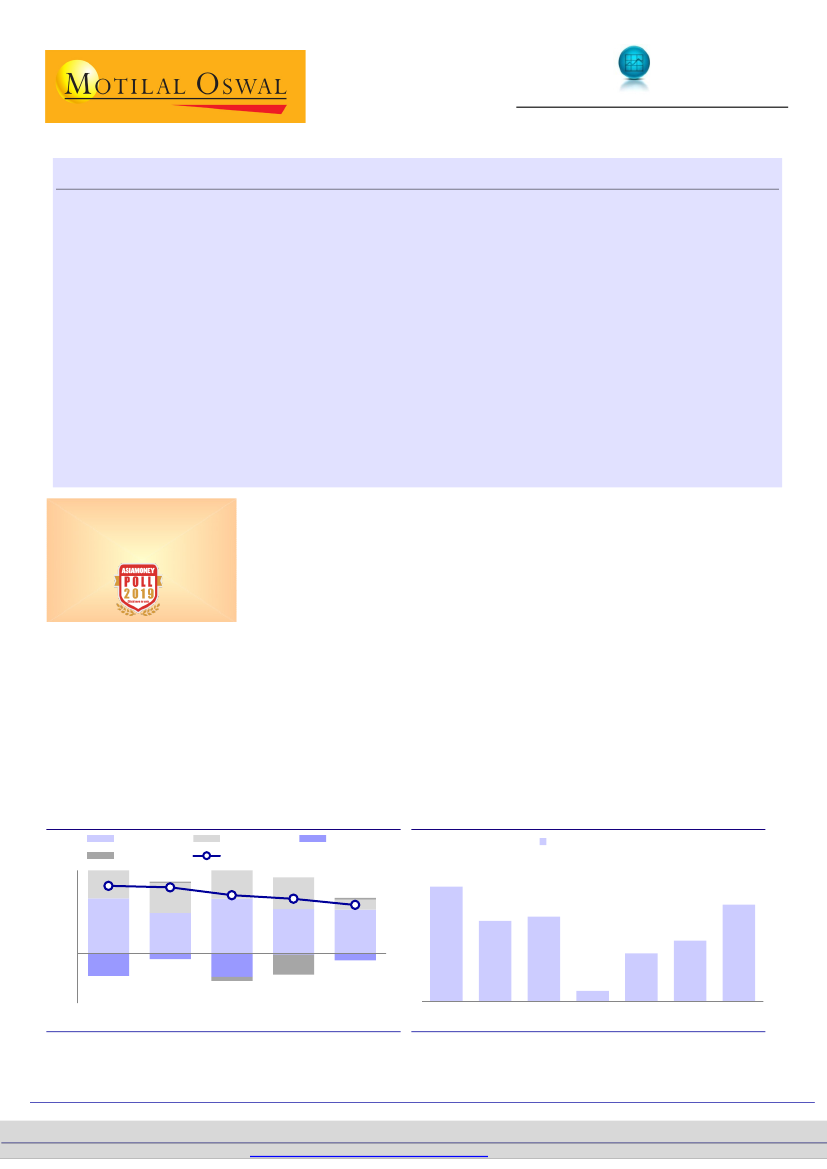
The official GDP statistics indicate that real private consumption expenditure (PCE) grew 7.2% YoY in 4QFY19 and 8.1%
in FY19, better than the 7.4% growth in FY18 and close to the highest growth in seven years. In nominal terms too, PCE
growth of 12% was close to the highest level in six years – a trend similar to that shown by listed FMCG companies.
While these numbers don’t suggest any slowdown in PCE, monthly leading indicators paint a very different picture.
An analysis of 22 monthly indicators linked with PCE suggests that both rural and urban consumption slowed
significantly in FY19 (the former slowed more than the latter). As many as 14 out of the 22 indicators witnessed
deceleration last year.
We have been arguing that the current model of consumption-driven growth is unsustainable because it is leading to
lower savings, and thus creating financing constraints for investment recovery. The most ideal scenario for sustainable
future growth should be driven by savings-led investments, for which consumption growth has to lag income growth.
Although consumption (suggested by monthly data) appears to be moderating now, the worry is that four out of six
income/wealth-linked indicators have also shown weaker growth in FY19. If so, gross domestic savings (GDS, led by
households) may have declined further last year, keeping our concerns intact.
Motilal Oswal values your support in
the Asiamoney Brokers Poll 2019 for
India Research, Sales and Trading
team. We
request your ballot.
The strong growth in PCE
suggested by official GDP is
in line with sales growth of
listed FMCG companies but
in contrast to numerous
monthly leading indicators
of consumption.
Discord between official consumption estimates and monthly leading indicators:
Real GDP growth weakened to 20-quarter low of 5.8% YoY in 4QFY19, driven by real
investments that weakened (from double-digit growth) to 3.5%, even as private
consumption expenditure (PCE) continued growing decently at 7.2% vis-à-vis 8.1% in
3QFY19. On an annual basis, nominal PCE growth picked up from 10.6% in FY18 to
12% last year, close to its highest level in six years — a trend similar to the one seen
in aggregate sales of listed FMCG companies
(Exhibit 1-2).
Though organized/listed
companies may have benefitted from the recent reforms (also incorporated into
GDP estimates), the stronger growth in FY19 is in stark contrast to the numerous
monthly leading indicators related to consumption, which tell a different story. In
this note, we analyze 22 such indicators – divided between rural (12) and urban (10)
sector, which help us gauge possible trends in private consumption, income and
savings in the last few years.
Exhibit 2:
Sales growth of 21 FMCG companies at six year
high in FY19
Sales growth (%, YoY)
15.2
1.2
5.8
5.3
(0.9)
1.4
4QFY19
FY13
FY14
FY15
FY16
FY17
FY18
FY19
10.7
11.3
6.4
8.1
12.8
Exhibit 1:
Major drivers of India’s real GDP growth (pp)
Consumption
Discrepancy
0.1
8.0
3.6
4.9
(0.7)
GCF
GDP (% YoY)
3.7
7.0
6.6
(2.8)
(0.5)
1QFY19
2QFY19
3QFY19
3.8
6.6
5.3
(0.2)
(2.4)
Net exports
10
6
2
(2)
(6)
3.9
8.1
6.6
(2.7)
(pp)
4QFY18
FY16 and FY17 data are affected by IND-AS adoption
Source: Central Statistics Office (CSO), Capitaline, MOFSL
Nikhil Gupta – Research Analyst
(Nikhil.Gupta@MotilalOswal.com); +91 22 6129 1555
Yaswi Agarwal
– Research Analyst
(Yaswi.Agarwal@motilaloswal.com); +91 22 7193 4196
Investors are advised to refer through important disclosures made at the last page of the Research Report.
Motilal Oswal research is available on
www.motilaloswal.com/Institutional-Equities,
Bloomberg, Thomson Reuters, Factset and S&P Capital.