Sector Update | 22 November 2020
Sector Update | Financials
Financials
Technology
RBI releases the Report of the
Internal Working Group to Review
Extant Ownership Guidelines and
Corporate Structure for Indian
Private Sector Banks
RBI report on private sector banks’ ownership
Market share gains to accelerate for private sector banks
We view the RBI’s Internal Working Group (IWG) report related to the ownership of
private sector banks as progressive in nature. a) Suggestions for corporate/industrial
houses on how to get a banking license and b) allowing NBFCs (even belonging to industrial
houses) above asset sizes of INR500b to get banking licenses would increase healthy
competition, making the banking system more efficient, reducing intermediation cost, and
ultimately increasing credit penetration in the system. Over the last five years, private
sector banks have rapidly gained market share to ~30% (2020) from ~18% (2015), and we
see this trend accelerating at a faster pace now. M&A opportunities may also increase in
the system as corporates with deep pockets may adopt this route rather than building
from scratch. Fit and proper criteria, increased surveillance on group entities, the
maximum allowed promoter shareholding, and regulatory cost of CRR, SLR, etc. have been
the key considerations thus far for applying and granting banking licenses. It remains to be
seen how corporate India, NBFCs, and the RBI would approach the matter this time
around, once final guidelines are out. Prima facie, we see IDFC Ltd, Bajaj Finance, L&TFH,
Equitas, and Ujjivan to be key beneficiaries.
Long-awaited opportunity for corporate/industrial houses
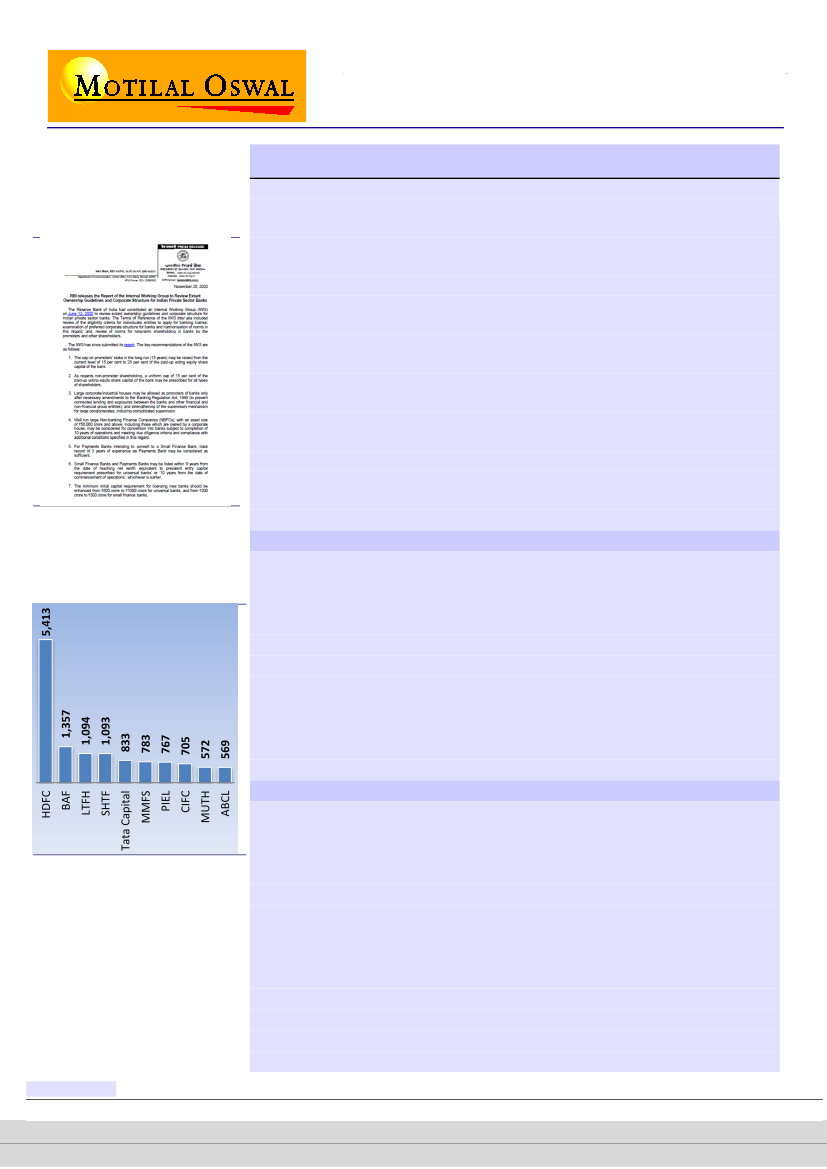
NBFCs with greater than INR500b
asset size (1HFY21, INR b)
One of the key suggestions in the report is to provide an opportunity for
corporate/industrial houses to get a share of the growing banking system pie. Apart
from 2013 guidelines, the RBI has thus far been averse to corporate/industrial
houses getting banking licenses. Even in the ‘on tap’ universal banking license
guidelines of 2016, corporate/industrial houses were not allowed to participate.
Some of them have a good understanding of the asset side via their NBFC arms. If
allowed, they would give strong competition to incumbents and may come up with
innovative solutions with no legacy baggage. We may see greater damage on the
CASA / retail liability front, especially at inefficient banks, as these entities have a
strong ecosystem and enjoy high levels of trust among people.
NBFCs’ proven business model on the asset side; fixing the liability side
NBFCs with assets sizes of INR500b+ and operating history should be given banking
licenses. Even entities promoted by corporate/industrial houses are eligible for the
same. In 2016, as per on tap licensing guidelines, NBFCs promoted by industrial
Source: MOFSL, Company; Note: Consol.
loans for ABCL, FY20 data for Tata Capital
houses were not eligible. The report is also silent on the requirement (part of 2013
guidelines) of a maximum of 40% of total assets/revenues of the group coming from
non-financial services. We believe certain NBFCs (including those promoted by
industrial houses) have created niche capabilities, increased credit penetration in
the system, and done a great job on the asset side. Even regulations for large-sized
NBFCs are coming on par with banks now. Banking licenses may resolve the issues
on the liability side – NBFCs had to suffer multiple shocks from events such as the
GFC, Taper Tantrum, the demonization, the IL&FS crisis, and the COVID-19
pandemic. Considering shallow bond markets, dependence on banks for such
entities is very high.
Research Analyst: Nitin Aggarwal
(Nitin.Aggarwal@MotilalOswal.com) |Himanshu
Taluja
(Himanshu.Taluja@motilaloswal.com)
Alpesh Mehta
(Alpesh.Mehta@MotilalOswal.com)
|
Yash Agarwal
(Yash.Agarwal@motilaloswal.com)
Investors are advised to refer through important disclosures made at the last page of the Research Report.
22 November 2020
1
Motilal Oswal research is available on www.motilaloswal.com/Institutional-Equities, Bloomberg, Thomson Reuters, Factset and S&P Capital.