



Future of Stock Market Research: Human vs AI
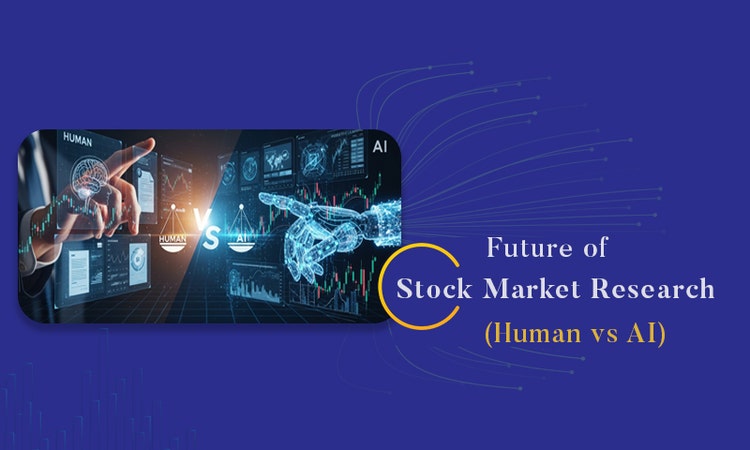
Artificial intelligence is transforming how investors conduct market research, evaluate companies, and manage portfolios. It enables faster data processing, sharper insights, and more efficient workflows. However, while AI can significantly enhance research capabilities, it does not replace sound judgment, financial discipline, or effective risk management.
Historically, investors who could process information quickly and think clearly had an advantage. AI now strengthens both capabilities by analysing vast datasets, identifying patterns, and reducing the time required for manual research. What once took hours can now be done in minutes, allowing investors to focus more on interpretation and decision-making.
Why AI Matters for Investors
The volume of financial information available today is overwhelming. Earnings transcripts, annual reports, news flows, sector trends, and valuation metrics all demand continuous attention.
AI helps compress this effort by organising and summarising information quickly, enabling investors to shift their focus from data collection to analysis. It also improves consistency in research and allows for faster comparisons across multiple investment opportunities, something that would otherwise take considerable time.
For investors tracking indices such as the Nifty 50 or BSE Sensex, this can significantly enhance efficiency without compromising depth.
Research and Screening Tools
AI-driven research platforms have become an important part of the investment process. They help investors screen stocks, benchmark financial metrics, analyse company performance, and summarise earnings calls and filings.
More importantly, these tools allow investors to narrow a broad universe of companies into a focused shortlist for deeper evaluation. The most effective platforms do not just provide summaries, they also retain access to underlying data, enabling investors to validate insights rather than rely on them blindly.
General AI Assistants
General-purpose AI assistants are increasingly being used as a starting point in the research process. They can help draft research notes, explain financial concepts, compare companies or sectors, and structure raw information into more usable formats.
Their strength lies in simplifying early-stage analysis. For instance, an investor can quickly understand a company’s business model or generate a checklist of risks to consider before diving deeper. However, these outputs should always be verified against primary sources such as company filings and earnings calls.
Portfolio and Planning Tools
AI is also playing a growing role in portfolio management. These tools can track performance, analyse asset allocation, and highlight potential concentration risks.
By bringing structure to portfolio reviews, they help investors maintain discipline, especially when managing multiple investments. Over time, this consistency can be just as valuable as identifying new opportunities.
What to Look For in AI Tools
Not all AI tools offer the same level of reliability. The most useful ones are built on high-quality data, provide clear and interpretable outputs, and are transparent about their limitations.
Equally important is alignment with the investor’s style. A long-term investor may prioritise tools focused on company fundamentals and valuation, while an active trader may prefer tools centred around price trends, sentiment, and alerts. The right tool is not the one that does everything, but the one that fits the task at hand.
Practical Use Cases
AI tends to deliver the most value when integrated into a structured workflow. An investor might begin by using a screener to identify potential opportunities, then use a summarisation tool to review company filings, and finally organise insights into a clear investment thesis.
In practice, this could mean quickly understanding a company’s business model, comparing its margins with peers, identifying key risks, and preparing follow-up questions for further research. AI can accelerate each of these steps, but the final investment decision still depends on the investor’s judgment.
Explore more: How is AI is quietly transforming Indian securities markets
Risks to Remember
Despite its advantages, AI is not without limitations. It can sometimes produce inaccurate or incomplete information with a high degree of confidence. Models may rely on assumptions that do not hold in real-world scenarios, particularly during periods of market stress.
There is also the risk of over-reliance. Treating AI outputs as shortcuts can lead to shallow analysis and weak conviction. Investors should instead use AI as a support tool and continue to validate insights through primary sources and independent thinking.
Closing View
AI is set to play an increasingly important role in stock market research. It improves speed, enhances clarity, and streamlines workflows across various stages of the investment process.
However, its true value lies in how it is used. The most effective approach is to use AI to reduce manual effort while relying on human judgment to interpret insights and make decisions.
The future of investing is not about choosing between humans and AI, but about combining the strengths of both.
Suggested read: 12 Best AI stocks to watch in India | AI vs Humans: Who invests better? | AI tools every investor should know
Open Demat Account and Begin Your Investment Journey!
Frequently Asked Questions (FAQs)
Why does AI matter for stock research?
What are the key AI tools used in research?
What should investors look for in AI tools?
Explore More Articles



Be the first to read our new blogs
Get Expert financial insights and advice for informed investment decisions.
Disclaimer: The stocks, companies, or financial instruments mentioned in this blog are for informational purposes only and should not be considered as investment recommendations. It is advised to consult with your financial advisor before making any investment decisions. Investment in securities markets are subject to market risks, read all the related documents carefully before investing. Investors are strongly encouraged to carefully read the risk disclosure documents prior to participating in market-related investments or trading activities. Due to the volatile nature of financial markets, no guarantees can be made regarding investment returns. Motilal Oswal Financial Services Ltd. does not offer any assured returns on market-linked securities. Please note that past performance of stocks or indices is not indicative of future results.