India’s Fertilizer Dependency on the Gulf: Risks from the Strait of Hormuz
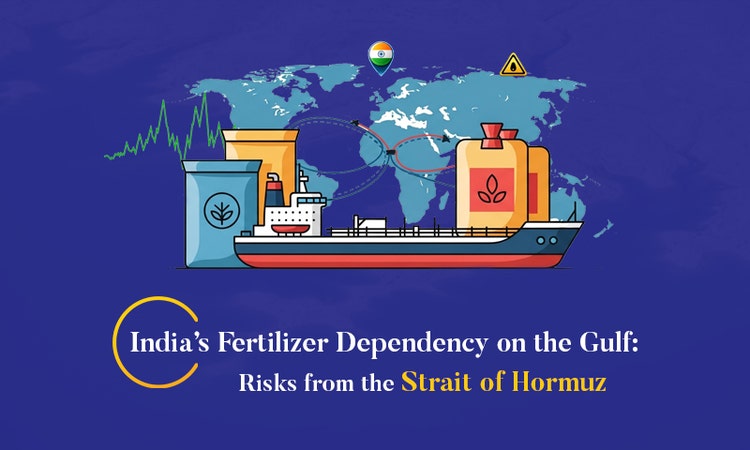
Today, the Strait of Hormuz is at the center of global discussion due to escalating regional conflicts and war risks that threaten to paralyze international trade. For India, this isn’t just a distant geopolitical issue, it is a direct threat to food security. Because a massive portion of India's fertilizer raw materials and finished products must pass through this narrow 21-mile-wide chokepoint, any military flare-up or blockade such as the reported deployment of sea mines or strikes on shipping vessels could instantly trigger a domestic crisis.
As tensions between major powers and regional actors intensify, the risk of a total supply chain collapse looms large. If this vital artery is blocked, India faces an immediate shortage of natural gas (LNG) and minerals required to grow crops, leading to skyrocketing costs for farmers and potential food inflation across the country.
The Importance of the Strait of Hormuz
The Strait of Hormuz is a critical chokepoint. While it is only about 21 miles wide at its narrowest point, it carries nearly one-fifth of the world’s total oil consumption and a massive amount of Liquefied Natural Gas (LNG).
For the fertilizer industry, this route is the primary highway for:
- Natural Gas: Used as a raw material (feedstock) to make Urea.
- Finished Fertilizers: Direct imports of Urea, DAP (Di-ammonium Phosphate), and MOP (Muriate of Potash).
- Raw Materials: Rock phosphate and sulfur used in local manufacturing.
Why India is Vulnerable
India is the second-largest consumer of fertilizers in the world. Since our soil often lacks enough nitrogen, phosphorus, and potassium, we must add these through fertilizers to keep crop yields high.
Current Dependency Levels:
- Urea: India produces a lot of Urea locally, but the feedstock (Natural Gas) required to run these plants is largely imported from Gulf nations like Qatar and the UAE through the Strait.
- DAP: A significant portion of DAP is imported directly from countries in the Middle East and North Africa.
- MOP: India imports 100% of its Potash requirement, as there are no local mines. While some come from Canada or Russia, a disruption in global shipping routes affects all sea trade.
The Link Between Gas Prices and Fertilizers
Fertilizer production is an energy-intensive process. Natural gas accounts for 70% to 80% of the cost of producing Urea.
If the Strait of Hormuz faces a blockade:
- Supply Shortage: Ships carrying LNG cannot reach Indian ports.
- Price Spikes: When supply drops, the price of gas goes up globally.
- Production Stops: If gas becomes too expensive or unavailable, Indian factories may have to reduce their output.
Impact on the Agriculture Sector
Agriculture is the backbone of the Indian economy. Any trouble in the fertilizer sector trickles down to the farm level:
- Higher Input Costs: If fertilizer prices rise, the cost of farming increases.
- Subsidy Burden: The Indian government provides fertilizers at a subsidized rate to farmers. If global prices rise, the government has to pay more to keep the prices stable for farmers, which increases the national fiscal deficit.
- Food Inflation: If farmers use less fertilizer due to high costs, crop production may fall. Lower supply of food grains leads to higher prices in the local market.
Key Risks Summary Table
Steps Taken by India to Reduce Risk
The government and the industry are working on several strategies to minimize the Hormuz Risk:
- Diversification: India is looking for new partners in countries like Jordan, Morocco, Senegal, and Canada to reduce the total reliance on the Gulf region.
- Reviving Old Plants: Several closed fertilizer plants in India (like those in Gorakhpur and Sindri) are being restarted to increase domestic production.
- Nano Urea: Promotion of Liquid Nano Urea, which requires less quantity and is easier to transport and store, reducing the overall demand for traditional bulky urea.
- Long-term Contracts: Signing 10 to 20-year supply deals to ensure a steady flow of raw materials at fixed or predictable prices.
Technical Terms Explained
- Feedstock: The raw material used in an industrial process. For fertilizers, natural gas is the primary feedstock.
- Chokepoint: A narrow sea route where traffic can be easily blocked.
- Nutrient Based Subsidy (NBS): A government policy where a fixed amount of subsidy is decided based on the nutrients (N, P, K, S) present in the fertilizer.
- Spot Prices: The current market price at which a cargo can be bought or sold for immediate delivery.
How it Affects the Stock Market
Investors watch the Strait of Hormuz closely because any tension there affects the profit margins of fertilizer companies.
- Inventory Levels: Companies with high storage capacity might survive short-term disruptions.
- Energy Efficiency: Companies that use less gas to produce more fertilizer are better protected against price hikes.
- Product Mix: Companies that produce complex fertilizers or specialty nutrients might be less affected than those purely dependent on imported Urea or DAP.
Conclusion
The Strait of Hormuz is more than just a waterway; it is a vital artery for India’s food security. While India is making progress in becoming Atmanirbhar (self-reliant) in fertilizers, the dependency on the Gulf for energy and raw materials remains high. Monitoring the geopolitical situation in this region is essential for understanding the future of the Indian fertilizer industry and the broader economy.
Open Demat Account and Begin Your Investment Journey!