CFD Trading vs Share Trading: Key Differences & Similaritiesa
Introduction
While exploring investment opportunities, primarily through international platforms, you may have encountered CFDs (Contracts for Difference). Though widely used in global markets, CFDs are not permitted for retail investors in India under SEBI regulations. Whether looking for short-term income opportunities from CFD trading or building wealth over the longer term by using share trading, it is essential to understand the similarities and differences between the two. This article will outline CFD trading versus share trading in a way that will enable you to choose the right decision for your financial goals and objectives.
Open Demat Account and Start Trading!
What Are CFDs and Share Trading?
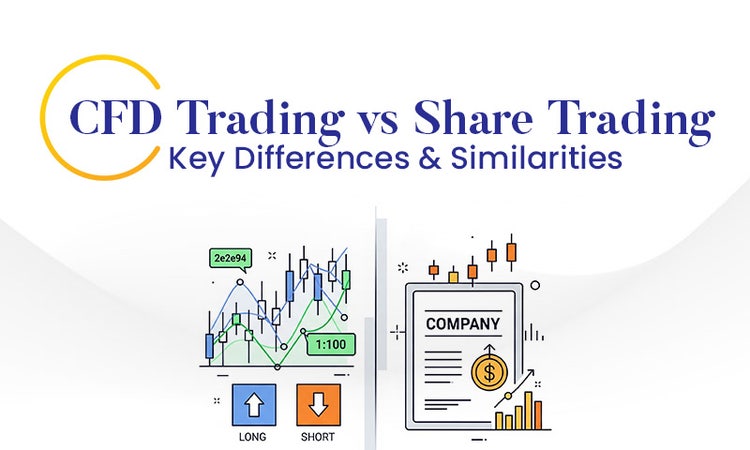
In CFD trading, you can speculate on the underlying asset's price movements, such as stocks, commodities or indices, without owning the asset itself. You enter a transaction with your broker as a contract, and they are now betting on the asset's price either going up or down. If you are correct, you benefit from the price difference; if not, you incur a loss.
Share trading means buying and owning shares of a company listed on a stock exchange, such as the BSE or NSE in India. Your profits come from the appreciation in the share's price and dividends. Therefore, share trading is the traditional way to build wealth in capital markets.
Similarities Between CFDs and Share Trading
- Market Exposure: Both allow you to capitalise on price movements of listed companies, such as Reliance Industries or TCS.
- Analytical Tools: You can make informed decisions using technical indicators (like moving averages) or fundamental analysis (like P/E ratios).
- Liquidity: Highly traded stocks, like those in the Nifty 50, offer ample liquidity for CFD trading and share trading.
- Global Access: Trading platforms let you access international markets, enabling you to trade or invest in global giants like Apple or local stalwarts like HDFC Bank.
- Diversification: In both methods, you can spread your capital across sectors like IT, pharma, or energy to manage risk.
Differences Between CFD Trading and Share Trading
1. Leverage - High Stakes vs Full Investment
In CFD trading, you trade on margin or leverage, meaning you only put a small percentage (also known as a margin, often 5–10%) to take control of a larger position. With a ₹10,000 deposit, you could control ₹1,00,000 worth of shares. If the trade moves in your favour, your profits increase exponentially, as do your losses. This means that CFDs are high risk, because a 2% drop in share price could mean a loss of 20% of your margin.
2. Ownership- Speculation vs Ownership
With a contract-for-difference trading, you are not purchasing the underlying asset. You are speculating on it changing price over the short term. You may be able to hold CFDs for the long term; however, it potentially becomes more advanced and requires more capital in part due to funding charges charged each night and/or later. With share trading, you own the underlying shares, rights to dividends, voting rights, and rights to the company's assets. This benefits those with a long-term approach (like retirement savings).
3. Trading Flexibility
Short-term vs. long-term. CFD trading allows you to "long" (bet on price increases) or "short" (bet on price decreases), offering flexibility when looking at bullish or bearish markets and wanting to incorporate that into your trading strategy. For instance, if you predict a fall in a stock like Infosys, you can short it via a CFD and profit if the price drops.
4. Risk and Reward
CFDs have more risk than investment instruments like shares because of the greater leverage and short-term market volatility or "noise" a trader sees. A SEBI study shows that only 89% of retail traders in leveraged instruments, such as futures and options, will lose money, averaging ₹1.1 lakh annually. The risk of loss from CFD trading is similar, especially if you are inexperienced.
5. Costs: Fees vs Charges
CFDs typically don't charge traditional brokerage fees, but do charge spreads, overnight financing (swap) fees, and other trading platform costs. Share dealing entails upfront costs from brokerage fees, stamp duty and taxes, such as STT (Securities Transaction Tax) in India. However, buying and holding shares is less costly since they do not have the repeated cost of keeping them through time, like you would have with CFDs.
6. Regulation: Oversight vs Flexibility
SEBI strictly regulates share dealing in India. Legitimate trades happen openly on transparent exchanges like the NSE (National Stock Exchange of India). SEBI regulations provide some protection against fraud and fair pricing to investors.
CFD trading typically occurs outside the scope of SEBI regulation and is often conducted through international brokers that operate under different, sometimes less stringent, regulatory frameworks.
Final Thoughts
CFD trading is not legally available for retail investors in India and presents significant risk due to leverage and no regulatory protections. Share trading, however, is your go-to for steadily building wealth, with the added perk of owning a piece of your favourite companies. Before diving in, assess your capital, study market trends, and consider consulting a financial advisor.
Disclaimer: Investments carry market risks. Always read scheme-related documents and consult a SEBI-registered advisor before trading or investing.