Algorithmic & Automated Trading for Intraday
Introduction
Algorithmic and automated trading have fundamentally changed intraday trading in India. The intraday trading algorithm will allow investors to analyse large amounts of market data, spot opportunities, and consider creating positions using programmed rules. This article is about algorithmic trading strategies specifically designed for the Indian market; it covers examples of algorithmic trading and potential benefits and risks. Algorithmic trading for intraday uses strategies that aim to take advantage of the price movement of stocks over a short period of trading (between 9:15 am and 3:30 pm IST) in India's markets.
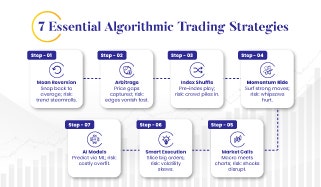
Listed here are four widely adopted strategies:
1. Momentum Trading
Momentum trading strategies identify assets that exhibit significant price upward or downward trends over a stipulated timeframe and attempt to enter trades in the direction of the momentum identified. Algorithms for momentum trading strategies generally utilise Moving Averages or Rate of Change (ROC) indicators to confirm trends.
Example: When Reliance Industries' stock rises above its 20-day EMA with above-average volume, the algorithm triggers a buy signal and exits the position when a trend reversal is detected.
Used in: Equities, futures.
Risk: False breakouts can result in loss in highly volatile market conditions. Many Indian stocks on volume tend to be highly volatile, and stop-losses must be tight.
2. Mean Reversion
This technique assumes that when a price deviates significantly enough from its average, it will eventually revert to it. The algorithms will use indicators such as Bollinger Bands or RSI to determine when a stock is overbought or oversold.
Example: If Tata Steel trades 15% above a 50-day simple moving average (SMA), the algorithm would short the stock, believing it will revert to the mean price.
Used in: Equities and Forex.
Risk: If a stock is in a strong trend, which occurs quite often in Indian markets because of earnings seasons. It may take longer to revert to the mean price, thus incurring losses.
Open Demat Account and Start Trading!
3. Arbitrage
Arbitrage explores a difference in price in the same underlying asset traded on different exchanges, such as the NSE and BSE. The algorithm simultaneously initiates buy and sell orders for that underlying asset to lock in risk-free profits.
Example: If HDFC Bank shares are offered at ₹1,550 on NSE and ₹1,560 on BSE, the algorithm would buy from NSE, sell to BSE, and earn ₹10 per share.
Used in: Equities, cryptos.
Risk: Transaction costs and latency can diminish the profit potential. Due to regulatory oversight and high market efficiency, arbitrage opportunities are limited and short-lived.
4. Market Making
Market-making algorithms create liquidity in an asset by quoting a bid price and an asking price and keeping the difference between the two prices (spread). Market-making algorithms dynamically adjust prices to match market forces.
Example: For Infosys, an algorithm may quote a bid price of ₹1,800 and an ask price of ₹1,805. When the bid is executed, the market-making algorithm receives the price difference.
Used in: Equities, options and futures.
Risks: Rapid market shocks, such as those from a Reserve Bank of India policy change, can create spreads that were otherwise not being priced, which can lead algorithm makers to realise losses.
Building an Intraday Trading Algorithm
Building a good trading algorithm for intraday trading requires technical knowledge, experience, and understanding of a specific market.
Here is an example of how traders in India could begin:
- Selecting a Trading Platform: Motilal Oswal's trading platforms are a good place to start. They have built-in good APIs so traders can take real-time feeds and automate trades. The platform can also accommodate the strategy for intraday trading.
- Defining the Logic of Your Strategy: Take the time to define rules for your desired asset using tools such as RSI (sell when above 70 and buy when below 30) and EMA crossovers.
- Code and Test: Python creates code using packages like Pandas to handle and analyse data. Backtest your algorithm with data from an NSE and brokerage tool, use fees and slippage, and understand volatility.
Optimise and Deploy
Assess your backtest by optimising it using whichever metric you prefer (for example, your Sharpe Ratio). Now, forward test it. Go ahead and forward test it in a demo account and become familiar with how it performs in real time with potential surgical accuracy for your price point and in the varying environment of India's markets.
Conclusion
Algorithmic and automated trading can provide Indian intraday traders with a clear edge: speed, accuracy, and the ability to carry out data-based trades. Traders can succeed in the fast-moving markets of NSE and BSE through information-driven trading strategies such as momentum, mean reversion, arbitrage, and market making. However, don't forget the importance of being aware of SEBI rules governing your trading and staying on the pulse of market movements in India's broader landscape.
Also Read: What is Algorithmic Trading? | SEBI regulations on Algorithmic trading in India | Algorithmic Trading Evolution in India