What is a Contract for Difference (CFD) in Commodities?
Introduction
Let's say you've been watching the price fluctuations of gold or crude oil. You want to profit somehow without holding the title to the physical asset. A Contract for Difference (a CFD) allows you to do this. As an investor from India, you may be aware of trading commodities in the traditional sense. CFDs enable traders worldwide to profit from a commodity price movement without owning it. In India, however, CFDs do not occur on a regulated exchange such as MCX; therefore, investors must be careful when looking at offshore offerings.
Understanding CFDs: The Basics
What Are CFDs?
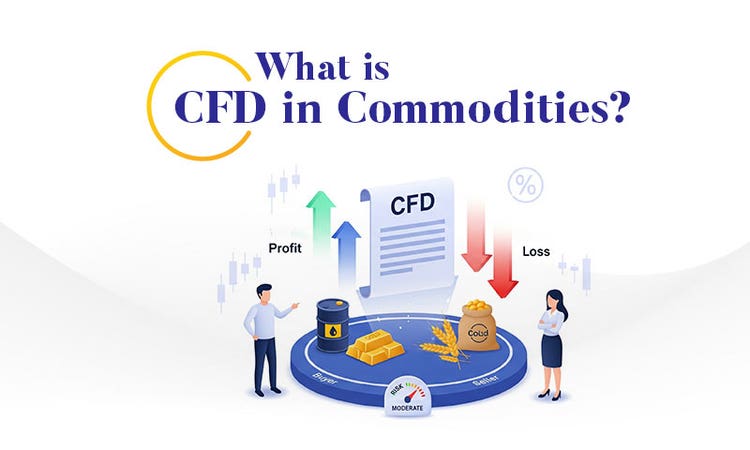
A CFD (Contract for Difference) is a contract between you and a broker speculating on the price change of an asset (in this case, a commodity) but never having to own the asset's title. You are simply betting on the difference in that asset's opening and closing price (in this case, a commodity). CFDs started in the 1990s in London to circumvent stamp duties on shares and have since become an evolving market across the globe due to their advantages to traders.
CFDs in Commodities
CFDs allow you to speculate on the price movement of commodities, such as wheat, silver, or natural gas. Instead of a physical product, you are trading a contract that reflects the commodity's market price. For instance, if you are convinced that global demand is likely to increase the cost of coffee due to crop shortages, you would want to buy a CFD to profit from that price rise.
Open Demat Account and Start Trading!
How CFD Trading Works for Commodities
Opening a Position
When you trade CFDs, you will decide to "go long (buy)" if you believe the commodity price will rise or "go short (sell)" if you think the commodity price will fall. For example, if you feel the copper price will increase due to India's boom in infrastructure, you will open a CFD position. If the price moves in your expected direction, you will profit from the difference when you close the position. You must cover the loss if the price does not move in your expected direction.
Leverage and Margin
Brokers offer leverage so you can manage a larger position for a much smaller deposit, often 5-20% of the actual face value of the trade. For example, you might be able to do this with ₹10,000 at the face value of ₹1,00,000. If the price moved to your advantage by 2%, you'd double your deposit amount or return; however, if the price moved by 2% in the opposite direction, you'd have lost all your deposit. The trade process is also a cash settlement, which means you don't have to deal with the hassle of storing or delivering the physical commodity. You can even stay in a trade for minutes or days; however, if you keep it overnight, you may have to pay a fee for remaining in the trade.
Over-The-Counter Trading
CFDs are traded over the counter (OTC) through brokers, usually on online trading platforms offered 24 hours a day from Sunday evening to Friday evening. This means they are reliable and consistent for all global commodities (Brent crude, US soybeans, etc.) right out your front door, while at home in Delhi or Mumbai or travelling.
Benefits of Commodity CFD Trading
High Leverage
With leverage, you can magnify returns with a small amount of capital, which is fantastic for incredibly volatile commodity markets such as metals or energy. A slight price movement can deliver a high return.
Flexibility with Market Conditions
You can make money whether prices are rising or falling. For example, you can short (sell) a commodity to make a profit if prices fall, as you would during an oil oversupply.
Low Costs and Accessibility
Often, CFD trades have a lower transaction cost than other trades, with no stamp duty or ownership cost. For example, with a CFD, you can buy commodities including gold, cotton, or natural gas without geography as a barrier.
Liquidity and Tools
CFD markets typically have high liquidity, which ensures your order is executed quickly. Fast execution is crucial, mainly when fast-moving events affect the price of gold, for example. Most brokers offer real-time charts, stop-loss orders, and educational resources to enhance your trading strategy.
Risks and Considerations for Indian Investors
Leverage risks
Leverage enhances gains and worsens potential losses, which may exceed your deposit. If a loss occurs, you might receive a margin call, requiring you to inject more funds or liquidate open positions at a loss.
Market volatility
Commodity prices depend on unpredictable weather, geopolitics, or supply chain issues, so CFDS open gaps and risks beyond traditional investing.
Regulatory issues
SEBI does not regulate CFD trading for retail investors in India, and access to offshore CFDS is not possible via India-based brokers like those on the MCX. Trading CFDs on offshore platforms may also violate FEMA rules and expose you to legal and financial risks.
Counterparty risk
CFDs are over-the-counter, so you face the risk of a broker defaulting or potential bankruptcy. At worst, you may lose your funds.
Conclusion
CFDs in commodities provide interesting access to potentially global markets, with leverage, flexibility, and relatively low cost being some of the top attractive features. However, the high-risk nature of CFDs and their regulatory limitations within India can pose challenges for investors. Review reasonable usability and regulated options in India, such as commodity futures, to broaden opportunities effectively and adequately without risk. Consult your financial advisor about your primary objectives and design tactical plans to sleep through the night while managing India's myriad inner complexities of the economy.
Explore More: CFD Trading vs Share Trading: Key differences & Similarities