What is a Margin Account and how does it work?
Introduction
Investing in the stock market offers a chance to build wealth. At the start of your investing journey, you need to have a cash or margin account. A cash account is where you trade with the cash you have in your account. A margin account is a type of brokerage account that lets you borrow money from your broker to buy certain stocks. While this can boost your profits, it could also accelerate your losses, making it a bit of a double-edged sword! So, while a margin account can help you out, it's important to understand the risks involved.
Start investing with a quick Demat account setup
What is a Margin Account
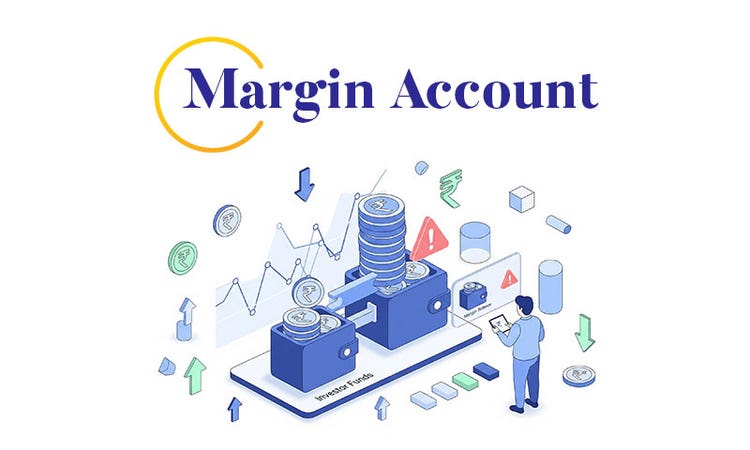
As an investor, a margin account allows you to borrow money from your broker. You can use this money to buy stocks that you don’t have enough cash for or to short-sell securities. The securities you buy, and the cash that you deposit, serve as collateral for the loan you get from your broker. This collateral safeguards your broker against any potential losses.
The Mechanism of Margin Trading
Margin is the difference between the selling price of a product or service and its manufacturing expenses, often known as the profit-to-revenue ratio. "Buying on margin" is the practice of acquiring stocks using money borrowed from a broker. A margin account, rather than a basic broking account, is required for this. A margin account allows a broker to extend credit to you, allowing you to buy additional securities that exceed the restrictions of your present amount.
Using margin to buy securities entails using current cash or securities in your account as collateral for a loan. When you employ borrowed cash, your potential losses and gains are multiplied. Investing on margin might be beneficial if you expect to earn returns that exceed the loan's interest charges.
Advantages of a Margin Account
More Buying Power
You get to buy more stocks and securities than you could with your account balance.
Higher Return Potential
When the value of securities increases, the profits from borrowed funds contribute to your overall gains.
Short selling
Margin accounts provide investors the opportunity to engage in short selling, which involves predicting that a stock's price will decline. This strategy is not available through a cash account.
Adaptability
Margin accounts serve as a tool for engaging in short-term trading strategies, capitalising on arbitrage opportunities, or hedging.
Disadvantages of Margin Account
Potential Losses
While it has the potential to increase profits, it also has the effect of increasing losses. A minor drop in stock price may lead to a considerable drop in equity.
Interest Costs
The broker charges interest on the borrowed money, which can eat into your profits if your investment does not yield favourable results.
Margin Calls
In case if you equity slips below the maintenance margin, you may need to pump in additional cash or sell your positions, in most cases at low prices.
Obligation to Liquidate
The broker may sell your stock without your authorisation if you are unable to satisfy a margin call.
Margin Trading Example
Here is a margin account example. You have ₹10 lakhs in your cash account, and want to buy stocks of ABC Company. Each stock is trading for ₹2k each, so based on that, here is how much you can invest.
With cash Account:
You can buy 500 shares of ABC corporation with the money in your account. (10,00,000 ÷ 2000 = 500)
With Margin Account:
Your broker provides you with the same amount as a loan with your initial amount of ₹10 lakhs as collateral, so now you have ₹20 lakhs to buy stocks of ABC Company. You now get 1000 shares (20,00,000 ÷ 2000 = 1000).
Now, let’s assume different scenarios of profit and loss, and how they affect your trade.
Profit
The price of your stock increases to ₹2.5k
The Value
- Value without margin = (500 x 2500 = 12,50,000)
- Value with margin trading = (1000 x 2500 = 25,00,000)
The profit
- Profit without margin is ₹2.5 lakhs (12,50,000 – 10,00,000 = 2,50,000)
- Profit with margin trading is ₹5 lakhs (25,00,000 – 20,00,000 = 5,00,000)
After paying the broker their initial investment of ₹10 lakhs, you are still left with ₹15 lakhs, which would have been ₹12.5 lakhs without margin funding.
Loss
The price of your stock decreases to ₹1.5k
The Value
- Value without margin = (500 x 1500 = 7,50,000)
- Value with margin trading = (1000 x 1500 = 15,00,000)
The profit
- Loss without margin is ₹2.5 lakhs (10,00,000 – 7,50,000 = 2,50,000)
- Loss with margin trading is ₹5 lakhs (20,00,000 – 15,00,000 = 5,00,000)
After paying the broker their initial investment of ₹10 lakhs, you will be at a loss of ₹5 lakhs, which would have been ₹2.5 lakhs without margin funding.
Conclusion
A margin account can serve as a significant asset and provide higher purchasing power and the opportunity for greater profits. It also has considerable risks due to margin calls, interest costs, and the potential for higher losses. After learning what a margin account means, you now know better if it fits in your investment strategy or not.
In a nutshell, margin trading can increase your potential for higher gains, but if the market goes down, you stand to lose a lot, too, making the trade volatile.
The fundamental principle is straightforward: utilise margin only if you have a complete grasp of its mechanics and are ready to face the potential risks.