The Journey of the Indian Stock Market: From BSE to NSE
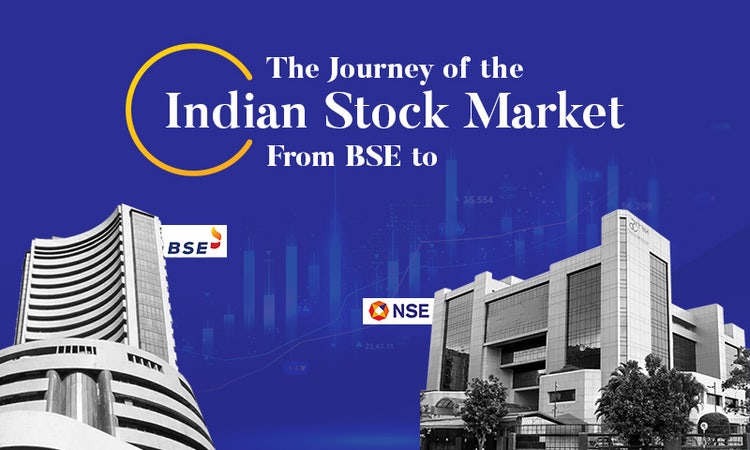
Introduction
Picture the 19th-century streets of Mumbai, where traders would gather under a banyan tree to trade. This is where your story of the Indian stock market begins. From those beginnings to the tech-savvy trading we know today, the changes from BSE to NSE form the basis of how you will invest. In this article, we explain the significant evolution of the BSE and NSE, and your future opportunities in India's financial environment will be highlighted.
Get instant access to markets—Open Demat account
BSE Story: The Humble Beginning
The humble investment story begins with the Bombay Stock Exchange (BSE), which 22 brokers established in 1875 on Dalal Street in Mumbai. An informal structure without much regulation, the stock exchange started evolving throughout the late 19th century under a banyan tree on Dalal Street. In 1956, the BSE was officially established under the Securities Contracts (Regulation) Act to support the growth structure of the Indian financial system. In 1986, the BSE began with the launch of the SENSEX 30-stock index, which serves as an indirect reference for the health and success of the market. A rise in the SENSEX meant your economy was doing well, while months of declines meant the strategies had to change.
Start your investing journey today!
However, the history of the BSE has not been without its pitfalls. Trading typically occurred with an open-outcry system where brokers loudly bid in a crowded, chaotic pit. This process was subjective, slow, and prone to mistakes. In 1992, the world of the BSE was rocked by the Harshad Mehta scam involving manipulated trades, which exposed a myriad of issues surrounding transparency. This scam shook confidence, indicated a desire for openness, and propelled the BSE toward the need to modernise its trading methods. This began your eventual demise with the BSE and opened the doors for the advent of the NSE. The evolution of options for you to invest changed forever.
NSE History: Your Path to Modern Trading
The new National Stock Exchange (NSE) started in 1992 and began operations in 1994, changing the world of the NSE stock market. Unlike the BSE, which had a noisy trading floor, the NSE introduced you to the world of electronic trading. The NSE revolutionised trading, where you could place an order from wherever you were at the time, with the simple click of a button. There are no physical barriers to trading now. The NSE's trading method created speed in your transaction and fairness in the underlying business transaction process. Because of the anonymity of the orders being matched at the NSE, the ability for one trader to take over the market was removed for the investor.
The NSE also introduced the NIFTY 50 index, which tracks 50 companies in multiple sectors. While the SENSEX provides a view into market sentiment, the NIFTY 50 index tends to provide a wider picture of market trends that you can use to guide your investments. Rather than adopting a face-to-face process like the BSE, the NSE adopted technology to catapult it past the BSE in trading volume. The NSE became the advisor choice for time efficiency and trustworthiness.
BSE, NSE: Creating a Competitive Space for You
While the NSE was developing a market, it created a competitive environment, forcing the BSE to change. The BSE, with its legacy, was in a very precarious position to innovate. In 1995, they developed BOLT, an online exchange, to compete with the NSE. Though the NSE surpassed the BSE in trading volume, the BSE remains an essential exchange, with many of the thousands of listed companies on the exchange (including small and medium-sized enterprises) potentially associated with you.
The BSE and NSE forced each other to compete by becoming more transparent and providing faster and better access. Derivatives trading was introduced as early as 2000. In 2010, algorithmic trading was established, providing the frameworks for empowered trading. Also, with the increase in mobile apps in the 2020s, traders can now trade anywhere.
Your Future in the Indian Stock Market
As a retail investor, you are contributing to unparalleled growth in the Indian stock market, led by two behemoths - BSE and NSE. Retail investors like you are now more committed to investing in mutual funds and systematic investment plans that drive unprecedented participation in the Indian stock market. With technologies like AI-driven trading and Blockchain, your trades will be even smoother and more secure. Financial inclusion, while driving disruptive forms of innovation in finance, makes instant access to market opportunities even more possible in India.
Conclusion
The journey from BSE to NSE is a testament to the grit and determination of the Indian capital market participants. Indeed, it has transformed the noisy and sweaty trading pits into digital and futuristic trading floors. This market offers a compelling set of options for you to navigate over the time to come courageously; the legacy of BSE and the modernity of NSE will provide you with a spectrum of possibilities. You can place your bets (investments) on blue-chip stocks, watch rapidly growing stocks in the SENSEX or explore the breadth of the NIFTY 50. The decision is yours, and your potential financial future is at stake. At Motilal Oswal, we are always happy to guide you and share our expert insights. We want you to leverage this journey into wealth creation. Start investing wisely, your journey in the stock market is about to take off.
Similar Reads: What is the difference between BSE and NSE? | Explaining SENSEX, NIFTY, BSE, NSE, and SEBI | What is BSE: Here’s all you need to know | What do the different groups on NSE and BSE mean?