Understanding Market Cycles and Economic Indicators
Introduction
The euphoric excitement of a Nifty bull run and the crippling anxiety of a Nifty collapse amidst global uncertainty are both recognisable to investors. These swings are not random events but are correlated with market cycles. You can use an understanding of market cycles and key economic indicators to make better decisions about where to invest. By understanding how long the current cycle is expected to last, you can time your investments when you wish the economy to be in your favour, as opposed to investing when it is at a low point in the cycle and getting washed away. With India's GDP growth expected to be at 6 - 7% by 2025, as a competent investor, applying these principles will provide you with a competitive advantage in your risk-adjusted strategy to wealth creation.
Begin your journey with a hassle-free Demat account
What are Market Cycles?
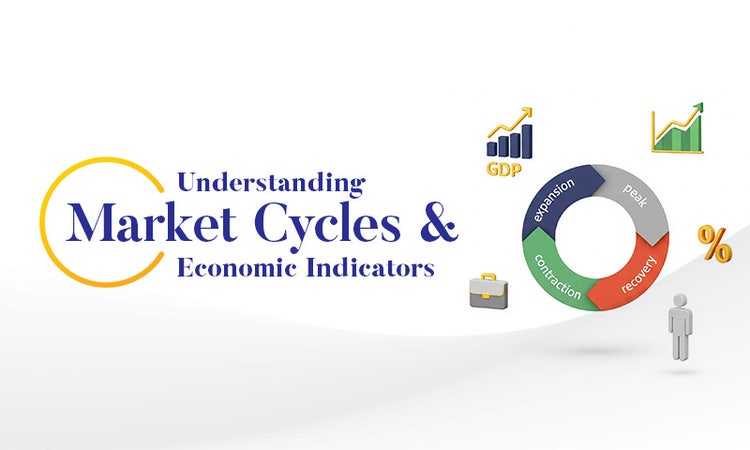
Market cycles represent the natural patterns of economic growth and decline, affecting stock prices and the value of your portfolio over time. They unfold over four stages, with the identified stages objectively guiding the optimisation of your investment decisions in India's ever-evolving economy.
Expansion: The Growth Phase
During an expansion, the economy runs like clockwork. Businesses do well, jobs are created, and consumers are spending. In the case of India, it may mean rising factory output or buoyant retail sector activity, as seen in the anticipated post-pandemic recovery when the Sensex rallied during 2020. Low-interest rates promote borrowing and allow the investor to save in stock or real estate. For you, this is when you would invest in certain growth stocks like tech or infrastructure stocks to take advantage of the uptrend.
The Turning Point
The peak is where the economy has peaked in its growth, and inflation is probably creeping up due to either supply chain issues or oil price increases. Stock valuations are stretched, and speculative bubbles can happen. For example, if consumer prices accelerated, the Reserve Bank of India (RBI) could raise rates to slow the economy down. As an investor, this is your signal to book profits for positions where stock prices are overvalued and to gird yourself for a potential change in pricing and economic conditions.
Start your investing journey today!
The Slow-Down
The contraction, or recession, is the slowdown phase. This is when economic activity decreases, unemployment rises, and consumer spending decreases. This can happen due to weaker exports from global trade tensions or, domestically, problems like a bad monsoon season impacting agriculture in India. Markets become bearish. Indices like the Nifty correct sharply. This contraction phase is also an opportunity. Savvy investors like you can begin looking for depreciated asset value with low P/E stocks to set yourself up for future gains.
The Beginning of a Recovery
The trough is the low point of an economy, but it's also the point at which recovery begins. Stimulus from government agency programs or easing the Reserve Bank of India policies on bank credit can unleash an economy's growth potential, as in the case of the government's infrastructure push (the National Infrastructure Pipeline). Economic conditions may take a long time to stabilise and form another expansion phase, but those who stayed the course will have better results. Gradual positioning can begin for the next upswing.
Interpreting Economic Indicators
How can you tell which stage you are in a market? Economic indicators, a helpful signpost of the economy, will help you locate yourself in the cycle. Cycle indicators are broken down into three variables, indicating near-time relevance for decisions.
Forecasting the Future
Leading economic indicators forecast what's on the way. In India, the stock market is another leading indicator. If the indices are rising, that is good news. The Purchasing Managers' Index (PMI) is another useful indicator; anything over 50 indicates an expanding economy. So, if the PMI is good or increasing, you know business is growing. Consumer confidence surveys are also important; if consumers feel good about jobs and income, they are more likely to spend money and promote growth. New business formations and building permits, tied to projects like smart cities, are further economic development indicators of an upcoming boom.
Confirming Trends
Lagging Indicators confirm trends after they happen. The unemployment rate in India is on a par with last year (roughly 5.2%); therefore, it drops as recovery in the economy strengthens, signalling improvement in the past conditions. Interest rates will trigger an adjustment to the former weakening of the economy; as per the RBI's official cash rate, which as of 2025 is 5.5%/inflation 1.55-2.1% suggests passive mark-out signals phase overheating if prolonged. So, they let you verify your cycle and the extent of recovery in prioritisation.
Conclusion
Market cycles and economic indicators provide a roadmap to manoeuvre through volatility. As you monitor them, you can turn market swings into opportunities, allowing you to cultivate a more resilient portfolio. Next time you hear news about a GDP stat, PMI data or an inflation rate, take notice; these indicators are not just numbers; they are your face-to-face instrument for understanding the value of your investments. There is nothing wrong with relying on knowledge as your ally, as you learn to master your investment environment instead of reacting to it.
Further reads: Market cycles: Key to smart investing