Dividend Recapitalisation: Definition, Process, and Example
Introduction
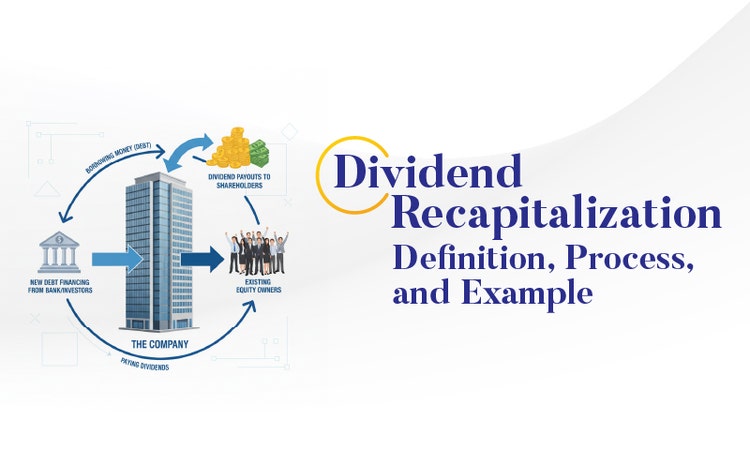
Dividend recapitalisation, commonly abbreviated as dividend recap, is simply a technique by which a company uses newly financed debt to pay an investor or a shareholder a special dividend. Due to conservative lending practices and regulatory regimes, dividend recapitalisation is very rare in India. While, in theory, it is possible in sectors with predictable cash flows (e.g., IT services or consumer staples), most Indian lenders have been reluctant to allow lending simply for a dividend payout. The process of dividend recapitalisation begins with determining if a company has excellent cash flows and the capacity for additional debt. It could likely be established companies in IT services or consumer goods in India, where cash flows are more predictable. Payments to debt holders (could be) sustainable.
This is how it typically works out:
Review Financial Position: The company needs to assess cash flows and ensure it will be able to cover new debt. It is often evaluated with the help of financial advisors.
New Debt: A firm incurs debt to borrow funds, typically in the form of a bank loan or bonds. In India, the RBI does not directly enforce corporate debt-to-equity ratios. In practice there are limits imposed for using dividend recaps, as many of the prudential lending norms of banks limit leverage, there are SEBI regulations (listed firms) that govern being leveraged, and the Companies Act limits companies as to what dividend can be declared. Lenders assess leverage and ability to repay conservatively.
Paying a Special Dividend: The firm then uses the borrowed funds to pay out a dividend to shareholders in a special dividend (often private equity investors or shareholders who are also owners). If everything works out, they make their immediate payout.
Greater Debt: After the recapitalisation concludes, the business is in higher debt. To achieve the needed serviceability with loan repayment, the company will have to ensure careful financial management in the future.
Open your Demat account with Motilal Oswal today!
The dividend recap process provides the immediate funds for the investor, but it does carry long-term risk. For the company, the recap can cause a depletion of resources for dividend payment. Also, it could cause financial constraints (as with many other companies that rely on capital from investors) if the repayment terms in economic downturns cannot be met. This is especially worrying in the Indian economy, where credit cycles and sector-specific slowdowns can quickly put stress on leveraged firms.
Dividend Recapitalisation Example: A Hypothetical Scenario in India
Let us consider a hypothetical Indian tech company, TechTrend Innovations, which is located in Bengaluru. A private equity fund invests ₹500 crore for a 30% ownership stake, which values the company at ₹1,667 crore. After two years of successful cash flows in TechTrend's software solutions, the company does a dividend recap. TechTrend takes ₹300 crore in debt with the bank, which they can repay due to their strong cash flows. The company raises ₹300 crore (US$40 million) in debt financing from an Indian bank consortium with predictable software revenues, allowing loan terms to fit in with applicable RBI rules. They can confidently distribute the (special) dividends to their shareholder owners.
The private equity fund, which has a 30% ownership stake in TechTrend, will receive ₹90 crore as part of the dividends, which recoups a net animus value of around 50% of their initial investment. As a result, TechTrend is short on repaying this loan and has unfortunately increased its debt/EBITDA ratio from 1.5x to 3x. The result is a higher financial risk for the company and an abundance of debt and net cash, which is suitable for private equity fund investors. Still, TechTrend now has to manage its higher interest debt obligations to maintain growth in India's highly competitive software market.
Understanding Dividend Recaps as Investors in India
Indian investors must treat dividend recapitalisations as a double-edged sword. From a private equity fund's perspective, dividend recaps represent a robust mechanism to unlock value from a company; even more so in sectors that exhibit significant levels of growth. However, it is critical to approach exceptional circumstances. Investors should look at the financial strength of cash flows, debt capacity, and market circumstances before realising a dividend recap. For advice, consult with financial practitioners, like Motilal Oswal, to identify your dividend recap as part of your portfolio intention.
Conclusion
Dividend recapitalisation forms a strategic opportunity that balances immediate gains for shareholders and real-life financial obligations. By understanding dividend recapitalisation, how it happens, and its associated risks, you now have a foundation for positive decision-making that could favourably influence your decisions in India's growing market. If you are a private equity investor or investing in a public entity, the options of getting early monetisation should weigh heavily, considering management not taking on unnecessary debt costs.
With reasonable expectations and the help of trusted advice, you can often find these types of strategies enticing, and you can use reasoned judgment to determine your result.