



Equity vs Gold vs Debt – Where Should You Invest Now?
Introduction
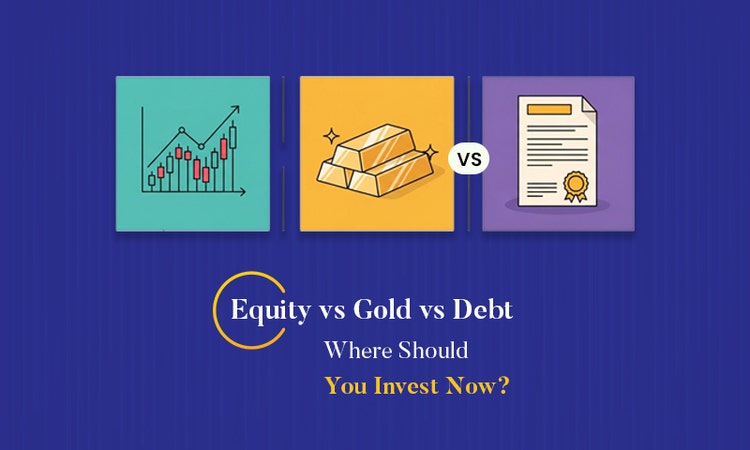
The best place to invest your money in 2026 depends on your personal financial goals, how much risk you can take, and your time horizon. Equity offers the highest growth potential over the long term but comes with high volatility. Gold acts as a safe haven and a hedge against inflation, especially during global uncertainty. Debt investments, such as bonds and fixed deposits, provide stable, predictable returns with much lower risk. For most investors, the answer is not choosing just one, but creating a balanced mix of all three to protect wealth while ensuring growth.
Understanding the Three Main Asset Classes
Before deciding where to put your hard-earned money, you must understand how these three engines of wealth work.
1. Equity (Stocks)
Equity means buying a small piece of ownership in a company. When the company grows and makes a profit, the value of your share goes up.
- Growth Potential: Very high over 5-10 years.
- Risk: High in the short term as market prices can fall quickly.
- Income: Provided through dividends.
2. Debt (Bonds and FDs)
Debt is like lending your money to a company or the government for a fixed period. In return, they pay you a fixed interest rate.
- Growth Potential: Moderate to Low.
- Risk: Very low, especially if lending to the government.
- Income: Regular interest payments.
3. Gold
Gold is a physical asset that has been valued for thousands of years. It does not produce a profit or interest, but its price usually rises when the value of paper money (like the Rupee or Dollar) falls.
- Growth Potential: Moderate.
- Risk: Low to Moderate (it can have price crashes, as seen recently).
- Role: Protection against inflation and war.
Comparison Table: Equity vs. Debt vs. Gold
Feature | Equity | Debt | Gold |
|---|---|---|---|
Primary Goal | Wealth Creation | Capital Preservation | Inflation Hedge |
Risk Level | High | Low | Moderate |
Ideal Duration | 5+ Years | 1-3 Years | 3+ Years |
Returns Type | Capital Gains / Dividends | Interest Income | Capital Appreciation |
Volatility | Very High | Very Low | Moderate |
Liquidity | High (T+1 Days) | High (Depends on product) | High (Instant for physical) |
Why the Choice Matters in 2026
The global economy in 2026 is facing unique challenges that make this comparison very important.
The Equity Outlook
The Indian stock market has shown great resilience. With the Make in India initiative and growth in the manufacturing sector, many companies are reporting strong earnings. However, because stock prices are already quite high, new investors should be careful. Equity is currently great for those who can stay invested for at least 7 years to ride out any sudden market dips.
The Debt Outlook
Interest rates in 2026 have remained steady but high. This is good news for debt investors. If you invest in Government Securities (G-Secs) or high-quality corporate bonds now, you can lock in these high interest rates before they eventually start to fall. This makes debt a very attractive place for people who want safety and regular income.
The Gold Outlook
Gold saw a massive rally followed by a recent price correction. In 2026, gold is acting as a balancer. If the stock market falls due to global tensions, gold usually stays strong or goes up. Keeping 10% to 15% of your money in gold ensures that your total portfolio doesn't crash completely during a crisis.
How to Allocate Your Money (Asset Allocation)
Instead of putting all your eggs in one basket, experts suggest Asset Allocation. This means dividing your money based on your age and goals.
Strategy A: The Conservative Path (For Seniors or Short-term Goals)
If you need your money in 1 or 2 years, safety is the priority.
- Debt: 70%
- Equity: 15%
- Gold: 15%
Strategy B: The Balanced Path (For Middle-aged Investors)
If you have 5 years and want a mix of safety and growth.
- Equity: 50%
- Debt: 35%
- Gold: 15%
Strategy C: The Aggressive Path (For Young Investors)
If you are in your 20s or 30s and have 10+ years to grow your wealth.
- Equity: 75%
- Debt: 15%
- Gold: 10%
Things to Consider Before Investing
1. Inflation
If inflation is 6% and your investment gives 5%, you are actually losing money. Equity and Gold usually beat inflation over time, whereas Debt might struggle to do so after taxes.
2. Taxation
- Equity: Short-term gains (held <1 year) are taxed at 20%. Long-term gains (>1 year) are taxed at 12.5% on profits exceeding ₹1.25 lakh.
- Debt: Most debt instruments are now taxed according to your income tax slab.
- Gold: Physical gold is taxed based on your holding period. Sovereign Gold Bonds (SGBs) offer the best tax benefits as the capital gains are tax-free if held until maturity.
3. Liquidity
How fast can you get your cash back?
- Equity: You get money in your bank account 1 day after selling (T+1).
- Gold: Jewelry takes time to sell and has making charges losses. Digital gold or ETFs are instant.
- Debt: Fixed Deposits may have a penalty for early withdrawal. Liquid funds give money in 24 hours.
Steps to Start Your Investment Journey in 2026
- Emergency Fund First: Before investing in equity or gold, keep 6 months of expenses in a safe debt fund or savings account.
- Identify Your Goal: Is it for a house (5 years), a wedding (3 years), or retirement (20 years)?
- Choose the Right Platform: Use the National Stock Exchange (NSE) or Bombay Stock Exchange (BSE) platforms through a registered broker for transparency and safety.
- Automate via SIP: Systematic Investment Plans (SIPs) work for both Equity and Gold (Gold ETFs). This helps you buy more when prices are low and less when prices are high.
Summary of Where to Invest Now
- Invest in Equity if: You want to build long-term wealth and can tolerate seeing your account value go down temporarily.
- Invest in Debt if: You want a fixed income, have a short-term goal, or are worried about stock market volatility.
- Invest in Gold if: You want to protect your savings from inflation or global political trouble.
Conclusion
There is no perfect investment that is the best for everyone. In the current 2026 market, Equity remains the king of growth, but Debt is offering very respectable returns due to high interest rates. Gold remains the ultimate insurance policy. A smart investor is one who balances these three based on their own needs. Always remember that the goal of investing is to meet your life targets comfortably, not just to chase the highest possible number.
Open Demat Account and Begin Your Investment Journey!
Frequently Asked Questions (FAQs)
Is gold safer than stocks?
Can I invest in all three with a small amount?
What is the Rule of 100 in asset allocation?
Why is debt important if returns are lower than equity?
How has gold performed in 2026 so far?
Are Fixed Deposits (FDs) better than Debt Mutual Funds?
Does the Indian stock market follow the global market?
What are Sovereign Gold Bonds (SGBs)?
How often should I check my investments?
What happens to my investments if the Rupee falls?
Explore More Articles


Be the first to read our new blogs
Get Expert financial insights and advice for informed investment decisions.
Disclaimer: The stocks, companies, or financial instruments mentioned in this blog are for informational purposes only and should not be considered as investment recommendations. It is advised to consult with your financial advisor before making any investment decisions. Investment in securities markets are subject to market risks, read all the related documents carefully before investing. Investors are strongly encouraged to carefully read the risk disclosure documents prior to participating in market-related investments or trading activities. Due to the volatile nature of financial markets, no guarantees can be made regarding investment returns. Motilal Oswal Financial Services Ltd. does not offer any assured returns on market-linked securities. Please note that past performance of stocks or indices is not indicative of future results.