Money Market vs. Capital Market: Key Differences Explained
When you hear about the stock market, there’s often a lot of talk about different kinds of financial markets. Among the most important are the Money Market and the Capital Market. These two markets play crucial roles in the world of finance, but they serve very different purposes. Understanding the difference between these two markets can help you make better investment decisions. Let’s break down what each market is, how they work, and the key differences between them.
What is the Money Market?
The Money Market is a financial market where short-term borrowing and lending take place. It is used by investors, businesses, and governments to manage their short-term funding needs.
Key Features of the Money Market:
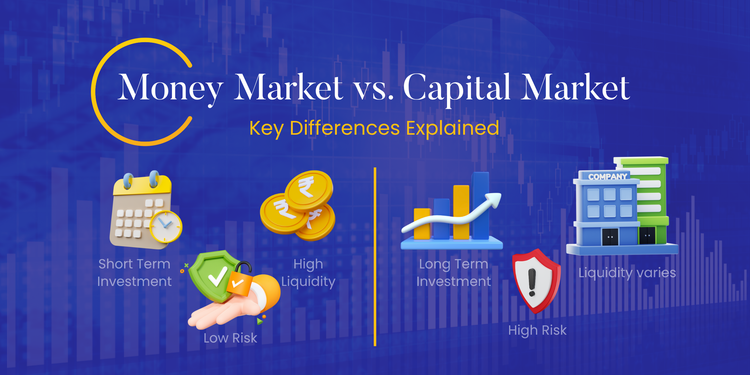
- Short-Term Investments: The Money Market deals with financial instruments that have a maturity period of less than a year.
- Low-Risk: It generally involves low-risk investments, as the time frame is short, and the transactions are usually with highly stable institutions like the government or top-rated banks.
- High Liquidity: Investments in the Money Market are very liquid, meaning they can be quickly converted into cash without a major loss in value.
Get instant access to markets—Open Demat account
Common Instruments in the Money Market:
1. Treasury Bills (T-Bills)
What they are:
Treasury Bills, commonly known as T-Bills, are short-term debt securities issued by the government to raise funds for short-term needs. These bills are considered one of the safest investments because they are backed by the government.
Maturity:
T-Bills have a short-term maturity period that typically ranges from 91 days to 364 days. Investors can choose the maturity period that suits their financial goals.
Why they matter:
T-Bills are an excellent way for governments to raise money without relying on long-term debt. For investors, they are a secure investment that provides a low but guaranteed return. T-Bills are often used by institutional investors and individuals looking for a safe, liquid place to park funds.
Example:
If you invest ₹1,00,000 in a 91-day T-Bill, the government will pay you back ₹1,00,500 (₹1,00,000 plus interest) after 91 days. This means a return of ₹500 over three months.
2. Commercial Paper
What they are:
A Commercial Paper (CP) is a short-term, unsecured debt instrument issued by corporations to meet their short-term funding requirements, such as for working capital, inventory financing, or short-term operational expenses.
Maturity:
The maturity period for Commercial Paper ranges from 7 days to 365 days, making it an ideal option for companies looking to borrow funds quickly for a short time.
Why they matter:
Commercial papers are issued by large corporations with good credit ratings. They are attractive to investors because they typically offer higher returns than T-Bills, though they come with slightly more risk, as they are not backed by the government.
Example:
If a company like ABC Ltd. issues a ₹5,00,000 Commercial Paper with a maturity of 90 days and an interest rate of 6%, an investor who buys the CP will receive ₹5,00,000 plus ₹30,000 (6% annualized) at the end of the 90 days.
3. Certificates of Deposit (CDs)
What they are:
A Certificate of Deposit (CD) is a fixed deposit issued by banks. It is a time deposit where investors lock their money for a specified period and earn interest at a fixed rate.
Maturity:
The maturity period of a CD can range from 7 days to 1 year, and they typically offer higher interest rates compared to regular savings accounts.
Why they matter:
CDs are ideal for conservative investors who want a safe, guaranteed return over a fixed period. They are offered by banks, and the rate of return is generally higher than savings accounts because the investor agrees to keep the money locked in for a certain period.
Example:
If you invest ₹1,00,000 in a 6-month CD with an interest rate of 5%, you will receive ₹1,02,500 after 6 months (₹1,00,000 principal + ₹2,500 interest).
4. Repurchase Agreements (Repos)
What they are:
A Repurchase Agreement (Repo) is a short-term borrowing arrangement where one party sells securities (usually government bonds or other financial instruments) to another party with the promise to repurchase them at a higher price at a later date.
Maturity:
Repos are typically used for very short-term borrowing, with a maturity period ranging from overnight to a few days, depending on the agreement.
Why they matter:
Repos are commonly used by financial institutions and banks to manage short-term liquidity needs. Repos offer low-risk returns for investors because they are secured by the sale of securities, and the government bonds involved are considered safe.
Example:
If a bank sells securities worth ₹1,00,000 to another party under a one-day repo agreement, the buyer agrees to sell back the securities at ₹1,00,100 (with ₹100 as the interest) at the end of the day.
5. Call Money
What it is:
Call Money refers to very short-term loans, typically for a period of 1 day, given by banks or financial institutions to each other or to meet their immediate liquidity needs.
Maturity:
As the name suggests, Call Money loans are overnight loans that are paid back the next day. This makes them highly liquid and a quick way to meet short-term funding needs.
Why it matters:
Call money is used by banks to manage their daily liquidity requirements. It is a key tool in the money market because it allows banks to maintain their reserve requirements and ensure that the financial system remains stable. For investors, it provides an opportunity to park short-term funds with a safe return, though the returns are typically lower than other money market instruments.
Example:
If Bank A lends ₹10,00,000 to Bank B under a one-day call money loan at an interest rate of 4%, Bank B will repay ₹10,001,000 (₹10,00,000 principal + ₹1,000 interest) the next day.
What is the Capital Market?
The Capital Market is a financial market for long-term investments. Companies and governments use this market to raise money by issuing stocks and bonds. This market is critical for the long-term growth of an economy.
Key Features of the Capital Market:
- Long-Term Investments: The Capital Market involves investments with a longer duration, typically exceeding one year.
- Higher Risk: Because of the long-term nature of investments, there is a higher degree of risk compared to the Money Market. However, this risk is often compensated for with the potential for higher returns.
- Wealth Creation: It is the place where investors can build wealth over time through capital appreciation (increase in value) and income generation (interest or dividends).
Common Instruments in the Capital Market:
-
Stocks (Equities)
Stocks or equities represent partial ownership in a company. When you buy a share of a company, you own a small part of that company, and your investment value increases or decreases with the performance of the company. As a shareholder, you may earn returns in two ways: through capital gains (when the stock price rises) and through dividends (periodic payouts made by the company from its profits). -
Bonds
A bond is a debt security issued by governments, corporations, or other organizations to raise funds. When you buy a bond, you are essentially lending money to the issuer, who agrees to pay you periodic interest, typically twice a year, until the bond matures. After the maturity period, the principal amount (the amount you initially invested) is paid back to you. -
Mutual Funds
Mutual funds are pooled investment vehicles where multiple investors pool their money together to invest in a diversified portfolio of stocks, bonds, or other securities. The fund is managed by a professional fund manager who makes decisions about which securities to buy and sell. Investors receive units of the mutual fund based on their investment, and the returns are distributed proportionately -
Derivatives
Derivatives are financial instruments whose value is based on the value of an underlying asset such as stocks, bonds, commodities, or market indices. Common derivatives include futures contracts and options contracts. Futures contracts are agreements to buy or sell an asset at a predetermined price at a future date, while options give the investor the right, but not the obligation, to buy or sell an asset at a certain price before a specific date.
Key Differences Between Money Market and Capital Market
Money Market vs. Capital Market: Pros and Cons
Money Market:
-
Pros:
-
Low risk and safe investments.
-
Ideal for short-term goals and parking funds.
-
High liquidity.
-
-
Cons:
-
Lower returns compared to the Capital Market.
-
Limited wealth-building potential.
-
Capital Market:
-
Pros:
-
Higher returns and long-term growth potential.
-
Can generate income through dividends (stocks) or interest (bonds).
-
-
Cons:
-
Higher risk compared to the Money Market.
-
Less liquidity, especially in smaller stocks or bonds.
-
When to Invest in the Money Market or Capital Market?
-
Money Market: If you have short-term financial goals or need to park your funds safely without worrying about major fluctuations, the Money Market is a good choice.
-
Capital Market: If you have long-term goals and are willing to take some risk for higher returns, then the Capital Market should be your focus. It's great for building wealth over time.
Real-Life Example: How Both Markets Work
Imagine you’re saving for a short-term goal like buying a car in two years. You would want to park your money in a Money Market instrument like a Certificate of Deposit (CD). It's safe and you know you will get your money back with interest at the end of the term.
On the other hand, if you're saving for long-term goals, such as retirement, you might want to invest in the Capital Market by buying stocks or mutual funds. Over time, these investments will likely grow more than what you would earn in a money market instrument.
Understanding the differences between the Money Market and the Capital Market is important for every investor. The Money Market is great for short-term savings and maintaining liquidity, while the Capital Market is where you can look for higher returns and long-term growth. By choosing the right market based on your financial goals, you can make better investment decisions.
Explore more: A look at leading money market mutual funds | What is in the money Call option? | Understanding the moneyness of a call option