Budget 2026 Expectations: Will Income Tax Slabs Change This Year?
With Union Budget 2026 approaching, income tax expectations have once again taken centre stage across Indian households. Rising living costs, moderate salary growth, and evolving tax rules have made the upcoming Budget especially important for salaried individuals, middle-income earners, and investors alike.
As pre-Budget discussions intensify, one question dominates conversations across offices, homes, and online searches: Will income tax slabs change in Budget 2026, and will taxpayers finally see meaningful relief? Even small adjustments in slabs or deductions could directly impact monthly cash flows and spending power.
Against this backdrop, Budget 2026 is being closely watched not just as a fiscal announcement, but as a signal of how the government plans to balance growth, consumption, and long-term financial stability. In this analysis, we evaluate possible income tax changes through the lens of QGLP (Quality, Growth, Longevity, and Price) and their implications for your personal finances.
Why This Budget Matters More Than Usual
Budget 2026 comes at a time when household expectations are unusually high. While economic growth remains strong, many families are feeling the pressure of higher living costs, EMIs, insurance premiums, and everyday expenses.
This has shifted attention from infrastructure-led growth to how much disposable income households retain after taxes.As a result, income tax reforms—especially slab rationalisation and deductions—have become a key focus area ahead of this Budget.
The Macro Context: Why 2026 is Different
Before we talk about slabs, we must understand the Why. As of late 2025, India’s GDP growth remains robust at approximately 7-8%, but there is a clear shift in policy focus.
After years of heavy lifting through Capital Expenditure (Government spending on roads, rails, and ports), the focus is now shifting toward reviving domestic consumption. At Motilal Oswal, our research suggests that for India to reach the $16 trillion GDP mark by 2042, the consumption story must be broadened.
LIVE Updates
- As of late January 2026, tax experts believe incremental slab rationalisation is more likely than sweeping structural changes.
Key Economic Indicators (FY2025-26)
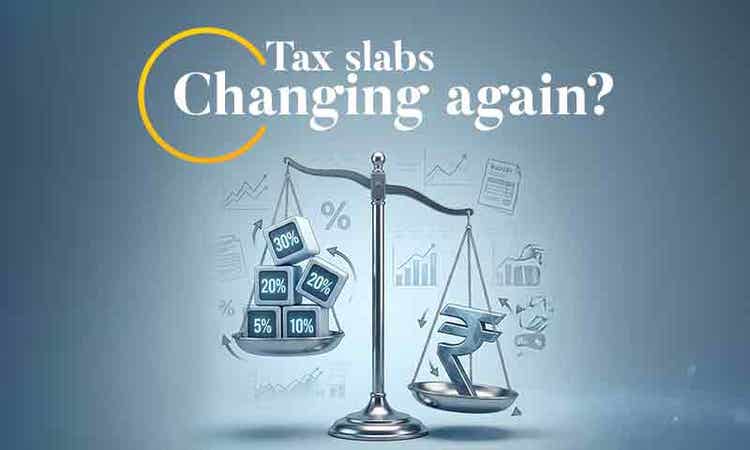
Will Income Tax Slabs Change? Our Prediction
The government has been very clear about its preference: the New Tax Regime. By gradually making it the default and more attractive option, the goal is to simplify the tax code and eliminate the compliance headache of tracking 70+ different exemptions.
The Expectation for the New Tax Regime (FY 2026-27)
In the previous budget (2025), the government already provided significant relief by exempting income up to ₹12 lakh (effective through rebates). For 2026, we anticipate a further fine-tuning rather than a total overhaul.
Why? Because the 8th Pay Commission is expected to be implemented in early 2026, putting more money into the hands of over 1.1 crore employees and pensioners. To ensure this doesn't all go back to the treasury in taxes, we expect the following potential changes:
- Expansion of the 5% and 10% Brackets: To help the lower-middle class, the government might increase the gap between slabs.
- Standard Deduction Hike: Currently at ₹75,000 (as of 2025), there is a strong case to increase this to ₹1,00,000 to account for the rising cost of living.
Open Demat account - Start your investment journey now!
Predicted vs. Current Slabs (New Regime)
We believe the sweet spot for the government will be the ₹12 lakh to ₹20 lakh category. By reducing the rates here slightly, they can significantly boost urban discretionary spending. This segment includes a large share of India’s salaried professionals, where incremental tax relief can quickly translate into higher consumption and investment participation.
The Silent Change: TDS Simplification
One of the biggest hurdles for investors is not the tax rate, but the Tax Deducted at Source (TDS). Our internal analysis shows that varying TDS rates on dividends, interest, and rent create a massive compliance burden.
We expect Budget 2026 to introduce a Unified TDS Framework. Instead of dozens of different rates, the government might move toward two or three standardized rates. This aligns with our philosophy of making investing frictionless for the common man.
Capital Gains: The Elephant in the Room
For us at Motilal Oswal, capital gains are the most critical part of the budget. In 2024 and 2025, we saw shifts in the holding periods for Long Term Capital Gains (LTCG).
For 2026, we expect stability. The market has just started digesting the previous changes, and any further hikes in LTCG or STCG (Short Term Capital Gains) could dampen the Financialization of Savings trend we are currently witnessing.
- Current Equity LTCG: 12.5% (above ₹1.25 lakh).
- Prediction: Status Quo. The government is unlikely to risk a market sell-off by raising this further.
Focus on the Silver Generation (Senior Citizens)
With India's demographics slowly shifting, the 2026 budget is expected to be Senior Citizen Friendly.
- Interest Income: We anticipate the threshold for TDS on interest (Section 194A) to be raised from the current ₹1,00,000 for seniors to perhaps ₹1,50,000.
- Health Insurance: Given the rising medical inflation (which often exceeds 10-12% annually), an increase in Section 80D limits for the Old Regime or a new health-linked deduction in the New Regime is a high-probability event.
How Should You Prepare?
At Motilal Oswal, we always say: Don't invest for tax savings; invest for wealth creation. While tax changes are important, they shouldn't be the only reason you pick an asset class.
Our Strategy for 2026:
- Don't wait for Feb 1st: If you are in the 30% bracket, the marginal changes in slabs won't change your life as much as an extra year of compounding will.
- Focus on Quality (The 'Q' in QGLP): Regardless of the budget, companies with strong balance sheets and moats will outperform.
- Equity is still King: Even at a 12.5% tax rate, equity remains one of the most tax-efficient wealth-building tools in India compared to Fixed Deposits (taxed at slab rates).
Final Thoughts
The 2026 Union Budget is likely to be a Consolidation Budget with a Consumption Heart. The government wants you to spend, and the best way to do that is to put more money in your wallet through slab rationalization.
Will the slabs change? Yes, we expect a widening of the lower brackets and a higher Standard Deduction. But the real winner will be the investor who stays disciplined and looks beyond the immediate tax outgo.
Explore Budget 2026 Insights - Taxpayer Expectations | Salaried Class Expectations | Standard Deduction & Rebates | Capital Gains Tax | LTCG Rule Changes | Mutual Fund Taxation | 80C & 80D Expectations
Stay ahead of the markets with PEAK by Motilal Oswal